
Angry crowd confronts Republican Rep. Mike Flood at Nebraska town hall over Trump policies

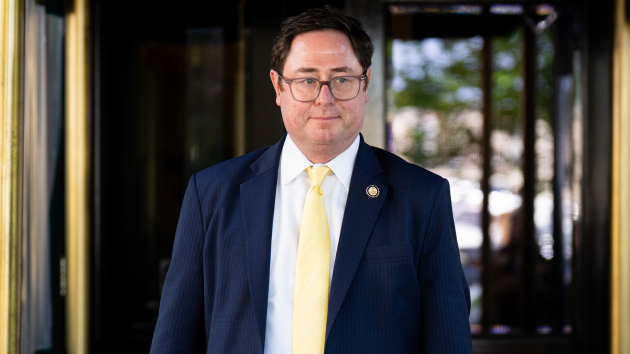
Rep. Mike Flood, R-Neb., leaves the House Republican Conference caucus meeting at the Capitol Hill Club in Washington on Wednesday, May 13, 2026. (Bill Clark/CQ-Roll Call, Inc via Getty Images)

(BELLUVUE, Neb.) — While Congress is out of session this week, a House Republican encountered a hostile crowd at a heated town hall meeting in Bellevue, Nebraska, Tuesday night – a sour reception that may preview the tenor other lawmakers could face heading into the midterm elections.  

Rep. Mike Flood faced repeated boos and shouts from audience members as they pressed him on the SAVE America Act, Israel, NATO, the bipartisan housing bill, the Trump administration’s policies and more, as seen on video of the town hall recorded by ABC affiliate KETV in Omaha.

While it’s uncertain how many in the audience were constituents, Tuesday’s contentious event wasn’t the first time Flood has found himself before angry crowds at town halls. Flood was shouted down and booed in Seward, Nebraska, where hundreds of people attended his town hall May 28 of last year, while defending the then-proposed One Big Beautiful Bill Act.

The month after Trump signed the bill into law, Flood faced a hostile crowd once more during an August town hall in Lincoln as the audience questioned its impact on Medicaid.

“F—— liar!” one attendee shouted at Flood Tuesday while he was discussing violent crime rates declining and the Trump administration’s ongoing deportation efforts.

“Listen, violent crime is down – ask the people of Washington, D.C., how much safer Washington is today compared to a year ago,” Flood said as the audience jeered.

“Violent crime is down in American cities. Violent crime is down in New York City. A lot of people that came here that were committing crimes have either been incarcerated or deported. The numbers speak for themselves,” Flood said.

Flood also was drowned out by the audience as he voiced his support for the proposed SAVE America Act and voter ID laws – key issues that are part of President Donald Trump’s policy agenda.

“What I can’t stand is what is so objectionable about having to show a driver’s license, a passport, or a birth certificate at your place where you vote,” Flood said, as the attendees booed. 

The congressman further said that while Nebraska in his “opinion” deals with “little” election fraud, he added, “when people believe that our elections are secure, it breeds respect for the law, our democracy, our country, our election leaders. There are so many benefits.”

A man in the audience demanded the congressman explain the evidence he has to back up claims of election fraud, which Trump continues to promote without evidence to support his claims. Flood pushed back, saying he believes Joe Biden was duly elected president in the 2020 election. 

”I have never argued that there was an inaccurate result, and I always recognized Joe Biden was our president, so I am not a congressman that has ever made that claim,” Flood responded.

Constituents further heckled Flood when the congressman said, “I want to be very clear: We have no greater ally in the Middle East than Israel,” prompting loud boos from the audience.

“What happened in Israel was horrific,” Flood said, referring to the Oct. 7, 2023, attack on Israel by Hamas. “If that had happened on our soil, we as Americans would rise up and eliminate that threat.”

As the conversation continued to scrutinize the Trump administration’s foreign policy, Flood also appeared to defend the administration’s actions in Iran

“We need to finish the job. We cannot put up with a regime that in the last 12 months has killed 45,000 of their own people. That is wrong. We have to have moral clarity here,” he said. “I support Israel.” 

While Trump attends the NATO Summit in Turkey, Flood said he fully supports the alliance, declaring it “has contributed greatly to the security of the world. I think they’re an important part of us.”

Flood received a more positive response regarding other topics, such as when he called Russian President Vladimir Putin “a thug” and voiced his support for Ukraine. He also earned some applause when he expressed confidence that the bipartisan housing bill currently on Trump’s desk will become law. 

“If [Trump] doesn’t sign it, it becomes law, and the good news about this is next week it’s likely to be a public law,” he said. “That’s what I’m focusing on – bipartisan common-sense results.”

However, when Flood brought up the One Big Beautiful Bill Act, which includes massive cuts to government benefits such as Medicaid and SNAP food assistance, the audience loudly booed. Several constituents raised concerns about losing SNAP benefits under the new law. 

“I want people that are food insecure to get resources. I also want people that are able-bodied and can work to work. If you don’t work, you shouldn’t expect free healthcare,” Flood said.

Flood’s comments about Medicaid prompted one audience member to shout “tax the rich” in response.

Copyright © 2026, ABC Audio. All rights reserved.

Trump needs to get tough on China to get tough on Iran’s economy. He’s been reluctant to do that

(CNN) — The Trump administration appears to have landed on a fallback strategy in the Iran war after military strikes and negotiations failed to deliver victory: threats of harsh economic sanctions.Treasury Secretary Scott Bessent has called them the “toughest sanctions in history,” which will “collapse this regime.” He’s even called it an “economic D-Day” for Iran, comparing it to the historic invasion of Nazi-occupied France during World War II.There’s just one problem: Making good on those tough words requires not just getting tough on Iran, but also getting tough on China, which is Tehran’s No. 1 trading partner.And Trump and his administration have proved quite reluctant to do that.When Bessent rolled out the economic strategy Monday, he didn’t name specific countries that would be punished — or lay out timelines — if they don’t cut ties. And the announcement notably did not include secondary sanctions on the large Chinese banks that facilitate Beijing’s purchases from Iran.China buys as much as 90% of Iran’s oil. Economic analysts have told CNN that targeting these banks and Chinese companies would be crucial to exacting a major toll on Iran’s economy.But not for the first time in recent days, Bessent punted on exactly what would be done on that front. He suggested messages were being sent — saying “no one is above the reach of US sanctions” — but didn’t detail what will happen with China.“If they facilitate transactions and are part of the ecosystem that turns Iranian oil into money, into repression, they will be targeted,” Bessent said. “We find that the best way to engage with countries is through quiet diplomacy.”He added: “So when the hammer of US Treasury actions falls upon them, they will have no one to blame but themselves.”But you could be forgiven for thinking this might be lots of sound and fury signifying relatively little.That’s because not only has the administration regularly backed off the threats it’s made in the Iran war, but it has a track record of treading gently around China, whose leader, Xi Jinping, is set to visit the White House next month.While Trump has made a big show about getting tough on China over the years, he backed off his trade war with Beijing in October, agreeing to a one-year truce. That followed shortly after Beijing upped its leverage by restricting access to critical rare-earth minerals and halting purchases of American soybeans.Trump last year also ignored federal law to help save the Chinese-owned video app TikTok, despite his first administration having labeled it a grave national security threat because of its ability to spy on Americans.Fast forward to Trump’s visit to China in May, and rather than pressing Xi publicly on a potential invasion of Taiwan, Trump made some major Taiwan-related rhetorical concessions.He also backed off his previous promises to get China to free Jimmy Lai, a former Hong Kong media tycoon who criticized the Chinese Community Party, as well as to ban Beijing from buying American farmland and to “aggressively” revoke Chinese student visas.By July, Trump delivered a primetime address in which he claimed China effectively interfered in the 2020 US election (which is not what the evidence actually showed). But rather than punish China for this seemingly major purported provocation, Trump downplayed the need for retaliation.The president seemed to prefer to use China to try to substantiate his still-baseless claims of stolen elections, without going to the trouble of holding the alleged thief accountable.And even in the context of the Iran war, Trump has been gentle with China.He has repeatedly shrugged off the idea that Beijing is helping Iran. And on his way back from China in May, he said he was considering lifting sanctions on Chinese companies that buy Iranian oil.Trump at the time was trying to secure a deal with Iran. But it’s telling that he’s been willing to telegraph potential carrots involving China, even as his administration is reluctant to publicly threaten to use the stick against it. In the latter case, it prefers “quiet diplomacy.”Also telling would seem to be Bessent’s comments Monday when CNN asked why the major secondary sanctions he previewed didn’t start immediately.“Well, we are giving everyone the opportunity to remedy bad behavior,” he said. “Why would I want to blow up the global financial system?”The administration appears well aware that getting tough on Iran would entail going after China — a risk that it might decide isn’t worth it.There’s an argument to be made that these topics are best addressed next month, during Xi’s state visit to Washington.But such pomp and circumstance can drain Trump of his resolve to get tough (as seen during his May visit to China) — and that’s if he even wants to get tough on China right now.The-CNN-Wire™ & © 2026 Cable News Network, Inc., a Warner Bros. Discovery Company. All rights reserved.
Read Next Story