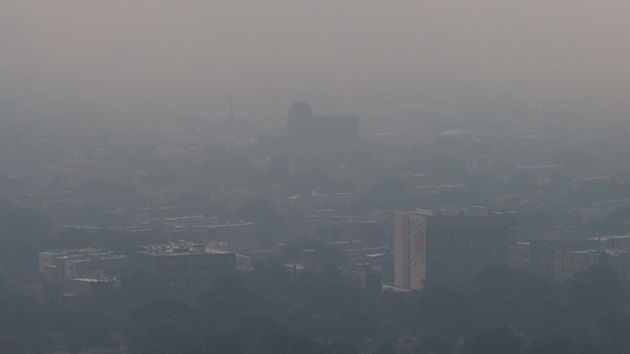
(MINNEAPOLIS) — Minneapolis’ air quality ranked the worst in the world among major cities Thursday due to thick smoke from wildfires burning throughout northern Minnesota and Ontario, Canada.
Much of the city’s air quality entered the “hazardous” category Wednesday night and remained there into Thursday.
Parts of the city reached an air quality index, or AQI, of 460. A hazardous AQI is categorized as 300 and above.
The air quality in Detroit also ranked worst in the world alongside Minneapolis.
All people are advised to remain indoors while the air quality is hazardous.
Minneapolis Mayor Jacob Frey urged residents to “please take this seriously” in a post on X Thursday morning.
“If you can, stay indoors, avoid activity outside, and keep indoor air as clean as possible,” Frey said in the post. “The risks are greater for kids, older adults, and anyone with heart or lung conditions.”
As of midday Wednesday, there are 15 active wildfires burning across Superior National Forest, including four in the Boundary Waters Canoe Area Wilderness, according to the U.S. Forest Service. The Forest Service noted several fires have merged since earlier reports.
In a press briefing Wednesday, officials warned the fires could keep burning until the fall.
While light rain is in the forecast in northern Minnesota on Thursday, Phil Manuel, incident meteorologist at the National Weather Service, said in the briefing it would not be enough to put out the fires.
“How are we going to end this? Weather’s going to have to change,” Manuel said. “It takes rain with a name to put out big fires.”
The fires in northern Minnesota come amid a slew of wildfires raging throughout Canada, which are sending dangerous smoke down to the Northeast and upper Midwest of the United States.
More than 183 wildfires were burning in Ontario on Wednesday, its Ministry of Natural Resources reported.
The Minnesota fires spread so rampantly because of hot, dry and windy conditions, as well as increased lightning strikes, officials said during the briefing.
Temperatures in the area recently rose into the 100s, while they typically only get to the upper 70s at this time of year, Manuel said.
First responders conducted door-to-door evacuations to bring residents and visitors to safety, and were continuing evacuations as of Wednesday, according to officials.
Firefighters continue working to extinguish the fires in coordination with Canadian first responders.
Copyright © 2026, ABC Audio. All rights reserved.