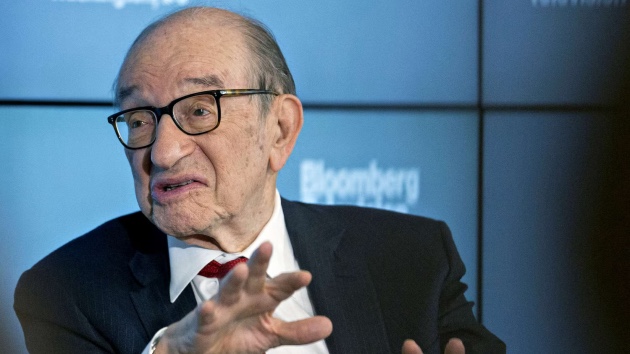
(NEW YORK) — Alan Greenspan, the longtime chairman of the Federal Reserve, has died, his wife confirmed. He was 100 years old.
“Alan passed away at our home this morning at the age of 100 from complications of Parkinson’s Disease,” Andrea Mitchell, his wife and a chief correspondent at NBC News, said in a statement published by the network on Monday.
The economist is remembered for leading the American central bank amid periods of historic U.S. economic expansion, while critics have also said his policies contributed to and exacerbated the mortgage crisis and financial crash of 2008.
Greenspan, a libertarian Republican, became the 13th chairman of the Board of Governors of the Federal Reserve System two months before the stock market crash on Oct. 19,1987, known as Black Monday. He was credited with moving quickly to alleviate investors’ fears after the crash and was instrumental in ensuring the Federal Reserve made plenty of money available to alleviate the impact on financial markets. Stocks quickly rebounded.
He was appointed Fed chair by four different presidents during his career, first by Ronald Reagan in 1987. Greenspan continued to serve as Fed chairman under presidents George H. W. Bush, Bill Clinton and George W. Bush. He steered the U.S. economy through the economic boom in the 1990s, the dotcom bubble, and the Sept. 11, 2001, terrorist attacks. His final term as chair ended on Jan. 31, 2006.
Under his leadership, the Fed fostered a distaste for regulation and promoted very low interest rates in the early 2000s — two phenomena critics say encouraged a bubble in housing prices that eventually burst with disastrous effects on the global economy.
During his tenure, and before the financial crisis began, the nation experienced one of the longest periods of economic growth in its history.
A decorated economist, first inspired by music
Greenspan was born on March 6, 1926, in New York City, the only child of Herbert Greenspan, a stockbroker, and Rose Goldsmith Greenspan, a retail worker. His parents divorced when he was 4 years old, and he was raised mainly by his mother and his grandparents.
An aspiring musician, Greenspan attended Juilliard for a year and played saxophone and clarinet before dropping out and enrolling at New York University. He went on to gain his bachelor’s, master’s and doctoral degrees in economics from New York University. He also engaged in some advanced graduate work at Columbia University in New York, where he studied under the influential economist Arthur Burns.
Though short-lived, his music career was an influential portion of Greenspan’s life, and he considered the move into economics a logical progression. He saw the organization of economic data into sound fiscal modeling as analogous to the organization of musical notes into tunes, according to Greenspan biographer Justin Martin in his book, “Greenspan: The Man Behind Money.”
“I get the same kind of joy from solving a hard mathematical problem as I do from hearing a Haydn quartet,” Greenspan once told The New York Times Magazine.
Greenspan taught economics at NYU between 1953 and 1955 and then founded the economic consulting firm Townsend & Greenspan, where he served as chairman and president from 1954 to 1974. He returned to the firm in 1977 and stayed until 1987.
President Richard Nixon nominated Greenspan to chair the President’s Council of Economic Advisers in 1974, the first of many government economic positions he would hold. Nixon resigned as president hours after Greenspan was nominated, but he continued to serve under President Gerald Ford. Greenspan also served as a member of President Ronald Reagan’s Economic Policy Advisory Board and was a consultant to the Congressional Budget Office.
In the private sector, Greenspan served as corporate director for many companies, including Alcoa, General Foods and J.P. Morgan & Co. He also served as a member of Time magazine’s Board of Economists and a senior adviser to the Brookings Panel on Economic Activity.
In 2002, Greenspan received an honorary knighthood from Queen Elizabeth II in recognition of his contribution to global economic stability. In 2005, President George W. Bush presented Greenspan with the Presidential Medal of Freedom.
He held the position of Fed chairman from the time Reagan appointed him in 1987 until 2006, serving an unprecedented five terms under four presidents before being succeeded by Ben Bernanke.
Greenspan is credited by many with facilitating the longest economic expansion in U.S. history. One day after the Black Monday stock crash, Greenspan affirmed the Fed’s “readiness to serve as a source of liquidity to support the economic and financial system” and the central bank moved to encourage banks to lend on their normal terms. Unlike prior financial crises, the events of Black Monday notably were not followed by an economic recession or a banking crisis and less than two years later, the U.S. stock market surpassed its pre-crash highs.
During his tenure, Greenspan developed a reputation for being a consensus-builder and for his strong anti-inflation stance, focusing more on controlling prices than on promoting full employment. He led the Federal Reserve through several events with major economic consequences, including two U.S. recessions, the 1997 Asian financial crisis and the Sept. 11, 2001, terrorist attacks.
‘How could we have possibly got it so wrong?’
Starting in June 2003, the Federal Reserve set the federal funds rate, the rate at which banks typically borrow from each other, to one percent for a year. Though its intention was to lower the cost of borrowing and stimulate the economy, critics said the rate was too low and encouraged investments in risky subprime mortgage-backed securities, which they say contributed to the financial crisis in 2008.
The National Bureau of Economic Research, a research organization seen as an authority on measuring economic performance, later said that the recession officially began in December 2007.
In September 2007, Greenspan published a book that was both a memoir and economic commentary, “The Age of Turbulence: Adventures in a New World,” in which he criticized the George W. Bush administration for overspending and admitted that he supported the administration’s tax cuts without stressing the need for spending cuts.
In an interview with Bloomberg Businessweek in August 2012, Greenspan said, “one day before Lehman Brothers crashes, conventional wisdom was not even certain that we would fall into a recession.”
“In fact, we learned many months later that the downward trend had actually started,” Greenspan said. “How could we have possibly got it so wrong? I mean, I actually was saying, ‘Yes, recession is coming, not that we’re here yet.’ We didn’t know that it had already hit.”
In October 2008, Greenspan acknowledged to a congressional committee discussing financial regulation that, “I made a mistake in presuming that the self-interests of organizations, specifically banks and others, were such as that they were best capable of protecting their own shareholders and their equity in the firms.”
After Greenspan finished his term as chairman of the Federal Reserve in 2006, he established Greenspan Associates, an economic consulting firm in Washington, D.C.
With Greenspan as president, the firm had four employees as of October 2012. His client list has included giant finance clients like German firm Deutsche Bank and hedge fund Paulson & Co.
Personal life
Greenspan married artist Joan Mitchell in 1952. The couple divorced in 1953 after less than a year of marriage, and the marriage was later annulled. The two remained friends.
His first wife is remembered for introducing him to novelist and philosopher Ayn Rand, with whom Greenspan shared a friendship, a belief in free-market economic ideals and a philosophy of objectivism. In his 30s and early 40s, Greenspan spent many hours sitting with Rand’s band of followers, known as the “Collective,” discussing topics including politics philosophy, current events and economics.
In addition to Burns at Columbia, Rand and her group were instrumental in helping hone Greenspan’s capitalist, free-market economic philosophy, according to Martin, Greenspan’s biographer.
The group’s open style of debate and discussion served Greenspan well in his various governmental roles. During his career in public service, he became known for a well-developed ability to communicate with Congress without offending those with opposing viewpoints or politicizing his messages.
Though he was said to back revamping the Social Security system and raising the retirement age, Greenspan was wary of how his public statements as Fed chairman might move markets. He rarely granted interviews. He was known for making openly ambiguous public statements about the state of the U.S. economy, once telling Congress, “If I’ve made myself too clear, you must have misunderstood me.”
Greenspan married NBC News correspondent Mitchell in 1997. Their marriage was officiated by the late Supreme Court Justice Ruth Bader Ginsburg.
“We’ve had the most wonderful marriage,” he told Bloomberg Businessweek in August 2012. “It gets better every year. We’re still very much together in love.”
Mitchell is Greenspan’s only surviving family.
Copyright © 2026, ABC Audio. All rights reserved.