A true American original’: Trump eulogizes Sen. Lindsey Graham at Washington funeral

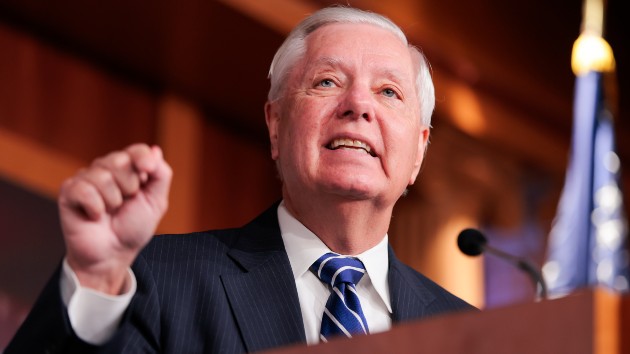
U.S. Sen. Lindsey Graham (R-SC) speaks during a press conference at the U.S. Capitol on April 27, 2026, in Washington, DC. Republican senators gathered to introduce legislation to fund construction of a White House ballroom as a secure alternative event space following the shooting at the White House Correspondents’ Association dinner in Washington, DC Saturday night. (Photo by Heather Diehl/Getty Images)

(WASHINGTON) — National political leaders and prominent figures from around the globe are remembering South Carolina Republican Sen. Lindsey Graham with a ceremony on Capitol Hill and a funeral service in Washington, D.C., on Tuesday.

President Donald Trump paid tribute to his close ally at Washington National Cathedral on Tuesday afternoon.

“Today, we gather in the deepest gratitude and profoundest sorrow to honor a beloved friend, a devoted brother, a respected statesman, a giant of the United States Senate and a true American original who left us much too soon,” Trump said. “And that can only be the one and only Lindsey Graham.”

The cathedral funeral is being attended by a number of world leaders, including Israeli Prime Minister Benjamin Netanyahu and Ukrainian President Volodymyr Zelenskyy. Graham worked closely with both men as a staunch ally to both nations. Graham spent some of his final days in Ukraine and met with Zelenskyy just before he died.

Sean Hannity and Graham’s niece, Emillie Boggs Roberts, will also deliver remarks.

Graham first was recognized with a ceremony in the Capitol rotunda Tuesday morning. His casket, draped in an American flag, was escorted by Air Force personnel and received by members of his family, including his sister Sen. Darline Graham, on the Capitol steps.

A great number of senators, both Democrats and Republicans, were in attendance. Senate Majority Leader John Thune and Vice President JD Vance gave remarks, as did South Carolina Republican Rep. Sheri Briggs.

Thune remembered Graham for his work in national security and defense, his efforts on the Senate Judiciary Committee and for his commitment to pro-life issues.

Thune seemed to choke back tears toward the ends of his remarks as he said a final goodbye to Graham.

“To Lindsey, rest in peace, my friend. I look forward to the days when you make us all laugh again,” he said.

Vance said he will remember Graham as someone who would fight alongside you on issues you both care about while respectfully disagreeing on others, and shared a story of an “intense argument” they had over Ukraine, but that it didn’t stop Graham from supporting him on another issue.

“I choose to remember Lindsey Graham as a person who could fight with you on one issue, but fight for you on another issue,” the vice president said. “I remember Lindsey Graham as a man who loved people, and because he loved people, he was willing to reason with them, to respect them, and ultimately to persuade them.”

“It was impossible not to like him — that swashbuckling, infectious laugh, that attitude, that passion that so many others have talked about. Lindsey Graham was impossible not to like as a human being, and of course, as a United States senator,” Vance added in his speech.

Graham served more than two decades in the Senate, becoming one of the chamber’s most recognizable Republicans and one of Trump’s closest friends and advisers. He advised the president on foreign matters, including the recent war in Iran, and was a prominent fixture of the Senate’s powerful Judiciary Committee.

He died suddenly and unexpectedly on July 11 at the age of 71. Preliminary findings from the Medical Examiner of the District of Columbia said that the senator died due to “aortic dissection due to arteriosclerotic cardiovascular disease.”

Graham’s casket will return to South Carolina on Wednesday, where further memorial services are set for Columbia, the state’s capital, and Pickens County, where Graham grew up and part of the district he represented.

The U.S. Air Force will rename Joint Base Charleston in South Carolina for Graham, a White House official confirmed on Tuesday.

The base, which falls under the command of the United States Air Force’s 628th Air Base Wing, will be renamed to Joint Base Lindsey Graham, according to a memorandum from Secretary of the Air Force Troy Meink dated July 27.

In the memo obtained by ABC News, Meink said that the renaming would honor “Graham’s decades of distinguished service to the United States Congress and the United States Air Force.” It was not immediately clear when the change would go into effect.

Copyright © 2026, ABC Audio. All rights reserved.
Millions of Americans with untreated high blood pressure should be taking medication

Nearly 1 in 3 adults in the United States with untreated high blood pressure would benefit from treatment and are not getting it, according to a new study.That’s because nearly 10 million Americans now meet newly updated guidelines by the American Heart Association and American College of Cardiology that redefine an adult’s risk for cardiovascular disease.“We estimated that approximately 200,900 all-cause deaths and 162,600 cardiovascular deaths could be prevented over the next 10 years,” said lead study author Dr. Mustafa Al-Jarshawi, a cardiologist at Keele University in England.Ideally, doctors want blood pressure to fall below 120 mmHg systolic and 80 mmHg diastolic. If blood pressure is around 130/80, doctors have typically advised people to make changes to their lifestyle, such as increasing exercise.If doctors use the American Heart Association’s new PREVENT tool, which considers blood sugar, kidney function and a person’s decade-long risk for heart disease as well as blood pressure, some 81 million Americans would be eligible for blood pressure medications.“What this is saying is that people who have traditionally not been at very high risk are now eligible to be treated with medications more aggressively,” said cardiologist Dr. Andrew Freeman, director of cardiovascular prevention and wellness at National Jewish Health in Denver.“Generally, I think when people have additional risk, blood pressure is really the silent killer,” said Freeman, who was not involved with the study.Expanding treatment could save livesThe study, published July 29 in the Journal of the American Heart Association, analyzed National Health and Nutrition Examination Survey data from 2009 to 2018. Newer data is available, but the most up-to-date version of the survey hasn’t been around long enough for researchers to know participants’ cause and time of death.The study examines how death rates might be lower if the 2025 hypertension guidelines were implemented during those years, Al-Jarshawi said.Among 81 million adults with high blood pressure and no cardiovascular disease, nearly 23 million may be newly eligible under the new guidelines. Of those 23 million, 9.7 million were untreated.Becoming eligible to receive blood pressure medication was associated with a 23% lower risk of dying compared with no treatment. When it comes to the chances of dying from a heart-related issue, risk dropped by 50%. The study also found that adults with diabetes would benefit most from treatment. This is because diabetes and high blood pressure often occur together, significantly increasing cardiovascular risk, Al-Jarshawi said.Treatment is more than a medicationAny eligible person shouldn’t hesitate to start taking medication in addition to making lifestyle changes to reduce long-term risks, Al-Jarshawi said.Controlling high blood pressure is a long-term commitment to health, CNN contributor Dr. Leana Wen, an emergency physician and adjunct associate professor at George Washington University, told CNN in a previous article. She recommended looking into a key inventory of five daily habits: level of physical activity, diet, substance use including alcohol and marijuana, stress levels, and a healthy weight.“You don’t have to do everything perfectly to make a difference in your health,” Wen said. She suggests starting with small lifestyle changes. Many people can’t easily reduce stress in their lives, but maybe they can more easily start eating more fruits and vegetables.”The findings of the new study highlight the importance of controlling high blood pressure, Freeman said.“The western world is ailing from a variety of cardiometabolic, kidney diseases,” Freeman said. “High blood pressure amplifies a lot of risk, and we have to do whatever we can to get that risk down and being aggressive about blood pressure is very low-hanging fruit.”However, medication only works when it’s inside the person, and not sitting in the bottle unused, Freeman said. About half of adults in the US with high blood pressure don’t regularly take their prescribed medication, according to a July 2025 study published in the journal JAMA Cardiology.Freeman recommends trying to form a habit, such as keeping your pillbox next to an alarm or toothbrush. That way, when set an alarm for the morning or brush your teeth, you remember to also take the pills.“There’s a way to cue yourself and remind,” Freeman said. “For those people that forget, consider having a small supply in your purse or your wallet or your car, just so you can always remember to take it.”The study’s findings also highlight the need for physicians to be alert to early signs of disease and consider blood pressure treatment, even in younger people, according to Freeman.“We’re seeing a lot more young people now who have chronic disease and diabetes and other things that may be relatively mild, but still at risk, and we need to be even more aggressive,” Freeman said.The-CNN-Wire™ & © 2026 Cable News Network, Inc., a Warner Bros. Discovery Company. All rights reserved.
Read Next Story