
20 dead, dozens injured in Kyiv as Ukraine hit with ‘massive’ Russian strike

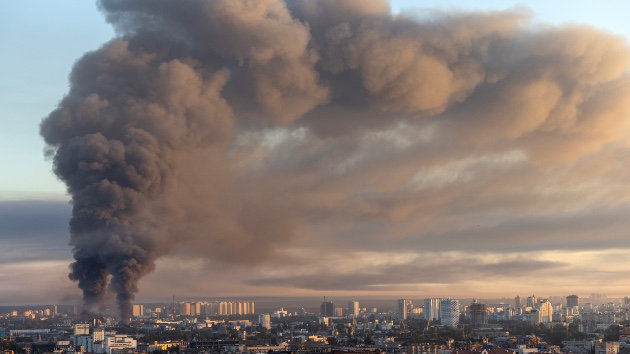
Smoke is seen as two major fires burn after a drone and missile attack by Russian forces on July 2, 2026 in Kyiv, Ukraine. (Photo by Paula Bronstein/Getty Images)

(LVIV, LONDON and NEW YORK) — At least 20 people were killed and dozens of others were injured after Kyiv came under attack from a “massive” barrage of Russian ballistic missiles and drones overnight, Ukrainian officials said, describing multiple explosions across the capital.

Tymur Tkachenko, head of Kyiv City Military Administration, published an updated death toll on his Telegram channel. The State Emergency Service of Ukraine said the attack’s main target was Kyiv. More than 90 people had been injured across the country.

Kyiv’s Mayor Vitali Klitschko described the attack as “massive.” President President Volodymyr Zelenskyy said first responders in the capital were “clearing the rubble, searching for people, and providing assistance.”

“Damage has been reported at more than 20 sites across the city, most of them ordinary residential buildings,” Zelenskyy said. “There was also damage to an ambulance station, a research institute, a hotel, and businesses.”

Moscow targeted Ukraine with more than 70 missiles, nearly half of which were ballistic, along with almost 500 drones in the overnight attack, Zelenskyy said.

Damage has been reported in every district in Kyiv. The worst hit was the Darnytskyi district, where part of a nine-floor apartment building collapsed, leaving people trapped inside, Klitschko. Search and rescue teams are still looking for those thought to be under the rubble, including a 15-year-old girl and her family.

Another air raid alert has been issued in Kyiv right now due to Russian drones.

In Holosiivskyi district, the roof of a multi-story residential building was on fire, Klitschko said. In the Shevchenkivskyi district, in the center of the capital, there was a fire on the roof of a hotel.

During the strikes, the mayor urged residents to stay in shelters. Klitschko said earlier that of the 34 people initially recorded as injured in the strikes, 32 were taken to the hospital; two others were treated on the spot.

The strikes targeting Kyiv came hours after the Ukrainian military struck a large Russian oil refinery in Ufa, and a military complex in the Penza region, Zelenskyy said. The night before, Ukraine also struck a satellite communications center in the Moscow region, Zelenskyy said.

Ukraine’s strikes on Russia came amid a mounting pressure campaign by Kyiv seeking to push Russia to end the war, which in February entered its fifth year.

An analysis from a U.S. think tank published on Wednesday said troop casualties in the war — missing, killed and wounded — had surpassed 2 million, including as many as 600,000 deaths.

The Center for Strategic and International Studies said in that report that the figures heavily skewed toward Russian losses, with roughly three Russians killed or wounded to every one Ukrainian killed or wounded.

Russian casualties amounted to 1.4 million people, according to the data, including 450,000 who had been killed in the war, the report said. Ukrainian forces have suffered 525,000 to 625,000 casualties, including 125,000 to 150,000 deaths, the study said.

Neither the Ukrainian nor the Russian military releases data detailing their own battlefield casualties.

The report’s authors, drawing on information collected from Western governments, including the U.S., and on open source information, said Russia also lost territory in April and May. Overall, the report’s authors said, 2026 has been counterproductive for the Russian military, and that Moscow may be losing the war.

Offering historical perspective, the report says Russian fatalities in Ukraine are more than four times greater than all U.S. fatalities in all wars combined since World War II, and more than nine times greater than all Soviet and Russian fatalities in all wars combined since World War II.

Russia’s advances in key Ukrainian areas “are among the slowest rates of advance in any war over the last century,” the report stated.

In Kyiv on Thursday, Ruslan Stefanchuk, the chair of Ukraine’s parliament, accused Moscow of using missiles and drones to deliberately target civilians, which turned “an ordinary night in the capital of a European state into a struggle for survival.”

“This crime, like every one before it, must be met not only with condemnation, but with a resolute response: stronger air defence for Ukraine, tougher sanctions against Russia, and inevitable accountability for everyone responsible,” he said on social media.

ABC News’ Patrick Reevell and Morgan Winsor contributed to this report.

Copyright © 2026, ABC Audio. All rights reserved.

Colombia limits foreign rescue teams as earthquake survival window narrows

(CNN) — Colombia has begun receiving international aid and rescuers after initially refusing some offers in the crucial hours following Monday’s devastating earthquake.The delay is considered the first controversy of the country’s new government, led by conservative President Abelardo de la Espriella, who took office on Friday.News of the holdup comes as the clock nears the end of the critical 72-hour window for rescuing survivors under the rubble of collapsed buildings, after which rescuers warn that the possibility of finding anyone alive drops dramatically.Leaders across the Americas had offered support right after the 7.4 magnitude quake struck this week – just as they had done with Venezuela when it was hit by two powerful tremors in June. The difference is that Venezuela immediately received dozens of international rescue groups without question, while Colombia either turned some of them down or limited how they would help.Political scientist Sandra Borda argued that the difficulties in aid management are related to the tense political transition between the current and previous administrations, which lacked a formal handover. Notably, it was only on Wednesday that David Tamayo Roldán was appointed director of the National Unit for Disaster Risk Management, the agency responsible for Colombia’s disaster preparedness and response.“Without a transition and with that kind of personnel change, it was perfectly normal for these short circuits to occur,” said Borda, a professor at Universidad de los Andes.The outlook on Tuesday was uncertain as multiple countries and organizations, including the UN, said they had not received a request for aid from Colombian authorities.“If that happens, the United Nations system and humanitarian actors are prepared to provide all the support we can,” said Jens Laerke, spokesperson for the UN Office for the Coordination of Humanitarian Affairs.Mexico, which had prepared tons of supplies and a contingent of 255 military personnel, also it had not received a request from Colombia and that the deployment depended on it.Meanwhile, Chinese ambassador to Colombia Zhu Jingyang “urgently” asked Colombia to establish an official channel to coordinate international assistance, saying, “We hope the Colombian Government will immediately announce the name of the official and their contact to coordinate international assistance for the earthquake victims.”As the hours passed, coordination finally began.Salvadoran President Nayib Bukele announced Tuesday afternoon that he was sending humanitarian aid to Colombia but noted that de la Espriella’s government requested aid “only in the form of supplies” for those affected.“We have been informed that their rescue teams, medical personnel, and other emergency bodies are deployed and attending to the situation, so at this time, they do not require personnel support,” he said.However, Peru confirmed Wednesday that it will dispatch volunteers to support search and rescue efforts.The Colombian Foreign Ministry later said it was preparing a list of “specific needs” to request international aid and that it had asked the United Nations Development Programme to provide support.The new head of disaster management also said Wednesday that the government has requested rescue teams from only four countries – the US, El Salvador, Ecuador and Israel – because, in Colombia’s view, their rescue teams have the international and national certifications required for the job.Foreign Minister Omar Bula insisted that the country has “not excluded absolutely any country in terms of the offers that have been made to us,” adding, “We work with countries without any ideological or political consideration.”The US confirmed Wednesday that had mobilized search and rescue teams from Virginia and California to Colombia after receiving a request from its government.Borda commented that the new government showed “a deep distrust of some parts of the international community,” which she considered “difficult to understand.”She added that there was “no clarity about the procedure that was to be followed” regarding the arrival of rescuers, saying, “I think this happened to us at a very difficult time. It is truly a regrettable situation.”She also said that the subsequent acceptance of the arrival of experts undermined the argument that they were not needed.“There was a perception from the beginning that the rescue teams would be sufficient, although a technical assessment was never made public to confirm that they would indeed be enough to deal with all the damage and destruction caused by the earthquake,” she said.In any case, it is also unclear where international personnel are needed. The emergency chief of the fire department in Cali, one of the most affected cities, indicated that volunteers should not approach collapsed sites “because there are already enough specialized personnel to carry out the rescue work without complications.”The Topos Tlatelolco Rescue Brigade, a Mexican group with extensive experience responding to natural disasters, said Wednesday that Colombian authorities “will not allow the entry of external rescue groups” because the work is being handled by national rescuers.Meanwhile, in Pereira, another severely affected city, the foreign ministry celebrated the arrival of 19.5 tons of aid from Mexico.“Additional flights are expected in the coming days. Colombia is not alone! The international community is with us,” the ministry said on X.Mexican President Claudia Sheinbaum confirmed that her government had finally coordinated with its Colombian counterparts, who “requested specific items” and that the flight also included “members of the Mexican Army to assist in the efforts.”The-CNN-Wire™ & © 2026 Cable News Network, Inc., a Warner Bros. Discovery Company. All rights reserved.
Read Next Story