
Man fatally shot by ICE in Maine was not intended target of warrant, lawmakers say

▶ Watch Video: Maine House speaker slams ICE after agent fatally shoots man: “We want ICE out”

An Immigration and Customs Enforcement agent in Maine fatally shot a man in his car on Monday, the Department of Homeland Security said, marking the second time in a week that ICE officers have used deadly force in the U.S.  

DHS alleged the man, who was in the country illegally, had “attempted to flee the scene” when ICE tried to stop him at around 7 a.m. ET in Biddeford, Maine, and “fearing for public safety, an officer discharged his weapon.” He later died from his injuries. DHS said ICE agents encountered the man while “conducting targeted surveillance on the last known address of an illegal alien with a final order of removal.”

DHS did not name the man. A family representative and the Colombian Embassy in Washington, D.C., confirmed to CBS News on Tuesday that his name is Johan Sebastián Durán Guerrero, a 25-year-old Colombian national. A source with knowledge of the investigation had earlier told CBS News his first name is Joan, and an immigrant rights group had said he was 26. 

Independent Sen. Angus King of Maine said on CNN that “the person that was killed was not the person that they were seeking,” citing a conversation he had with Secretary of Homeland Security Markwayne Mullin. The senator said Mullin initially told him the man was the intended target of a warrant, but about three hours later, Mullin called him back with updated information that the man actually wasn’t the target. 

In a news conference earlier Monday, King said the deceased man had been given an order to leave the country. 

Democratic Rep. Chellie Pingree of Maine said in an interview with CBS News that she had “heard on good authority, though it’s not been confirmed by [DHS], that they perhaps shot the wrong person, that it was not the person they were going after.” She called the shooting “very disturbing” and said she is pressing DHS for more information.

The Colombian Embassy issued a statement saying it “regrets the death of a Colombian national in Biddeford, Maine and is providing the necessary consular assistance to his family.” The embassy said it has “requested information and clarification from the Department of Homeland Security regarding the circumstances surrounding this lamentable death and will continue to follow the case closely as the investigation progresses.”

During Monday’s news conference, King said Mullin told him the man had “weaponized” his vehicle. In its statement later Monday, DHS did not use that wording, instead saying the officer shot at the man out of concern for “public safety.”

King told CNN “we haven’t seen evidence” yet suggesting that the officer feared for their safety or the safety of others, and called for an “unvarnished, transparent investigation.”

The agents involved in the shooting weren’t wearing body cameras, King told reporters. 

Sen. Susan Collins, a Maine Republican, said on social media she was told that the Department of Homeland Security’s inspector general will take the lead on investigating the shooting, with help from the FBI. 

The state attorney general’s office, which is also investigating the shooting, said in a statement that the man “attempted to flee in a vehicle in the direction of” an officer with ICE’s Enforcement and Removal Operations directorate, according to initial statements collected by investigators. The officer who opened fire will be placed on leave, according to the attorney general’s office. 

Videos show car circling, man pulled from vehicle

The Maine Immigrants’ Rights Coalition said the man killed in the shooting was authorized to work in the U.S. and had been issued a Social Security number.

A neighbor, Nelson Elias, told reporters that the man was married with a young daughter who’s about 2 or 3 years old.

‘This was a father. This was a person who was trying his best to create a life and provide for his family,” Ruben Torres, of the Maine Immigrants’ Rights Coalition, told CBS News. “Overall there’s kind of just a general sense of confusion, pain and anger, both from the community and then also a sense of loss and hurt from the family.”

A video of the incident, taken from a nearby security camera and obtained exclusively by CBS News, appeared to show the vehicle slowly driving in a circle a few times before coming to a stop. At least two people then approached the car and appeared to pull a person from the driver’s seat out onto the ground.

Cory Poulin, who owns a pawn shop and laundromat across the street, said he believes the vehicle was rolling because the driver had already been shot. He said he considers it a community tragedy.

“If someone’s a different race and wants to do laundry, I don’t want them to be worried that they’re going to — that they have to worry about ICE coming in and doing what they do,” Poulin said.

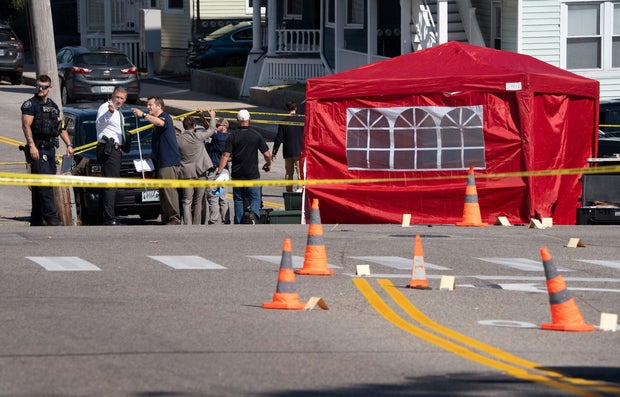
A photo from the Portland Press Herald shows a car behind police tape with four bullet holes in the windshield on the driver’s side.

A Kia sedan with four bullet holes in the windshield is seen at the scene of a shooting in Biddeford, Maine, July 13, 2026.

Gregory Rec/Portland Press Herald via Getty Images

The Press Herald also posted a video of the incident from another angle. The video, which was recorded from a nearby vehicle, shows two people approaching the car while it’s moving, and one person appears to grab onto the driver’s side door handle before the video ends.

“The question is, what did he do with his vehicle?” King told reporters. “Were officers threatened? Were the threats rising to the level that justified deadly force? That’s what this investigation is all about, and I certainly intend to stay after it to do everything I can to be sure the investigation is as transparent and thorough as possible.”

Em Akerley, who lives near where the shooting happened, told WMTW-TV she initially thought she heard a car backfiring and went to her window when the sound continued.

“I see a small white car being corralled by two men trying to stop it from losing control around the intersection and, all of a sudden, all these plainclothes, vested men sort of running down the street, abandoning their cars kind of everywhere with regular people behind them,” she said.

She said she didn’t see the man who was shot.

“I don’t know what he did, but he didn’t deserve to be executed in the street,” Akerley said. “I didn’t hear anything until the gunshots.”
ICE Shooting Maine
The scene where a man was killed in a shooting involving U.S. Immigration and Customs Enforcement agents on July 13, 2026 in Biddeford, Maine. 

Gregory Rec/Portland Press Herald via AP

Project Relief Maine, an immigrant advocacy group, said in a statement on social media that the person who was killed was one of their community members.

“We are in contact with the family and are committed to supporting them during this unimaginable time,” the group said. “This was a young person whose life was cut short, and our community must come together to stand with their loved ones and ensure they are not alone. They must get justice.”

Maine Democratic Gov. Janet Mills said she was briefed on the shooting. “I know that situations like these are alarming and frightening,” she said in a statement

The Maine State Police was at the scene after the shooting working with the state attorney general’s office, the state Office of Chief Medical Examiner and federal officials, Mills said. Democratic State House Speaker Ryan Fecteau had said on Facebook that the state Department of Public Safety was also at the scene gathering details.

The Biddeford Police Department said in a statement that it responded to an incident involving ICE personnel at the intersection of Pool and Hill streets and was providing security at the scene. The department directed inquiries about the incident to ICE.

A community vigil was set for Monday evening.

Maine shooting comes after deadly incident in Houston

The shooting comes after an ICE officer shot and killed a Mexican man in his work van last week in Houston.

In that incident, security camera footage obtained by CBS affiliate KHOU-TV shows ICE officers in unmarked vehicles followed Lorenzo Salgado Araujo after he picked up co-workers for a construction job.

The Department of Homeland Security said officers thought one of the men resembled someone they were looking for and that Araujo attempted to run over an officer who fired in self-defense. An attorney for two of the men in the van said the ICE officer fired into the vehicle through a window on the passenger side.

“Lorenzo had already parked the van. The ICE agent reaches in, fires a shot directly in front of Victor’s face, strikes Lorenzo on the side,” attorney Hugo Balderas-Ibarra said in an Instagram video.

The ICE officers involved in that shooting weren’t wearing body cameras and didn’t have dashboard cameras in their vehicles. The FBI is investigating the shooting. 

Si otra civilización avanzada hubiera vivido en la Tierra antes que nosotros, ¿lo sabríamos?

Cuando el astrobiólogo Adam Frank entró en la oficina del científico de la NASA Gavin Schmidt, tenía lo que creía que era la pregunta más extraña: ¿Los extraterrestres experimentan el cambio climático? Solo tomó unos momentos para que Schmidt lo superara en rareza.Frank, profesor de la Universidad de Rochester que busca señales de vida en el universo, estaba investigando si las civilizaciones avanzadas inevitablemente provocarían cambios climáticos, tal como los humanos lo están haciendo ahora. Estaba mirando otros planetas, le dijo a Schmidt aquel día de 2017, “porque, por supuesto, sabemos que no ha habido otras civilizaciones en la Tierra”.Schmidt lo interrumpió de inmediato. “¿Cómo lo sabes?”, preguntó.Fue un momento de quiebre abrupto, dijo Frank, y eso llevó a los dos científicos a iniciar una investigación. Si una civilización avanzada hubiera vivido en la Tierra hace millones de años, se hubiera abastecido de energía y se hubiera autodestruido, ¿lo sabríamos? ¿Habrían dejado rastros de su presencia grabados en el registro de nuestro planeta?Llamaron a la idea la “hipótesis silúrica”, en honor a una raza avanzada ficticia de reptiles en la serie de televisión “Doctor Who”, y publicaron un artículo sobre ello en 2018.Es una idea que desafía la mente y que no solo mira profundamente al pasado de la Tierra, sino también muy lejos en su futuro, ya que los humanos cambian el clima de manera rápida y dramática al quemar combustibles fósiles. “Es un experimento mental, pero uno que expone nuestra potencial vulnerabilidad a nivel global”, dijo Katharine Hayhoe, científica atmosférica de la Universidad Tecnológica de Texas, quien no participó en la investigación.La hipótesis silúrica plantea grandes preguntas sobre la trayectoria de las civilizaciones avanzadas y si todas aquellas que aprovechan la energía a escala global están destinadas a extinguirse, o si existe la posibilidad de vivir de manera sostenible y sobrevivir durante millones de años.“Estas preguntas son totalmente relevantes para el momento exacto en el que estamos”, dijo Frank. “Estamos empujando al planeta hacia un nuevo régimen climático… sabemos que esto es cierto, ¿verdad? Sin embargo, no estamos haciendo nada al respecto”. La razón por la que Schmidt había estado reflexionando sobre la posibilidad de civilizaciones avanzadas previas en la Tierra era un evento ocurrido en el pasado profundo.Hace unos 55 millones de años, el clima del planeta cambió drásticamente. Las temperaturas mundiales aumentaron hasta 8,3 °C y los ecosistemas colapsaron, mientras enormes cantidades de carbono que calienta el planeta llegaban a la atmósfera.Este período, conocido como el Máximo Térmico del Paleoceno-Eoceno y registrado por primera vez en la década de 1990, pudo haber sido el resultado de una enorme erupción volcánica, o tal vez una liberación repentina de metano. Pero la razón exacta por la que ocurrió sigue siendo en parte un misterio. Lo que intrigaba a Schmidt eran las similitudes con lo que está ocurriendo ahora, mientras los humanos elevan las temperaturas y provocan extinciones.Y no es el único cambio inexplicado en el pasado profundo del planeta que resuena con nuestro presente; otros períodos han visto océanos privados de oxígeno y aumentos bruscos de temperatura.Lo más probable es que estos sean eventos climáticos naturales, pero ¿y si no lo fueran? ¿Cómo lo sabríamos? En su informe, Frank y Schmidt repasan la cadena de posibles evidencias que podrían existir en apoyo de una civilización avanzada pasada.Hoy, solo alrededor del 1 % de la superficie terrestre está urbanizada y no tomaría mucho tiempo para que lo que hemos construido fuera borrado. Cuanto más atrás en el tiempo existió una civilización hipotética, más difícil sería encontrar evidencia directa, como objetos.A lo largo de millones de años, el planeta se remodela a medida que las placas tectónicas se desplazan, los volcanes entran en erupción y la tierra se erosiona. El tramo de tierra a gran escala más antiguo de la Tierra es el desierto de Negev, en el sur de Israel, con unos 1,8 millones de años de antigüedad.Las características superficiales pueden no aportar mucha evidencia, por lo que los científicos miraron los fósiles. No obstante, solo una fracción diminuta de las especies animales se fosiliza, y aún menos son encontradas. Los dinosaurios recorrieron la Tierra durante unos 180 millones de años, pero solo se han descubierto unos pocos miles de fósiles casi completos. Podría ser fácil pasar por alto una civilización que solo existió durante 100,000 años, un simple parpadeo en la historia de 400 millones de años de la vida compleja en el planeta.Luego, los investigadores consideraron las huellas dejadas por los cambios químicos. Piensa en el Gran Cañón, dijo Frank, donde puedes ver línea tras línea que representa diferentes edades de la Tierra. “Cada una de esas capas es roca triturada que conserva una memoria de cómo era la química de la Tierra en ese entonces”. Si una civilización anterior hubiera alterado la química del planeta —como los humanos lo han hecho al liberar enormes cantidades de contaminación por carbono—, podría haber un registro.Los científicos también consideraron qué otras evidencias podrían dejar los humanos después de que nuestra civilización haya terminado, como las enormes cantidades de plásticos, así como hormonas artificiales para la agricultura y productos químicos persistentes, que no se descomponen en el medio ambiente. Todos estos podrían aparecer en sedimentos futuros, dentro de muchos millones de años. Lo mismo podría ocurrir con los metales pesados utilizados en la electrónica.El objetivo del artículo no era establecer si la hipótesis silúrica es correcta, dijo Frank. En cambio, “era para decir: aquí están las cosas que querrías buscar de una manera mucho más detallada para ver si alguna vez existió una civilización antes que la nuestra”.Tanto Frank como Schmidt están en la extraña posición de haber escrito un estudio sobre una teoría en la que ninguno de los dos cree; simplemente dicen que aún no podemos descartarla.Nadie parece haber respondido al llamado para una investigación más profunda en los años posteriores, pero algunos científicos han planteado preguntas.Jan Zalasiewicz, geólogo, paleontólogo y profesor emérito de la Universidad de Leicester en el Reino Unido, dijo que la hipótesis silúrica es “una idea maravillosa y profundamente provocadora”. Pero Schmidt y Frank subestimaron cuánto han transformado los humanos modernos el planeta, así como “la efectividad del proceso de fosilización y lo bueno que es preservando una historia de lo que ha sucedido en nuestro planeta”, dijo.No podemos descartar sociedades inteligentes prehumanas, “dinosaurios que pudieran cantar arias complejas, por ejemplo, o amonites jurásicos que pudieran componer poesía”, dijo Zalasiewicz, quien coescribió el libro de 2025 “Discarded: How Technofossils Will be Our Ultimate Legacy”. Pero tan pronto como se construyen ciudades, se funden metales, se fabrican y desechan plásticos, esto dejará una huella clara, afirmó.Zalasiewicz se siente cómodo descartando la existencia previa del tipo de civilización avanzada en la que vivimos hoy, “consumidora de energía, manipuladora, constructora y productora de desechos en cantidades colosales”.Y esa es la belleza de la ciencia, dijo Frank. “Publicas un artículo, es como, ‘¡Guau, esto es genial!’, y luego alguien viene y dice que estás equivocado”. Alguien más puede encontrar algo que apunte en una dirección diferente, y eventualmente, a medida que se acumula la investigación, se formará un consenso.Por ahora, quizás la razón más importante para explorar esta hipótesis son las preguntas importantes que plantea sobre la longevidad de civilizaciones tecnológicas avanzadas como la nuestra.Somos lo suficientemente inteligentes como para desarrollar tecnología, pero puede que no seamos lo suficientemente inteligentes como para descubrir cómo lidiar con sus consecuencias sobre el clima, dijo Frank. “¿Somos un experimento que el planeta ha realizado y que va a fracasar?”The-CNN-Wire™ & © 2026 Cable News Network, Inc., a Warner Bros. Discovery Company. All rights reserved.
Read Next Story