
Trump says ‘too bad’ SCOTUS upheld birthright citizenship, pushes legislation to end it

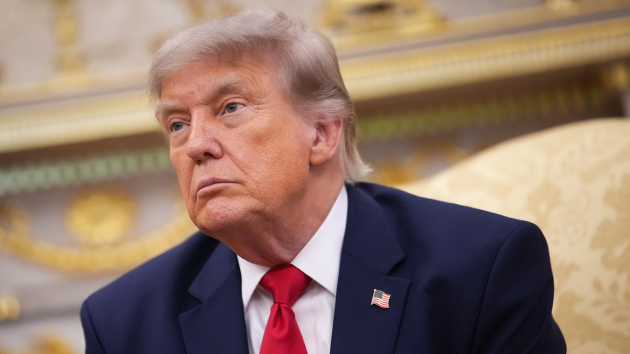
U.S. President Donald Trump attends a meeting with NATO Secretary-General Mark Rutte in the Oval Office of the White House on June 24, 2026, in Washington, DC. Secretary-General Mark Rutte is meeting with the President before the annual NATO summit next month and as the Pentagon does a six-month review of American forces in Europe. (Photo by Andrew Harnik/Getty Images)

(WASHINGTON) — President Donald Trump brushed off his loss after the Supreme Court rejected his attempt to end birthright citizenship — rooted in the 14th Amendment — on Tuesday, saying the decision is “too bad for the Country” and insisting that he can “easily make it up in Congress through Legislation.”

The court ruled in a 6-3 decision to reject Trump’s executive order that he issued on the first day of his presidency, with Chief Justice John Roberts writing for the majority, “Citizenship, then and now, was the right to have rights — to freely participate in our political community. The Framers of the Fourteenth Amendment extended that promise to every free-born person in this land. We keep that promise today.”

Trump responded to the court’s decision with a post on his social media platform, writing, “The Supreme Court upheld Birthright Citizenship, which is too bad for our Country, but we can easily make it up in Congress through Legislation, with the support of the President, that has now been determined during this process,” he wrote on his social media platform.

“No long and unwieldy Constitutional Amendment is necessary! Congress should start TODAY to work on ending expensive and unfair to our Country, Birthright Citizenship,” he added.

Birthright citizenship is rooted in both the Constitution and 1940 federal citizenship law. But even if the law were to be changed, this would likely be challenged in court on constitutional grounds with the possibility of the issue making its way back to the Supreme Court. 

ABC News reached out to the White House for more information about how the president would use Congress as a workaround for the court’s decision and if he is prepared for the issue to potentially return to legal scrutiny, but the White House referred questions back to the president’s post. 

On Monday, Trump said he would “accept” the results of the Supreme Court and acknowledged that “it’s up to them.”

In a subsequent post Tuesday, Trump again reiterated his desire to “correct” the birthright citizenship case in Congress while touting other cases that he won before the court.

House Speaker Mike Johnson, speaking at a House Republican news conference before Trump posted, said he was “very disappointed” with the decision and that Congress will look at amending the Constitution to address the issue.

“I think it subjects the country to serious challenges going forward and we’ll have to deal with it as a Congress,” Johnson said, saying the policy has been “grossly abused.”

“I’m sure we will continue to look at that. I’m sure the conclusion from this opinion is going to be you’ve got to amend the Constitution to fix that,” he said.

Johnson acknowledged a constitutional amendment would be “very complicated” and a “many-years-long process,” but said he thought it was likely the only way forward. 

Amending the Constitution would take a two-thirds majority in both chambers of Congress ratification by three-quarters of the states.

Copyright © 2026, ABC Audio. All rights reserved.

Vance, Caine raised munitions stockpile concern, source says, as US pauses consecutive nights of strikes in Iran

(CNN) — Vice President JD Vance and Chairman of the Joint Chiefs of Staff Gen. Dan Caine both raised concerns about the US munitions stockpile to President Donald Trump as he weighed potentially escalating the war with Iran during a White House meeting on Friday, a US official told CNN.On Friday night, the US appeared to pause its bombing campaign on Iran after nearly two weeks of consecutive nights of strikes. Operations are “on a hold,” a Department of Defense source told CNN on Saturday.It’s currently unclear if the stockpile concern was the primary reason why the US paused consecutive nights of strikes or whether it will continue to do so.“President Trump has always been consistent in saying he prefers a diplomatic solution, but he continues to retain all options if Iran continues terrorist activities in the (Strait) of Hormuz or against allies,” White House Communications Director Steven Cheung said in a statement.“Combined with successful sanctions that have crippled Iran’s economy and 13 straight days of strikes against military targets in response to their repeated aggression, it would be wise for Iran to work towards a negotiated deal. Otherwise, they know what will happen.”CNN has also reached out to Vance’s office for comment.This comes as key US weapons stockpiles remain significantly depleted and could come under more pressure if strikes on Iran continue, as CNN has previously reported.Speaking to reporters after the Friday meeting with Cabinet members and top advisors, Trump stressed that the US officials were actively negotiating with Iran, though he also said it was possible the military could continue its bombing campaign or “make it a heavier dose.” He claimed Iran seemed to be getting “more serious” in ongoing talks.As of Friday afternoon, the Trump administration was still deliberating over what a potential escalation would look like, according to a source familiar. Gulf countries have urged restraint in recent conversations with administration officials but acknowledged the US has unique capabilities it could use to escalate the conflict if it chooses to do so, the source said.Even after Trump said he was considering a massive attack against Iran this week, he had privately directed his negotiators to “keep talking,” according to a source familiar with the matter, underscoring how the president has been grappling with the reality of limited escalatory military operations short of putting US troops on the ground.Few within Trump’s inner circle, or inside the Pentagon, believed the president’s options for escalating would yield the results he was looking for, according to multiple sources.CNN has also reported that before the war began, Caine and other military leaders had warned Trump that a protracted military campaign could impact US weapons stockpiles.“America’s military is the most powerful in the world and has everything it needs to execute at the time and place of the President’s choosing,” Chief Pentagon Spokesman Sean Parnell said in a statement to CNN.“We have executed multiple successful operations across combatant commands while ensuring the U.S. military possesses a deep arsenal of capabilities to protect our people and our interests.”The-CNN-Wire™ & © 2026 Cable News Network, Inc., a Warner Bros. Discovery Company. All rights reserved.
Read Next Story