
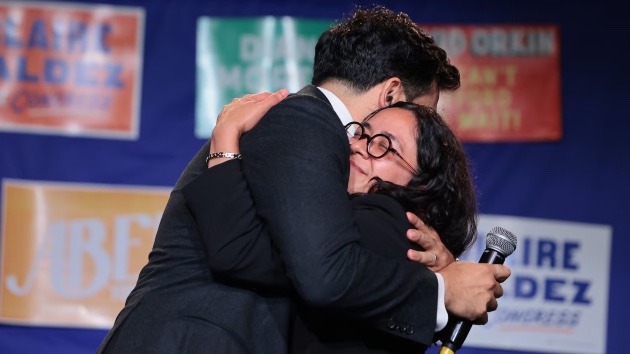
(NEW YORK) — A trio of progressive Democrats sharply criticized billionaires on their way to victory in House primaries in New York City.
The clean sweep for candidates endorsed by far-left New York City Mayor Zohran Mamdani on Tuesday drew attention to economic populism as affordability remains a top issue for voters ahead of the midterm elections.
In Manhattan and Brooklyn’s 10th District, incumbent Rep. Dan Goldman lost in a landslide to former comptroller Brad Lander, who vowed to “put working people first – not billionaires.”
Darializa Avila Chevalier, a community organizer, defeated incumbent Rep. Adriano Espaillat in New York’s 13th District, which covers upper Manhattan and the Bronx. Claire Valdez, a one-term state assemblymember, beat Brooklyn Borough President Antonio Reynoso in the primary race for New York’s 7th District.
Valdez and Chevalier, both of whom are democratic socialists, called for a four-day work week and a pause in the construction of AI data centers, among other measures.
To be sure, center-leaning candidates won Democratic primaries on Tuesday in upstate New York and Utah. New Jersey Gov. Mikie Sherrill and Virginia Gov. Abigail Spanberger, who are both Democrats, won general elections last year with moderate campaigns touting their own plans to ease price woes.
Here’s what to know about economic proposals put forward by Lander, Chevalier and Valdez:
Tax on billionaires
All three of the victorious progressive House candidates support a tax on wealthy individuals.
Lander “strongly supports” the Ultra-Millionaire Tax Act, a bill proposed by Democratic Sen. Elizabeth Warren that would tax the net wealth of households with over $50 million, according to Lander’s website.
Lander also backs an ultra-wealth tax on individuals worth over $1 billion, as well as the Equal Tax Act, which matches tax rates for capital gains and ordinary income over $1 million.
Chevalier supports the Ultra-Millionaire Tax Act and the Equal Tax Act. Similarly, Valdez has voiced support for taxing billionaires as means of funding social programs.
The top opponents in each of the three primary races held similar positions. Both Espaillat and Goldman had signed on to the Ultra-Millionaire Tax Act and the Equal Tax Act. Reynoso said he would “fight to tax the rich – a lot.”
Proponents say wealth taxes could raise tax revenue from affluent Americans in a position to spare funds. Critics, on the other hand, warn wealthy individuals may move assets abroad or prove less likely to start businesses or other ventures.
For his part, Mamdani sought a two-percentage-point tax increase for residents making more than $1 million, which would have raised the tax rate for high earners in New York City from roughly 3.9% to 5.9%.
Instead, New York enacted a tax on second homes in New York City valued at $1 million or more.
Pause on construction of AI data centers
All three progressive House candidates back a moratorium on the construction of AI data centers.
Many of the nation’s largest companies have poured funds into the chips and data centers necessary to operate AI.
The data center projects have drawn ire from critics who say they drive up residential water and electricity bills in some areas, while offering limited job gains. Proponents of the sector point to its role in fueling economic growth and ensuring the competitiveness of U.S. tech firms.
Sen. Bernie Sanders, I-Vt., and Rep. Alexandria Ocasio-Cortez, D-N.Y, have proposed the AI Data Center Moratorium Act, which would pause the development of data centers until the federal government imposes industry regulations.
Goldman, Lander’s opponent, signed onto the AI Data Center Moratorium Act. By contrast, Espaillat – Chevalier’s opponent – has not supported the bill. Reynoso’s position on a data center moratorium could not be immediately found.
On her campaign website, Valdez said she would “fight to hold major technology corporations accountable, protect our workforce from the harms of AI, and ensure that new technologies benefit communities, not just corporate executives.”
Four-day work week
Chevalier and Valdez support shifting from a standard workweek of 40 hours spread across five days to one lasting 32 hours across four days.
Such an approach, Valdez says, would reclaim the “economic gains of automation for workers.”
Spain, Iceland and South Africa are among the nations that have implemented a trial of the four-day workweek for select companies and workers.
In California and the U.S. House, lawmakers have introduced bills that would set the standard workweek at 32 hours.
The Thirty-Two Hour Workweek Act, introduced in the U.S. House in March 2023, garnered support from eight members. Neither Goldman nor Espaillat was among the backers.
Reynoso’s position on a four-day workweek could not be immediately found, though last month he spoke in support of unionized Kickstart employees seeking a four-day workweek as part of their labor contract.
Some experts previously told ABC News that a combination of escalating market pressure and legislative activity could ultimately bring a nationwide four-day workweek standard; others said such an outcome would prove nearly impossible, at least anytime soon.
Labor law reform
The share of unionized workers has fallen nationwide in recent decades. All three of the New York City progressives say they want to reverse that.
Lander, Valdez and Chevalier each support the PRO Act, a labor law reform measure with strong backing among U.S. labor unions.
The legislation would ease the path toward forming unions and winning labor contracts. The latest version of the bill, known as the Richard L. Trumka Protecting the Right to Organize Act, boasts the support of 215 House members, including at least one Republican.
Both Goldman and Espaillat signed onto the PRO Act. Reynoso, meanwhile, vowed to “champion the PRO Act.”
On her campaign website, Chevalier calls for passage of the PRO Act, so that “everyone who wants a union can form one.”
Copyright © 2026, ABC Audio. All rights reserved.