
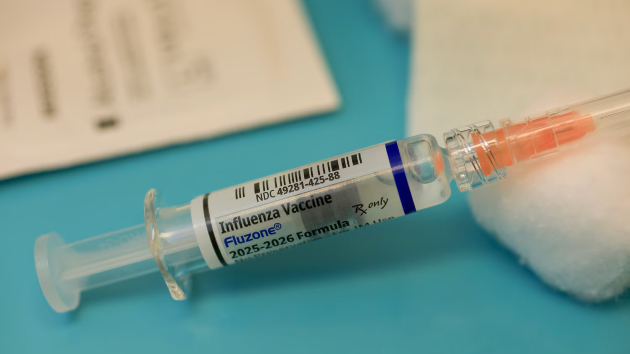
(SAN ANTONIO) — The basic training facility for the Air Force in San Antonio, Texas, is experiencing a flu outbreak following the end of mandatory vaccination for all service members.
As of Wednesday, there are at least 159 known cases among recruits and two hospitalizations at Joint Base San Antonio, two sources familiar with the matter told ABC News. One source told ABC News the number of cases and hospitalizations may be higher.
The outbreak comes after Defense Secretary Pete Hegseth announced in April that the annual flu vaccine would be optional for all U.S. military personnel, both active and reserve.
Previously, the flu vaccine was mandatory, but the new policy is in line with a previous change of making the COVID-19 vaccine optional.
The Pentagon has granted the military services exceptions to the policy, so the flu vaccine can be required in certain cases.
An Air Force spokesperson confirmed the outbreak to ABC News and said in a statement that over the last three weeks there has been a “localized influenza outbreak among trainees at Basic Military Training.”
“Medical professionals and Public Health officials have implemented mitigation measures to isolate and treat symptomatic trainees to reduce further exposure and continue to monitor the situation,” the statement read. “Medical personnel are also monitoring trainees who were in close contact with sick members in case they become symptomatic.”
The spokesperson said symptomatic trainees are receiving “the appropriate care” including antiviral medications such as Tamiflu.
“Once they are cleared by medical professionals they will return to training,” the statement said.
Earlier this year, when Hegseth ended mandatory vaccination, he referred to the policy as “overly broad and not rational.”
“Our new policy is simple: If you, an American warrior entrusted to defend this nation, believe that the flu vaccine is in your best interest, then you are free to take it; you should. But we will not force you,” Hegseth said.
The sources told ABC News that there is 40% flu vaccination rate among recruits at the San Antonio base since the mandate was lifted. Previously, the rate was nearly 100%.
Chief Pentagon spokesman Sean Parnell told ABC News that the Defense Department recently granted exceptions to the policy for the Army, Navy, Air Force, National Security Agency (NSA) and Defense Health Agency (DHA) through the Under Secretary of Defense for Personnel and Readiness.
“The decisions were based upon thorough risk assessments and are designed to maximize operational readiness, lethality, and force generation, while safeguarding at-risk populations,” Parnell said. “The Army, Navy, Air Force, NSA, and DHA are responsible for implementing the [exceptions to the policy]. The Department remains committed to the health and readiness of our warfighters and civilian personnel.”
The annual flu vaccine is currently recommended to everyone over 6 months old between September and the start of November. Although the typical flu season ends by February or March, people can become infected at any time.
People who travel internationally or live in group settings are at higher risk of transmitting and acquiring infectious diseases.
Public health specialists have warned that military members may suffer unnecessary complications from the flu after the vaccination mandate was ended and fear that severe cases will continue to climb in subsequent flu seasons if preventive vaccinations aren’t given to those most at risk.
Evidence has shown that young recruits are much more vulnerable to severe infection from influenza compared to other service members, though lower than the general population due to the military having historically high immunization rates.
A study published last year by the Defense Health Agency found that from the 2010-2011 to the 2023-2024 flu seasons, the highest rate of influenza hospitalizations among active service members were among those under the age of 25, especially young recruits.
The flu vaccine has been required for the military since 1945, at the end of World War II, partly tied to the threat of biological warfare use by rival nations and as well as the devastation that the flu pandemic of 1918-1920 wreaked on U.S. troops, according to a 2022 analysis from Wright State University in Ohio and the U.S. Air Force.
It’s estimated that between 20% and 40% of Army and Navy personnel fell ill, with more than 26,000 deaths among U.S. soldiers during the 1918-1920 flu pandemic.
After researchers noticed the effectiveness of the vaccine fading, the mandate was withdrawn in 1949. This was later found to be caused by abrupt and major changes to the flu virus — and the mandate was reinstated in the early 1950s after the changes became “clearer and combatable,” according to the analysis.
Compliance among military health care personnel has exceeded 95% in past years, compared to less than 75% among civilian health care personnel.
Copyright © 2026, ABC Audio. All rights reserved.