
Ebola cases in DRC surpass 1,000 as UNICEF warns millions of children at risk

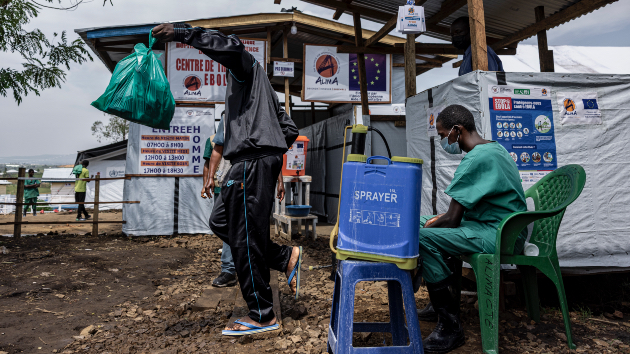
Ebola survivors leave the ALIMA Ebola Treatment Center at Rwampara General Hospital following their recovery from the disease, as a health worker sits beside a disinfectant sprayer and disinfects their shoes during discharge procedures on June 16, 2026 in Rwampara near Bunia, Democratic Republic of Congo. (Michel Lunanga/Getty Images)

(NEW YORK) — The Democratic Republic of Congo (DRC) has surpassed 1,000 Ebola cases as the country’s deadly outbreak continues.

The DRC Ministry of Health reported 1,003 confirmed cases and 254 confirmed deaths as of Sunday evening. There are 365 patients either hospitalized or in isolation, according to the ministry.

Contact tracing remains a concern, officials said. The Ministry of Health said only 58% of identified contacts have been followed up with, far below the desired 90% to 95% target needed to contain the outbreak, according to the World Health Organization (WHO).

Bonheur Baeni, project manager for the Ebola emergency for the humanitarian NGO CARE, told ABC News that there has been a great amount of misinformation in affected communities that has made it difficult to contain the virus.

“It is in fact among the great challenges, the misinformation that is characterized by rumors, rumors that circulate on social networks, rumors that also circulate mouth-to-mouth,” he told ABC News in French. “It really makes the population resistant.”

Baeni said the group is working with the Ministry of Health and other partners to engage with the community and answer questions that people have. They are also working with trusted leaders within the community to help combat the misinformation.

“You see that it creates a climate of trust,” Baeni said. “It creates a confidence climate because it’s their brother, it’s a member of the community.”

The Ministry of Health wrote on X that “response teams continue active investigations, epidemiological surveillance, and prevention actions in affected areas.”

Health officials added that eight more people have recovered from Ebola, bringing the total number of recoveries to 100.

Meanwhile, UNICEF warned on Monday that an estimated 2.95 million children and adolescents aged 18 and under — representing 54% of the population in 31 affected health zones — are at risk from Ebola and the breakdown of essential services in the eastern DRC.

“Our teams in Ituri [province] have met children who have lost their mothers, and in some cases both parents, to Ebola,” Catherine Russell, UNICEF executive director, said in a statement. “Children are trying to make sense of the threat while surrounded by rumors and online misinformation.”

UNICEF said children and adolescents make up about 15% of confirmed Ebola cases and more than 25% of confirmed deaths in the eastern DRC as of June 19, and that children and adolescents with confirmed Ebola are almost twice as likely to die as adults

In Ituri province, which is the epicenter of the outbreak, dozens of children have been orphaned, according to UNICEF. The agency said that 135 of those children are receiving support, including psychosocial care.

In neighboring Uganda, there are at least 20 confirmed cases, in large part linked to cross-border transmission from the DRC, and two deaths, according to UNICEF. The agency said children have also been affected in Uganda, with at least one child who has tested positive and 19 children under quarantine monitoring.

“Children are especially vulnerable because they depend on caregivers and cannot distance themselves from a sick parent or sibling in the same way that an adult can,” Russell said. “To better protect children, we need sustained access, and the resources needed to reach every affected community.”

ABC News’ Dada Jovanovic and Zoe Magee contributed to this report.

Copyright © 2026, ABC Audio. All rights reserved.

WHO says risk of Ebola in World Cup host countries is low

Workers wearing protective visit a patient in an isolation unit an Ebola treatment center on June 2, 2026 in Monigi, Democratic Republic of Congo. (Daniel Buuma/Getty Images)(GENEVA) -- The World Health Organization said on Thursday that the risk of Ebola transmission in Europe and World Cup host countries is low as the tournament gets ready to kick off across the U.S., Canada and Mexico.Dr Hans Henri P. Kluge, WHO's regional director for Europe, said in a statement that there are currently no Ebola cases in North America or Europe amid an outbreak spreading in the Democratic Republic of Congo.The DRC has recorded 676 confirmed cases as of Thursday morning, according to DRC's minister of health. In Uganda, there are 19 confirmed cases -- many of them travel-related -- and two deaths, the country's health officials said.Kluge made reference to an Ebola patient who was treated in the European Region after being evacuated from the outbreak region.An American physician, Dr. Peter Stafford, tested positive for Ebola after being exposed while treating patients at Nyankunde Hospital. Stafford, a medical missionary with the mission organization Serge, was transferred to Germany and treated at Berlin's Charite University Hospital.His wife, Dr. Rebekah Stafford, and their four children were also transferred to the same hospital, where they were monitored in quarantine for 21 days as high-risk contacts.Last week, the family was released from the hospital after Dr. Peter Stafford had no symptoms for more than 72 hours and a negative result in repeated PCR tests, Serge said."There is no reason to change your plans. Travel as normal, stay informed and enjoy the tournament," Kluge said.Kluge said there are several reasons why the risk is low in other countries: most cases are in remote areas of the DRC, Ebola is not an airborne illness and it is spread through direct contact with the bodily fluids of a sick person.Additionally, screening is in place before travel is allowed from affected regions and people are only infectious once visibly ill, according to Kluge.The CDC has temporarily restricted entry to the U.S. for certain travelers who were recently in the DRC, Uganda or South Sudan. Currently, U.S. citizens and nationals may still enter but will undergo enhanced public health screenings.Kludge said the WHO does not recommend travel restrictions, "though if you don't have to travel to the affected areas in the Democratic Republic of the Congo or Uganda, it is safer not to."He added that it's important to challenge the stigma associated with Ebola patients and those from affected regions or African communities."The spread of Ebola is not determined by nationality or ethnicity," he said. "Stigma discourages people from seeking care and can make outbreaks harder to control. Stay informed, rely on trusted sources and treat others with understanding. With common sense and compassion, we can keep both people and the game safe."Copyright © 2026, ABC Audio. All rights reserved.
Read Next Story