
DRC reports record number of Ebola cases in a single day as outbreak hits 1-month mark

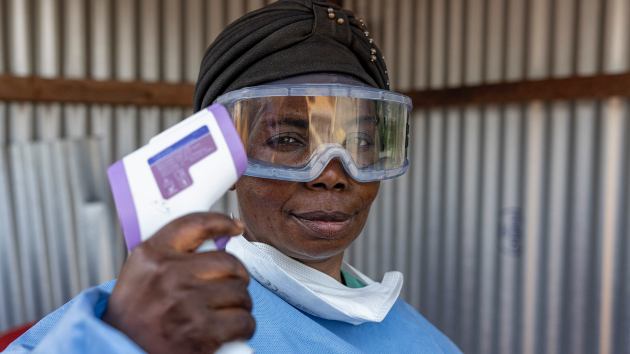
Viviane Nzale, a health worker responsible for triage, stands at a screening post at the entrance of Mongbwalu General Hospital while monitoring patients and visitors entering the facility as they respond to the continuing Ebola outbreak here on June 12, 2026 in Mongbwalu, Democratic Republic of Congo. (Michel Lunanga/Getty Images)

(NEW YORK) — Health officials in the Democratic Republic of Congo (DRC) have reported a record one-day increase in Ebola cases since the current outbreak was first detected one month ago.

The DRC Ministry of Health reported 72 new confirmed Ebola cases on June 13, bringing the total number of cases to 782. Additionally, 29 deaths were recorded, bringing to 181 the number of fatalities that have occurred in the last month.

The majority of cases are still concentrated in three provinces in the northeast part of the country: Ituri, North Kivu and South Kivu. Two new health zones, Nia-Nia in Ituri and Mabalako in North Kivu, reported cases for the first time, increasing the number of affected health zones to 31, according to the Ministry of Health.

Contact tracing remains a concern. Health officials said only 56.5% of identified contacts have been followed up on, far below the desired 90%-95% target needed to contain the outbreak, according to the World Health Organization (WHO).

DRC health officials say they’re still experiencing community hesitance as well as shortages of essential medicines and infection-control supplies.

Meanwhile, Uganda has reported 19 confirmed cases, in large part linked to cross-border transmission from the DRC, and two deaths, according to the World Health Organization.

Last week, United Nations agencies warned that children in the eastern DRC could become increasingly affected by the Ebola outbreak. The U.N. said it may be difficult to accurately track the number of children who may be affected by the outbreak due to inefficient surveillance.

Although most infections have been among adults, “as the outbreak evolves, we must be prepared for increasing household transmission which means we may see more children affected in the days ahead,” Dr. Douglas Noble, UNICEF global lead for public health emergencies and global incident manager for Ebola, said on Friday.

“These are already very vulnerable children, so the capacity for this community to absorb any additional stressors was already stretched to breaking point,” he said.

In past Ebola outbreaks in the DRC, children “made up a significant share of cases and an even greater share of deaths, with the youngest facing the highest fatality rates and many left orphaned or separated from caregivers,” Noble said.

Meanwhile, the U.S. State Department recently announced plans to provide $50 million to the Coalition for Epidemic Preparedness Innovations (CEPI), which describes itself as “a global partnership working to accelerate the development of vaccines and other biologic countermeasures against epidemic and pandemic threats,” to help develop vaccines and treatments against the Bundibugyo strain of Ebola that’s driving the current outbreak.

The State Department further said it has committed more than $270 million directly to the Ebola response, with U.S.-funded partners screening more than 6,300 people in Ituri, supporting 100 health facilities and carrying out 200 safe burials.

Copyright © 2026, ABC Audio. All rights reserved.

WHO says risk of Ebola in World Cup host countries is low

Workers wearing protective visit a patient in an isolation unit an Ebola treatment center on June 2, 2026 in Monigi, Democratic Republic of Congo. (Daniel Buuma/Getty Images)(GENEVA) -- The World Health Organization said on Thursday that the risk of Ebola transmission in Europe and World Cup host countries is low as the tournament gets ready to kick off across the U.S., Canada and Mexico.Dr Hans Henri P. Kluge, WHO's regional director for Europe, said in a statement that there are currently no Ebola cases in North America or Europe amid an outbreak spreading in the Democratic Republic of Congo.The DRC has recorded 676 confirmed cases as of Thursday morning, according to DRC's minister of health. In Uganda, there are 19 confirmed cases -- many of them travel-related -- and two deaths, the country's health officials said.Kluge made reference to an Ebola patient who was treated in the European Region after being evacuated from the outbreak region.An American physician, Dr. Peter Stafford, tested positive for Ebola after being exposed while treating patients at Nyankunde Hospital. Stafford, a medical missionary with the mission organization Serge, was transferred to Germany and treated at Berlin's Charite University Hospital.His wife, Dr. Rebekah Stafford, and their four children were also transferred to the same hospital, where they were monitored in quarantine for 21 days as high-risk contacts.Last week, the family was released from the hospital after Dr. Peter Stafford had no symptoms for more than 72 hours and a negative result in repeated PCR tests, Serge said."There is no reason to change your plans. Travel as normal, stay informed and enjoy the tournament," Kluge said.Kluge said there are several reasons why the risk is low in other countries: most cases are in remote areas of the DRC, Ebola is not an airborne illness and it is spread through direct contact with the bodily fluids of a sick person.Additionally, screening is in place before travel is allowed from affected regions and people are only infectious once visibly ill, according to Kluge.The CDC has temporarily restricted entry to the U.S. for certain travelers who were recently in the DRC, Uganda or South Sudan. Currently, U.S. citizens and nationals may still enter but will undergo enhanced public health screenings.Kludge said the WHO does not recommend travel restrictions, "though if you don't have to travel to the affected areas in the Democratic Republic of the Congo or Uganda, it is safer not to."He added that it's important to challenge the stigma associated with Ebola patients and those from affected regions or African communities."The spread of Ebola is not determined by nationality or ethnicity," he said. "Stigma discourages people from seeking care and can make outbreaks harder to control. Stay informed, rely on trusted sources and treat others with understanding. With common sense and compassion, we can keep both people and the game safe."Copyright © 2026, ABC Audio. All rights reserved.
Read Next Story