
WHO says Ebola risks high for region, but not a ‘pandemic emergency’

▶ Watch Video: Details on Ebola outbreak as Americans urged to avoid travel to Congo, Uganda, South Sudan

Geneva — The World Health Organization on Wednesday said the risk of the Democratic Republic of Congo’s deadly Ebola outbreak was currently high at the national and regional levels but low worldwide.

WHO experts said that while investigations into its origins were ongoing, given the scale of the situation in the eastern DRC, the outbreak probably began a couple of months ago.

But the UN health agency’s emergency committee said it did not currently meet the pandemic emergency threshold.

“WHO assesses the risk of the epidemic as high at the national and regional levels, and low at the global level,” said the organization’s chief Tedros Adhanom Ghebreyesus.

So far, 51 cases have been confirmed in the DRC, in the eastern provinces of Ituri and North Kivu, “although we know the scale of the epidemic in DRC is much larger,” he told a press conference at the WHO’s headquarters in Geneva.
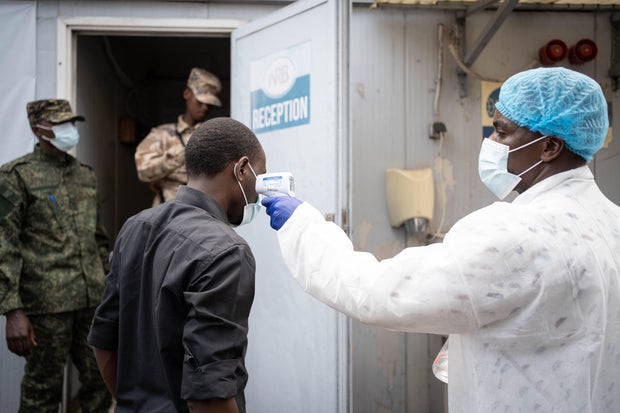
DR CONGO-GOMA-EBOLA OUTBREAK
A medical worker checks the temperature of a local resident as part of Ebola screening in Goma, Democratic Republic of the Congo, May 19, 2026.

Stringer/Xinhua/Getty

He said Uganda had also reported two confirmed cases in the capital Kampala, including one death, while a U.S. national working in the DRC has been confirmed positive and transferred to Germany. American doctor Peter Stafford, whose family lived with him in the DRC, was evacuated to Germany and was receiving treatment, the missionary group Serge said Tuesday.   

“There are several factors that warrant serious concern about the potential for further spread and further deaths,” said Tedros.

“Beyond the confirmed cases, there are almost 600 suspected cases and 139 suspected deaths,” he said. “We expect those numbers to keep increasing, given the amount of time the virus was circulating before the outbreak was detected.”

Ebola outbreak not “a pandemic emergency”

On Sunday, Tedros declared the situation a public health emergency of international concern — the second-highest level of alarm under the legally binding International Health Regulations (IHR) — triggering emergency responses in countries worldwide.

The WHO emergency committee convened to assess the outbreak met on Tuesday.

“The current situation and criteria for a public health emergency of international concern have been met, and we agree that the current situation does not satisfy the criteria for a pandemic emergency,” the committee’s chair, Lucille Blumberg, told reporters from South Africa.

Anais Legand, WHO technical officer on viral hemorrhagic fevers, said investigations were under way to pinpoint how long Ebola has been spreading in the eastern DRC.

“Given the scale, we are thinking that it has started probably a couple of months ago, but investigations are ongoing and our priority is really to cut the transmission chain by implementing contact tracing, isolating and caring for all suspect and confirmed cases,” she said.

WHO responds to U.S. criticism

U.S. Secretary of State Marco Rubio on Tuesday said the WHO was “a little late” in identifying a deadly outbreak.

President Trump, in one of his first acts on returning to office last year, set in motion a U.S. withdrawal from the WHO, which he attacked bitterly over its response to the COVID-19 pandemic. Numerous public health officials and experts warned at the time that, as one of the world’s largest funders of global health through both international and national agencies, including the WHO, America’s step back from such programs could impact efforts to provide lifesaving healthcare and combat deadly outbreaks, especially in lower-income countries.

Asked about Rubio’s criticism, Tedros said that “maybe what the secretary said … could be from lack of understanding of how IHR work, and the responsibilities of WHO and other entities,” he said, explaining that the agency acted in support of countries rather than replacing them in outbreak responses.

What a new Justice Department filing says about the ‘botched’ Reflecting Pool renovation

(CNN) — The Justice Department on Friday said the rush to complete President Donald Trump’s renovation of the Lincoln Memorial Reflecting Pool led to “hasty and botched work,” shedding new light on the problems behind the Washington landmark’s $14 million facelift.In delivering a sharp contradiction to weeks of claims from Trump and Interior Secretary Doug Burgum that vandals destroyed the Reflecting Pool, DC US Attorney Jeanine Pirro attributed the bungled installation to bad weather, testing failures and shipment setbacks.Trump and Burgum, meanwhile, continue to blame alleged vandals for the deteriorating pool lining, algae blooms and green water that appeared after the renovation.“I disagree 100% with Jeanine Pirro, the U.S. Attorney for the District of Columbia, on the Reflecting Pool. I don’t know what she was thinking? To me, it was a pure case of VANDALISM,” Trump wrote Saturday on Truth Social. Burgum also dismissed the findings in a social media post, saying that “The evidence is clear, vandals have repeatedly caused damage to the Reflecting Pool.”The new details come from the DOJ’s Friday filing announcing it was dropping the case against former Olympian David Hearn, who was accused of vandalizing the landmark.Here’s what we know about what went wrong with the Reflecting Pool:Renovation on an expedited timelineTrump set out in late March to renovate the Reflecting Pool, which he described as “absolutely filthy” and vowed to make it “look gorgeous.”In the weeks that followed, Trump expanded the scope of the project and ordered cosmetic changes, including painting the bottom of the pool “American flag blue.” The paint change immediately sparked a lawsuit from a nonprofit group, which argued the project violated federal laws requiring the Interior Department to complete a consultation process before beginning the work.The president also wanted the project to be complete before America’s 250th birthday on July Fourth, an expedited timeline that the administration acknowledged drove up the cost — nearly seven times as much as the initial estimate of $1.8 million.Installation for the Reflecting Pool lining began on May 5 by Virginia-based firm Atlantic Industrial Coatings, the sole contractor for the extensive project, according to the Justice Department filing.The firm used two coating products — Rhino 406 and Pipeliner 5000 — in the renovation of the nearly 340,000-square-foot pool (that’s about the size of about six football fields).Construction was significantly stalled due to spring showers, which hindered the expedited installation process the Trump administration had hoped for, at one point requiring crews to pump out the rain water to allow the coating to dry, according to the filing.Crews continued to spray coats of the lining material, but the delays, largely due to weather, caught the attention of an employee with Brown Construction Services, a contractor charged with monitoring Atlantic Industrial Coatings’ progress. “It appears AIC is significantly behind schedule,” the employee wrote on May 7.Delays ballooned when AIC ran out of Rhino 406, one of the primary coatings, and a quality control inspector flagged “blistering” in the finished portions of the lining and called for repairs.Algae blooms and lining peelsOn June 9, crews completed a final inspection of the site and refilled the pool. One day after it was filled, CNN first observed the presence of algae — in some areas. It could be seen from the water’s edge on the bottom of the pool. A worker who was vacuuming in the water told CNN the substance was algae.At the onset of the project, the administration dispatched a company to use a $1.7 million “ozone nanobubbler” to clear the algae, bacteria and other chemicals. The company, Greenwater Services, previously walked CNN through a timeline of its work, revealing some accommodations were needed to meet the president’s July Fourth deadline.By June 11, a National Park Service engineer’s attention was drawn to peeling of the Reflecting Pool lining. “Only the top layer of liner has peeled. This is very thin and will not impact the strength of the liner,” the employee wrote in an email to NPS and Interior Department personnel, according to the court documents.The Park Service engineer said the contractor attributed the peeled area as an “overspray” from spraying the perimeter joint with polyurea — a type of elastic coating. The employee flagged his concern that the “overspray” could lead to a 1-to-2-foot strip that is “vulnerable to peeling,” but said the contractor would not confirm whether this was a risk. The area along the perimeter is where Hearn, the former Olympian, was accused of peeling just eight days after the email.Claims of vandalismAs media reports swirled about peeling liner at the Reflecting Pool, Trump first claimed that the pool’s broader problems were a result of vandalism.“We’ve had some real problems with Vandalism at the beautiful Reflecting Pool,” Trump wrote on Truth Social, without citing evidence. He said the algae was “75% gone” and that the “vandalized” area would be fixed in late June.On June 20, Trump said he met with contractors and vowed to repair the damage as quickly as possible, saying vandals used a blade to cut a “250 foot long gash” and poured “corrosive and destructive chemicals” into the pool.Following July Fourth celebrations, the pool was drained again for repairs. The contractor charged with monitoring AIC’s progress inspected the Reflecting Pool and attributed the peeling to overspraying and the coatings’ inability to bond to the surface, according to the DOJ’s filing. Even AIC said that “99% of anything that was going to fail” would show up within a couple of weeks of finishing the renovation.Trump doubled down on claims in July, complaining about news reports on the pool and insisting the lining “was slashed with a knife, or a box cutter” and that even the algae blooms were “caused by vandals.”Burgum, in a July 5 interview on CNN’s “State of the Union,” said the government could “absolutely” prove the damage was caused by vandals, and that there were photographs supporting the claim. But he dodged a question about whether those photographs showed anyone damaging the pool.Pirro and her prosecutors say they weren’t able to fully view the extent of the damage until July 17, after the pool was drained and a defense expert inspected the site.That very day, Trump railed against the alleged vandals on Truth Social, calling them animals. “The Reflecting Pool, so badly damaged by Deranged Vandals, has been emptied as the massive slash gets repaired,” Trump said, adding, “The Scum in Court will hopefully be prosecuted to the MAX.”After requesting more documents on the pool’s renovation, Pirro’s office said that information “indicated a rushed and flawed installation process, with repeated failures of the lining during the installation process, and extensive peeling of the lining throughout the Reflecting Pool.”Nearly three months from the outset of construction, Trump said Monday the Reflecting Pool is “almost ready to open” once again.The-CNN-Wire™ & © 2026 Cable News Network, Inc., a Warner Bros. Discovery Company. All rights reserved.
Read Next Story