
Geneva — The World Health Organization on Wednesday said the risk of the Democratic Republic of Congo’s deadly Ebola outbreak was currently high at the national and regional levels but low worldwide.
WHO experts said that while investigations into its origins were ongoing, given the scale of the situation in the eastern DRC, the outbreak probably began a couple of months ago.
But the UN health agency’s emergency committee said it did not currently meet the pandemic emergency threshold.
“WHO assesses the risk of the epidemic as high at the national and regional levels, and low at the global level,” said the organization’s chief Tedros Adhanom Ghebreyesus.
So far, 51 cases have been confirmed in the DRC, in the eastern provinces of Ituri and North Kivu, “although we know the scale of the epidemic in DRC is much larger,” he told a press conference at the WHO’s headquarters in Geneva.
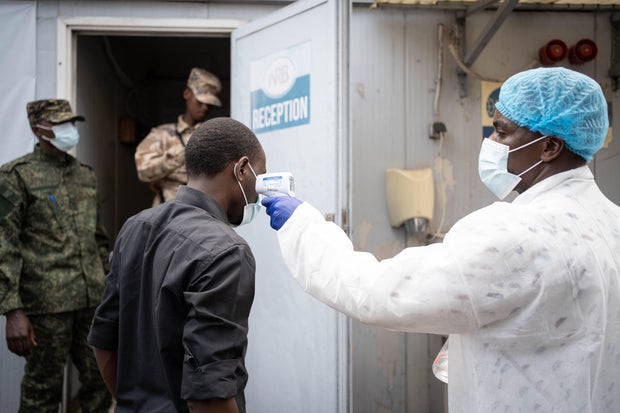
Stringer/Xinhua/Getty
He said Uganda had also reported two confirmed cases in the capital Kampala, including one death, while a U.S. national working in the DRC has been confirmed positive and transferred to Germany. American doctor Peter Stafford, whose family lived with him in the DRC, was evacuated to Germany and was receiving treatment, the missionary group Serge said Tuesday.
“There are several factors that warrant serious concern about the potential for further spread and further deaths,” said Tedros.
“Beyond the confirmed cases, there are almost 600 suspected cases and 139 suspected deaths,” he said. “We expect those numbers to keep increasing, given the amount of time the virus was circulating before the outbreak was detected.”
Ebola outbreak not “a pandemic emergency”
On Sunday, Tedros declared the situation a public health emergency of international concern — the second-highest level of alarm under the legally binding International Health Regulations (IHR) — triggering emergency responses in countries worldwide.
The WHO emergency committee convened to assess the outbreak met on Tuesday.
“The current situation and criteria for a public health emergency of international concern have been met, and we agree that the current situation does not satisfy the criteria for a pandemic emergency,” the committee’s chair, Lucille Blumberg, told reporters from South Africa.
Anais Legand, WHO technical officer on viral hemorrhagic fevers, said investigations were under way to pinpoint how long Ebola has been spreading in the eastern DRC.
“Given the scale, we are thinking that it has started probably a couple of months ago, but investigations are ongoing and our priority is really to cut the transmission chain by implementing contact tracing, isolating and caring for all suspect and confirmed cases,” she said.
WHO responds to U.S. criticism
U.S. Secretary of State Marco Rubio on Tuesday said the WHO was “a little late” in identifying a deadly outbreak.
President Trump, in one of his first acts on returning to office last year, set in motion a U.S. withdrawal from the WHO, which he attacked bitterly over its response to the COVID-19 pandemic. Numerous public health officials and experts warned at the time that, as one of the world’s largest funders of global health through both international and national agencies, including the WHO, America’s step back from such programs could impact efforts to provide lifesaving healthcare and combat deadly outbreaks, especially in lower-income countries.
Asked about Rubio’s criticism, Tedros said that “maybe what the secretary said … could be from lack of understanding of how IHR work, and the responsibilities of WHO and other entities,” he said, explaining that the agency acted in support of countries rather than replacing them in outbreak responses.