WHO director arrives in Canary Islands to oversee hantavirus cruise evacuation

▶ Watch Video: Hantavirus cruise passengers to be evacuated to home countries, including Americans

World Health Organization Director-General Dr. Tedros Adhanom Ghebreyesus arrived in Tenerife Saturday to personally oversee the painstaking process of evacuating more than 100 people from a cruise ship dealing with an outbreak of the rare and deadly hantavirus.

Addressing the people of the Canary Islands, where the ship will anchor off the coast of its largest island, the WHO chief said the public’s concern is legitimate after what the world experienced in 2020 during the global coronavirus pandemic.

“This disease is not COVID,” Tedros said, reiterating a letter he wrote earlier Saturday. “The risk to the local population is low.”

Tedros said that the nature of the hantavirus is not the same as the coronavirus, but “that trauma is still in our minds.”

“That’s why also I came here,” he said. “To be on the side of the people because saying things from far could be easy. But I had to change my plans to come here because this is very, very important to the whole world and to the people of Tenerife as well.”

The Dutch-flagged MV Hondius cruise ship is expected to arrive at the island of Tenerife early Sunday, officials said.

Eight people on the ship had confirmed or suspected cases of the hantavirus and three people have died, the WHO said on Friday. None of the 147 people currently on board, including 60 crew members, are symptomatic, according to Oceanwide Expeditions, which owns the vessel.

Tedros estimated Saturday that there will be six evacuation flights headed for the EU and four for non-EU countries.

There are 17 Americans on the MV Hondius, according to Oceanwide Expeditions, who will be taken off the ship in a small boat, taken to shore and immediately to a plane on the runway waiting for them. The plane, provided by the U.S. government with oversight from the Centers for Disease Control and Prevention, will take the Americans to the National Quarantine Center at the University of Nebraska, Omaha, according to the CDC. 

“I’m sure they’re very anxious to get home, but (we need) to make sure they do that in the most safe way possible,” Maria van Kerkhove, WHO’s acting director of the Department of Epidemic and Pandemic Preparedness and Prevention, said at a press conference on Saturday.

Each country with passengers on board the ship will proceed with a similar evacuation to awaiting planes, according to the Spanish Health Ministry.

The WHO said it was recommending each country keep the passengers removed from the ship in isolation for 42 days from the last point of exposure to the virus.
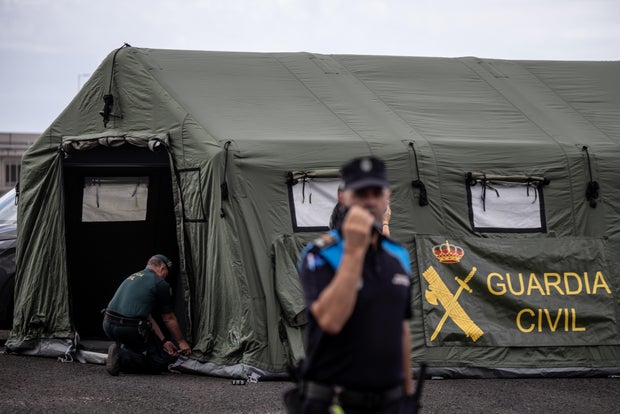
Cruise Ship MV Hondius To Dock In Tenerife
A member of the Guardia Civil finishes erecting a tent at an expected reception point for passengers from the MV Hondius on May 9, 2026, in Tenerife, part of the Canary Islands, Spain.

Chris McGrath / Getty Images

The disease is usually acquired through close contact with rodents, and is not transmissible from person to person. However, testing of those who were sickened on the Hondius has confirmed they have the Andes strain of the virus, the only variation that can be transmitted through close contact with a sick individual. 

However, health experts say the chances of widespread transmission are very small.

“I know that when you hear the word ‘outbreak’ and watch a ship sail toward your shores, memories surface that none of us have fully put to rest,” Tedros said in the letter addressed to the people of the Canary Islands earlier Saturday. “The pain of 2020 is still real, and I do not dismiss it for a single moment. But I need you to hear me clearly: this is not another COVID.” 

“The current public health risk from hantavirus remains low,” he continued. “My colleagues and I have said this unequivocally, and I will say it again to you now.”

The ship left Argentina on April 1 for a cruise stopping at several remote islands in the south Atlantic, including Tristan da Cunha and Saint Helena, both British territories.

The outbreak on the ship appears to have started with a Dutch couple who traveled around South America, the only place the Andes strain exists, in the months leading up to the cruise. The couple spent time bird-watching in areas where rodents are known to have tested positive for hantavirus, according to Oceanwide Expeditions.

The husband died on the ship April 11, while his wife was one of 32 people who disembarked the ship in Saint Helena, according to Oceanwide Expeditions. She would fly to South Africa and then die days later when she was removed from a KLM Airlines plane because she was too sick to fly, according to the airline.

Dozens of people on the plane or who disembarked at Saint Helena are already under observation around the world, including in the U.S. None of the people in the U.S. — in Texas, Virginia, Georgia, Arizona, New Jersey and California — are experiencing any symptoms of the virus, the state’s respective health departments have confirmed to CBS News.


‘They don’t trust him anymore’: How VA Secretary Doug Collins drew the ire of the White House and Republicans

(CNN) — A month after House Republicans failed to pass a veterans health bill, lawmakers are meeting behind closed doors to try to get the legislation back on track. But there’s one key person they haven’t invited to the table: Veterans Affairs Secretary Doug Collins.Collins and his team at the VA have been excluded from recent meetings on Capitol Hill because some senior congressional Republicans and Trump officials blamed him when the planned House vote was abruptly abandoned in July, according to multiple sources who were involved in crafting the legislation.“His relationship with the Hill directly is garbage at this point,” said one person familiar with the dynamics surrounding Collins.“They don’t trust him anymore,” another source familiar with the situation said.The episode underscores how Collins’ standing in the administration has steadily deteriorated over the past several months. A longtime ally of President Donald Trump who previously served in the House before joining Trump’s Cabinet, Collins has confounded those around him with his lackluster engagement on issues like the veterans health bill, spurring widespread speculation over how much longer he’ll remain in the job.Trump is unlikely to fire Collins, at least for now, amid efforts in the White House to minimize upheaval ahead of November’s midterm elections. But Trump officials have increasingly scrutinized Collins’ performance, including tracking his travel and examining the extent of his involvement in key departmental priorities, said the person familiar with the dynamics. Collins’ receding role has prompted speculation he may soon leave the administration of his own accord, the person added.Resurrecting the legislation, called the “Take Care of America’s Veterans Act,” is also considered key to the midterms. The bill would expand benefits for tens of thousands of veterans – a key constituency for many Republicans in Congress – and passage would be viewed as an important legislative win ahead of the November vote.The VA, in an email to CNN, denied that Collins worked against the bill’s passage. VA press secretary Quinn Slaven said: “The Trump administration, Secretary Collins and VA broadly support this bill, and while we believe it could benefit from some amendments, it contains many priorities of the administration.”Slaven added: “Under the leadership of President Trump, Secretary Collins is proud to work every day to make VA benefits better, faster and easier to use than ever before.”The White House did not address Collins’ role in GOP efforts to advance the veterans health bill.In a statement, spokeswoman Olivia Wales said that the VA secretary “is doing a great job and works tirelessly to deliver for our heroic veterans.” Another White House official downplayed the focus on Collins’ travel, contending that Cabinet officials are encouraged to be on the road to “highlight the administration’s accomplishments.”The White House also forwarded a statement of support from GOP Rep. Jack Bergman, who sits on the House Veterans Affairs Committee and insisted that Collins “has been great to work with” and has “taken action when we bring him difficult issues involving Veterans.”The veterans health bill would cut billions of dollars in future disability benefits to some veterans suffering from tinnitus and sleep apnea. The money saved from those cuts would pay for another measure that would allow veterans to receive both their retirement benefits and combat injury-related benefits. Veterans are currently allowed to receive one, but not both, of those benefits.The bill is also aimed at improving access to private sector care, working to cut down wait times for care and providing benefits for the spouses of deceased veterans, even if they re-marry.Democrats oppose the bill, along with some veterans service organizations including the Veterans of Foreign Wars, Disabled American Veterans, and Iraq and Afghanistan Veterans of America, saying they disagree with the idea of taking away some veterans’ benefits to pay for other benefits.Other veterans’ advocacy groups like The American Legion and Concerned Veterans for America are in favor of the bill, pointing to all the ways they say it would expand benefits for many of the roughly 9 million veterans enrolled with the VA as well as their families.Confusion over CollinsThe House adjourned for summer recess not long after the legislation was pulled from the House floor ahead of a scheduled vote. But sources say House Republicans are continuing discussions about the bill – without input from Collins.The VA secretary had initially indicated to Republican congressional leadership that he supported the measure, but then started to subtly work against it, according to two sources familiar with the interactions.They said he would signal to some lawmakers he wasn’t entirely behind the bill, telling some GOP members he shared their concerns about the legislation. The tension between Collins and the White House and congressional Republicans was first reported by Politico.Some of what the legislation aims to accomplish had been proposed during the Biden administration, through the rulemaking process. But a VA press secretary told the website Government Executive in June that that proposal “would need to undergo significant changes” – further baffling Hill staffers about where Collins stood on the issue.Confusion over Collins’ stance continued into mid-July, sources say, at which point too many House Republicans started to waver in their support. When the bill was pulled, White House officials and Republican House members and staffers grew angry with Collins, the sources said.“I’ve never seen them so mad,” one source said of some House Republicans. “Their anger was off the charts.”Sources say senior Republicans complained to the White House about how Collins and Don Bergin, the VA’s assistant secretary for congressional and legislative affairs, dealt with the bill – and that those Republicans do not view Collins and Bergin as honest brokers moving forward.After Collins’ handling of the legislation that the president and administration have prioritized, one of the sources said: “They can’t decipher or figure out what’s going on in his mind.”In the midst of the fallout, Collins praised Trump on Fox Business. “He is providing the leadership over the country to say ‘Hey we want to put America first. We want to put our veterans first,’” Collins said.The-CNN-Wire™ & © 2026 Cable News Network, Inc., a Warner Bros. Discovery Company. All rights reserved.
Read Next Story