
(NEW YORK) — A global pandemic that put millions of Americans out of work within days. The highest inflation in four decades. An unprecedented federal criminal investigation.
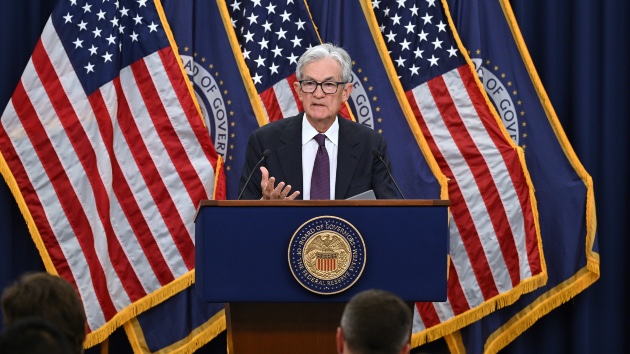
Fed Chair Jerome Powell faced a succession of crises over his 8-year tenure atop the central bank, which ends on Friday. Powell’s decisions along the way held stakes as concrete as the budgets of everyday Americans and as heady as the political independence of a pillar institution.
President Donald Trump’s Fed Chair nominee Kevin Warsh is set to take the helm, inheriting a resilient economy by some measures, though one suffering from a renewed bout of inflation.
Powell said last month that he would take the unusual step of staying on at the central bank’s 12-person board of governors after his term expires. The move grants Powell a role in interest-rate policy that could last until 2028, though he says he will step down once a Fed inspector general’s investigation into a renovation of the central bank headquarters is closed.
The transition offers an opportunity to look back at Powell’s tenure, which spanned two presidents, three Treasury secretaries and 66 interest-rate decisions.
“You don’t choose your challenges, but you do choose how you respond,” Claudia Sahm, chief economist at New Century Advisors and a former Fed official, told ABC News. “In the end, Powell’s legacy will be judged by those outcomes.”
When Trump nominated Powell to become Fed chair, Trump described him as a “consensus builder” who “understands what it takes for our economy to grow.”
Powell, a former investment banker and Treasury official under President George H.W. Bush, assumed the role in 2018. At the time, the economy was humming, the unemployment rate clocked in at a historically low level and inflation stood just a tick above the Fed’s target rate of 2%.
Powell hiked interest rates four times in his first year, putting strain on the stock market but leaving the Fed in position to stimulate the economy with rate cuts in the event of a slowdown. Policymakers wouldn’t have to wait long.
In the early months of 2020, the COVID-19 pandemic put tens of millions of Americans into lockdown, halting business across industries like restaurants and hospitality, while putting a large swathe of the labor force out of work.
At an emergency meeting in March 2020, Powell slashed interest rates to near-zero levels in an effort to stimulate a battered economy.
“Families, businesses, schools, organizations, and governments at all levels are taking steps to protect people’s health. These measures, which are essential for containing the outbreak, will nonetheless understandably take a toll on economic activity in the near term,” Powell told reporters at the time.
The unemployment rate soared from 4.4% in March to 14.7% in April, U.S. Bureau of Labor Statistics data showed.
To supercharge the recovery, Trump and President Joe Biden enacted economic stimulus meant to support people who’d lost their jobs or faced other hardship. Alongside low interest rates, that spending helped bring about a speedy economic recovery from the downturn.
The COVID-19 recession lasted only two months, making it the shortest in U.S. history, according to the National Bureau of Economic Research.
The speedy recovery vindicated the Fed’s decision to slash interest rates, though it hadn’t been a particularly difficult choice, Alan Blinder, a professor of economics at Princeton University and former vice chairman of the Federal Reserve, told ABC News.
“The dropping of rates to the floor was both necessary and appropriate, and in a real sense, obvious,” Blinder said.
A bout of acute inflation soon took hold, however, emerging as a result of a supply shortage imposed by the COVID-19 pandemic and exacerbated by the Russia-Ukraine war. Powell initially downplayed the price increases, describing them as “transitory.” It proved a consequential mistake — and Powell would later admit his error.
Annual inflation peaked at a 40-year high of 9.1% in June 2022. By then, Powell had begun to ratchet up interest rates and it would continue over the following year. The aggressive series of rate hikes put the central bank’s benchmark rate at its highest level since 2001. The move sent mortgage and credit card rates soaring.
By June 2023, annual inflation had plummeted to 3%, but Americans remained widely dissatisfied with price increases long afterward. Many economists forecast a recession and the type of job losses it typically entails. Fortunately, the downturn never came to pass.
“Inflation stayed high for too long but once it came down, it came down really fast. It came down without creating unnecessary pain in the labor market,” Wendy Edelberg, director of the Hamilton Project and senior fellow in economic studies at the Brookings Institution, told ABC News.
In September 2024, less than two months before the presidential election, the Fed cut interest rates by 0.5%. The decision drew criticism from allies of Trump, who considered the move a potential boost for the economy that would benefit incumbent Democrats. Trump went on to win the election.
Within weeks of his return to the White House, in early 2025, Trump voiced public criticism of Powell, urging him to cut interest rates. The attacks intensified criticism of Powell that had begun in Trump’s first term.
Over the ensuing months, Trump began to slam Powell for cost overruns in a renovation project at the Fed’s headquarters in Washington, D.C. Last July, Trump made the first official trip to the Fed by a sitting president in almost 20 years, donning a hard hat as he toured the renovation with Powell.
The Fed attributed spending overruns to unforeseen cost increases, saying that its building renovation would ultimately “reduce costs over time by allowing the Board to consolidate most of its operations,” according to the central bank’s website.
By January, the Department of Justice had opened a criminal investigation into Powell, ratcheting up an extraordinary clash between the White House and the Fed. It was the first criminal probe of a Fed chair in the 113-year history of the central bank.
The probe centered on Powell’s testimony to Congress last year about the cost overruns. Powell issued a rare video message rebuking the investigation as a politically motivated effort to influence the Fed’s interest rate policy.
“No one — certainly not the chair of the Federal Reserve — is above the law,” Powell said. “But this unprecedented action should be seen in the broader context of the administration’s threats and ongoing pressure.”
Trump previously denied any involvement in the criminal investigation. The DOJ moved to drop its criminal probe into Powell last month. Washington U.S. Attorney Jeaninne Pirro said the investigation into the office renovation would be taken up by the Fed’s inspector general.
“The attack on the Fed chair was appalling,” Rebel Cole, a professor of finance at Florida Atlantic University who formerly worked at the Federal Reserve, told ABC News. “Powell stood up to it.”
Warsh, a former Fed official, will serve a 4-year term as chair. He is set to lead the Fed in a challenging period for central bank policymakers.
Inflation rose for a second consecutive month as the U.S.-Israeli war with Iran continued to send gasoline prices surging in April, government data on Tuesday showed. Annual inflation jumped to its highest level in three years, according to the U.S. Bureau of Labor Statistics.
Despite the disruption, some measures of economic health have proven resilient.
The unemployment rate held steady at a historically low level of 4.3% in April, leaving it little changed from when Powell began his tenure in 2018.
“The economy is pretty good but far from perfect,” Blinder said, faulting Powell in part for elevated inflation, while attributing much of the blame to the Iran war. At the same time, Blinder praised Powell for his commitment to the independence of the Fed.
“That’s the legacy that Warsh is inheriting,” Blinder said.
Copyright © 2026, ABC Audio. All rights reserved.