
Pope Leo calls for ‘disarming’ of AI in technology-focused encyclical

▶ Watch Video: Pope Leo warns about dangers of AI

Rome — Pope Leo XIV issued a major document Monday focused largely on the implications of the rise of artificial intelligence for humanity, warning the technology could make civilization itself “less human.”

Pope Leo, who has repeatedly clashed with the Trump administration over the Iran war and some U.S. officials’ religious justification for it, also appeared to dismiss the argument that the conflict was a necessary preemptive measure for American safety.

“Today, more than ever, without prejudice to the right to self-defense in the strictest sense, it is important to reaffirm that the ‘just war’ theory, which has all too often been used to justify any kind of war, is now outdated,” he wrote in his Magnifica Humanitas (Magnificent Humanity), an 82-page teaching known as an encyclical.

Leo also issued a first-ever apology for the Vatican’s role in facilitating and justifying the transatlantic slave trade, calling it “a wound in Christian memory.”

“For this, in the name of the Church, I sincerely ask for pardon,” he wrote. 

But the vast majority of the encyclical was devoted to what Leo clearly sees as humanity’s risk-laden embrace of AI.

Pope Leo warns AI could make civilization “less human”

When the world’s first U.S.-born pope chose his name last year, Leo deliberately invoked the last pope to bear it: Pope Leo XIII, whose landmark 1891 encyclical Rerum Novarum helped guide the Catholic Church through the upheaval of the Industrial Revolution.

More than a century later, the Chicago native attempted something similarly ambitious for the AI Revolution.

In the Magnifica Humanitas, the leader of the world’s roughly 1.4 billion Catholics warned that artificial intelligence risked making civilization “less human,” hollowing out work, concentrating wealth and reducing people to systems driven by data and efficiency rather than dignity and morality.

“The pressing duty,” Leo wrote, is “to remain profoundly human.”
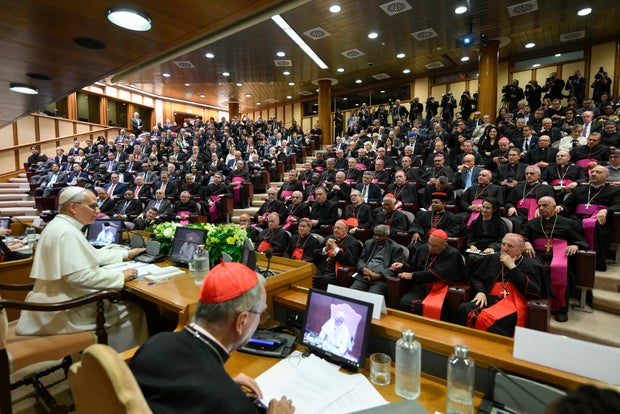
Presentation of Pope Leo XIV First Encyclical Letter 'Magnifica Humanitas'
Pope Leo XIV, flanked by Vatican Secretary of State cardinal Pietro Parolin, attends the presentation of his first Encyclical Letter “Magnifica Humanitas” at the Synod Hall on May 25, 2026 in Vatican City, Vatican.

Simone Risoluti/Vatican Media via Vatican Pool/Getty

Leo called for the “disarming” of AI, warning that the technology could fuel “a race for ever more powerful algorithms and larger datasets, driven by the desire to secure geopolitical or commercial dominance.” 

The document marks the first major papal encyclical written in the era of generative artificial intelligence, and it frames the current technological revolution not merely as an economic challenge, but as what the pope calls an “anthropological” one — a crisis touching the meaning and purpose of humanity.

“Please note that the encyclical is not about AI,” Cardinal Michael Czerny, one of the Vatican officials who helped present the document, told CBS News. “It’s about the human condition during the time of AI.”

In unusually direct language for a Vatican document, Leo — who holds a degree in mathematics — warned of the growing power of IT companies, with influence that can rival that of governments. 

At the same time, the pope stressed that technology itself is not inherently evil.  

“Artificial intelligence is a great human achievement,” Cardinal Czerny said. “We have a lot to admire and a lot to be thankful for … But we can’t renounce responsibility.”  

The Vatican’s concerns extend well beyond Silicon Valley. The encyclical repeatedly echoes broad societal concerns that AI could ⁠hollow out the middle class; ⁠eliminate vast numbers of jobs; ⁠deepen inequality; fuel social fragmentation; and normalize AI-driven warfare.

“There exists no algorithm capable of making war morally acceptable,” the encyclical states.

“Constraints that can sometimes conflict with doing the right thing”

That warning arrives as militaries around the world rapidly integrate AI into weapons systems. CBS News recently observed U.S. forces conducting exercises in Morocco and saw first-hand the growing use of AI-assisted targeting systems and autonomous technologies, including systems linked to Maven, the Pentagon’s AI platform.

One of the more striking aspects of the Vatican’s rollout of Leo’s encyclical was the inclusion of Christopher Olah, a co-founder of the AI company Anthropic, who was there in person alongside senior church officials on Monday.
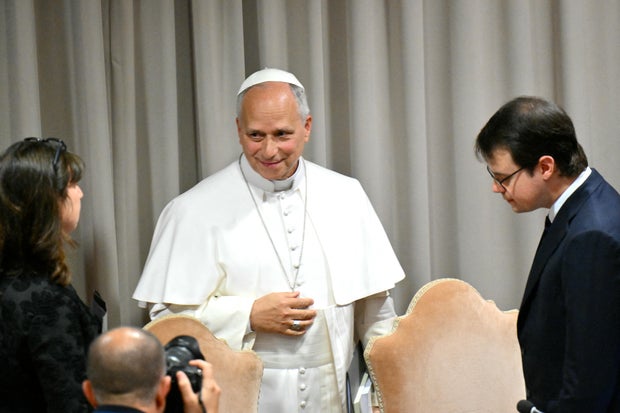
VATICAN-IA-ENCYCLICAL-MAGNIFICA HUMANITAS
Pope Leo XIV speaks with co-founder of U.S. artificial intelligence (AI) company Anthropic, Christopher Olah (right) and the Professor of Catholic Social Thought & Practice at the Durham University (left), Anna Rowlands, at the end of the presentation of the Encyclical Letter “Magnifica Humanitas,” focused on the rise of artificial intelligence, at the Vatican, May 25, 2026.

Alberto PIZZOLI/AFP/Getty

Olah said AI companies work “inside a set of incentives and constraints that can sometimes conflict with doing the right thing,” and he welcomed input from outside, including from the Catholic Church, to “push events in a better direction.”

“The questions raised by AI are bigger than the AI research community,” he said.

Leo said he had accepted an invitation from Olah, “to walk together, to listen and to speak and together to find the way for humanity,” and he was confident that, “together, we can discern the major questions of our time, and so, the future of humanity.” 

While Anthropic has often presented itself as a safety-conscious, “human-first” AI company, the Trump administration recently listed it as a supply-chain risk over its refusal to let the Pentagon use its technology in automated lethal systems or mass domestic surveillance. 

Its models remain integrated in military and intelligence applications, however, as CBS News has witnessed.

When asked whether Anthropic’s reputation as a human-centered AI company had influenced the Vatican’s decision to engage with it, Czerny replied: “I’m sure it did.”

He stressed, however, that dialogue with AI companies should not be mistaken for Vatican endorsement.

“We dialogue with anyone,” Czerny said. “We don’t endorse.”  

The encyclical repeatedly returns to the idea that the dangers posed by AI are not simply technological, but spiritual and existential paralysis.

“We’re overwhelmed,” the cardinal told CBS News. “We feel like we actually have nothing to say … and this paralyzes us.”  

Asked whether the pope worried that people were beginning to treat AI as a substitute for God, Czerny answered: “Yes … many things become substitutes for God and we call them idols.”

Just as the Industrial Revolution transformed labor and capital, the AI revolution is transforming humanity itself, the pope cautioned in his remarks.

Blanche fue confirmado como secretario de Justicia en un Departamento de Justicia configurado para servir a Trump

Todd Blanche, quien arriesgó su carrera como miembro prestigioso del sistema legal de Nueva York para evitar que Donald Trump fuera a la cárcel, fue confirmado el sábado como secretario de Justicia.Blanche, de 52 años, ejercerá de forma permanente como máximo responsable de la aplicación de la ley en el país, bajo el liderazgo de su antiguo cliente.Fue confirmado por una votación de 50 a 49, con las senadoras republicanas Susan Collins y Lisa Murkowski votando junto con los demócratas en contra de la nominación.Desde que Trump regresó al Despacho Oval, Blanche ha sido fundamental para remodelar el departamento a imagen y semejanza del presidente, pasando de ser el rostro de la defensa de Trump al rostro de su amplia campaña de represalias.Presentó argumentos legales que amplían los poderes y la protección en torno a la presidencia, supervisó los despidos masivos de fiscales experimentados y funcionarios de larga trayectoria, y encabezó una estrategia legal que ha llevado a jueces de todo el país a cuestionar las decisiones del departamento.Y en los pocos meses transcurridos desde su nombramiento como secretario de Justicia interino, el Departamento de Justicia ha presentado acusaciones contra figuras políticas, incluido el exdirector del FBI James Comey, ha emitido citaciones para identificar las fuentes de los periodistas, ha creado —y luego abandonado— el controvertido fondo contra la militarización de armas y ha aprobado un acuerdo de inmunidad fiscal entre el presidente y el Servicio de Impuestos Internos.Pero Blanche lleva mucho más tiempo al frente de las operaciones diarias del departamento, y su nombramiento formalizó lo que ya ocurría internamente desde hacía tiempo. CNN informó anteriormente que, incluso como secretario de Justicia adjunto, Blanche solía dirigir reuniones, incluidas aquellas que el secretario de Justicia debía supervisar.Ese papel central resultó especialmente trascendental en una de las sagas más turbulentas de la administración: las consecuencias del caso Epstein.En un momento dado, la exsecretaria de Justicia Pam Bondi fue apartada de los medios durante varias semanas por sus repetidos errores en sus apariciones televisivas sobre el caso Epstein. Blanche la sustituyó y, según Bondi, continuó gestionando la crisis por su cuenta.Fuentes consultadas por CNN han revelado que Blanche tendrá una estrategia similar una vez confirmado oficialmente: presentar casos que pongan de manifiesto lo que el presidente afirma que fueron casos de “instrumentalización” del Departamento de Justicia contra él, sus aliados y sus partidarios.También impulsará otras prioridades de la administración, como los casos de inmigración de línea dura y la lucha contra el fraude relacionado con los programas gubernamentales.Blanche trabajó durante años como fiscal federal antes de dedicarse al ejercicio privado de la abogacía hace aproximadamente una década. Cuando aceptó a Trump como cliente en 2023, renunció al prestigioso bufete neoyorquino Cadwalader, Wickersham & Taft, del que era socio.En aquel momento, Trump se enfrentaba a varios casos penales.La decisión de Blanche en abril de ese año de unirse al equipo legal de Trump sorprendió a quienes lo rodeaban, según varias personas cercanas. Estaba registrado para votar como demócrata y quienes lo conocen dicen que no hacía alarde de sus convicciones políticas. Conocido como un abogado trabajador que disfrutaba de su labor como fiscal, algunos de sus antiguos colegas se sorprendieron al verlo asumir ese rol y hacerse eco de la retórica de su cliente. Incluso esta misma semana, algunos antiguos colegas seguían desconcertados y tratando de analizar la transformación de Blanche.Pero la apuesta dio sus frutos con creces.Blanche se convirtió rápidamente en la abogada de confianza de Trump para gestionar tres acusaciones federales.Blanche fue uno de los pocos elegidos que acompañaron a Trump y lo asesoraron durante su juicio penal por soborno en Nueva York, cuando la libertad del presidente estaba en juego. Incorporó las quejas de Trump en los informes legales y adoptó sus argumentos ante el juez, lo que le valió reprimendas en ocasiones.Aunque Trump fue declarado culpable, las tácticas legales de Blanche ayudaron a retrasar su sentencia hasta después de las elecciones, lo que garantizó de hecho que no tendría que ir a prisión.En un caso federal que acusaba a Trump de interferencia electoral , el equipo de defensa de Trump logró una victoria en la Corte Suprema para ampliar las protecciones contra el enjuiciamiento penal del presidente justo antes de que ganara su segundo mandato. Blanche y su equipo también convencieron a un juez designado por Trump en Florida para que desestimara los cargos en un segundo caso federal que lo acusaba de malversación de documentos clasificados .Mientras circulaban rumores de que su trabajo para Trump podría conseguirle a Blanche un puesto en la administración, Blanche les dijo a sus aliados que no estaba interesado en un trabajo en el gobierno, según informaron fuentes a CNN en ese momento.Aun así, Trump lo nominó para ocupar el segundo puesto en el Departamento de Justicia. En aquel entonces, Trump escribió en las redes sociales que Blanche arreglaría «un sistema de justicia que ha estado roto durante demasiado tiempo».Según fuentes, una vez en el cargo, Blanche inmediatamente puso sus ojos en el puesto de fiscal general. Su trabajo complació al presidente, según informaron fuentes a CNN, sobre todo porque se sentía cada vez más frustrado con la predecesora de Blanche, Bondi. Cuando Bondi fue despedida , Blanche se integró sin problemas en el puesto, incluso ocupando la antigua oficina de Bondi la primera semana después de su partida.“Esto es exactamente lo que estaba esperando”, dijo un funcionario del departamento sobre su confirmación.El camino de Blanche hacia la confirmación estuvo lejos de ser fácil. Pasó semanas tratando de ganarse el favor de los senadores cuyos votos eran cruciales para su éxito, pero algunos de sus esfuerzos fueron en vano.Su dificultad para lograr el consenso de los legisladores republicanos fue más evidente con la senadora Lisa Murkowski. A pesar de un viaje de dos días a su estado natal de Alaska, de haber alcanzado dos acuerdos y dos demandas, y de haber otorgado más de US$ 6 millones en subvenciones, Murkowski votó en contra de Blanche.“El país necesita un secretario de Justicia que frene los peores impulsos de esta administración”, dijo Murkowski sobre su decisión. “Espero que el Sr. Blanche pueda lograrlo, si es confirmado, pero simplemente no tengo confianza en que así sea”.Blanche también se centró en el senador republicano Bill Cassidy, quien expresó su preocupación por la “instrumentalización del Departamento de Justicia”, incluida una investigación sobre Cassidy Hutchinson, exasesora de la Casa Blanca y testigo clave en la investigación del Congreso sobre el ataque al Capitolio del 6 de enero.No está claro si el Departamento de Justicia solicitará la imputación de la exasesora.La votación inicial de Blanche en la Comisión Judicial del Senado incluso se retrasó mientras mantenía tensas conversaciones con los senadores republicanos John Cornyn y Thom Tillis, quienes tenían inquietudes sobre el fondo contra la militarización de armas y el acuerdo con el IRS.Finalmente, Blanche firmó un memorando que ponía fin al fondo contra la militarización de armas y publicó un segundo memorando, sin firmar, que aclaraba los términos del acuerdo de inmunidad fiscal.Morgan Rimmer y Kara Scannell de CNN contribuyeron a este reportaje.The-CNN-Wire™ & © 2026 Cable News Network, Inc., a Warner Bros. Discovery Company. All rights reserved.
Read Next Story