
Pope Leo calls for ‘disarming’ of AI in technology-focused encyclical

▶ Watch Video: Pope Leo warns about dangers of AI

Rome — Pope Leo XIV issued a major document Monday focused largely on the implications of the rise of artificial intelligence for humanity, warning the technology could make civilization itself “less human.”

Pope Leo, who has repeatedly clashed with the Trump administration over the Iran war and some U.S. officials’ religious justification for it, also appeared to dismiss the argument that the conflict was a necessary preemptive measure for American safety.

“Today, more than ever, without prejudice to the right to self-defense in the strictest sense, it is important to reaffirm that the ‘just war’ theory, which has all too often been used to justify any kind of war, is now outdated,” he wrote in his Magnifica Humanitas (Magnificent Humanity), an 82-page teaching known as an encyclical.

Leo also issued a first-ever apology for the Vatican’s role in facilitating and justifying the transatlantic slave trade, calling it “a wound in Christian memory.”

“For this, in the name of the Church, I sincerely ask for pardon,” he wrote. 

But the vast majority of the encyclical was devoted to what Leo clearly sees as humanity’s risk-laden embrace of AI.

Pope Leo warns AI could make civilization “less human”

When the world’s first U.S.-born pope chose his name last year, Leo deliberately invoked the last pope to bear it: Pope Leo XIII, whose landmark 1891 encyclical Rerum Novarum helped guide the Catholic Church through the upheaval of the Industrial Revolution.

More than a century later, the Chicago native attempted something similarly ambitious for the AI Revolution.

In the Magnifica Humanitas, the leader of the world’s roughly 1.4 billion Catholics warned that artificial intelligence risked making civilization “less human,” hollowing out work, concentrating wealth and reducing people to systems driven by data and efficiency rather than dignity and morality.

“The pressing duty,” Leo wrote, is “to remain profoundly human.”
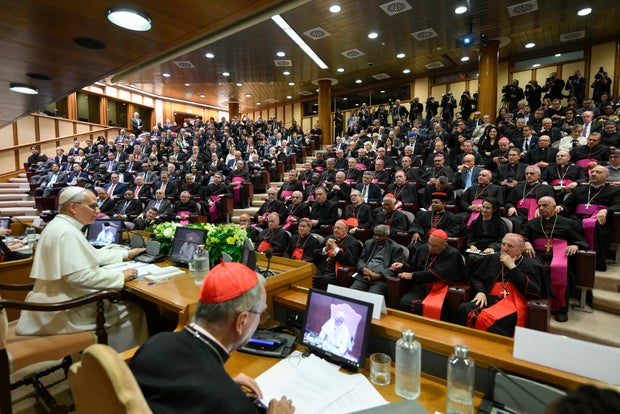
Presentation of Pope Leo XIV First Encyclical Letter 'Magnifica Humanitas'
Pope Leo XIV, flanked by Vatican Secretary of State cardinal Pietro Parolin, attends the presentation of his first Encyclical Letter “Magnifica Humanitas” at the Synod Hall on May 25, 2026 in Vatican City, Vatican.

Simone Risoluti/Vatican Media via Vatican Pool/Getty

Leo called for the “disarming” of AI, warning that the technology could fuel “a race for ever more powerful algorithms and larger datasets, driven by the desire to secure geopolitical or commercial dominance.” 

The document marks the first major papal encyclical written in the era of generative artificial intelligence, and it frames the current technological revolution not merely as an economic challenge, but as what the pope calls an “anthropological” one — a crisis touching the meaning and purpose of humanity.

“Please note that the encyclical is not about AI,” Cardinal Michael Czerny, one of the Vatican officials who helped present the document, told CBS News. “It’s about the human condition during the time of AI.”

In unusually direct language for a Vatican document, Leo — who holds a degree in mathematics — warned of the growing power of IT companies, with influence that can rival that of governments. 

At the same time, the pope stressed that technology itself is not inherently evil.  

“Artificial intelligence is a great human achievement,” Cardinal Czerny said. “We have a lot to admire and a lot to be thankful for … But we can’t renounce responsibility.”  

The Vatican’s concerns extend well beyond Silicon Valley. The encyclical repeatedly echoes broad societal concerns that AI could ⁠hollow out the middle class; ⁠eliminate vast numbers of jobs; ⁠deepen inequality; fuel social fragmentation; and normalize AI-driven warfare.

“There exists no algorithm capable of making war morally acceptable,” the encyclical states.

“Constraints that can sometimes conflict with doing the right thing”

That warning arrives as militaries around the world rapidly integrate AI into weapons systems. CBS News recently observed U.S. forces conducting exercises in Morocco and saw first-hand the growing use of AI-assisted targeting systems and autonomous technologies, including systems linked to Maven, the Pentagon’s AI platform.

One of the more striking aspects of the Vatican’s rollout of Leo’s encyclical was the inclusion of Christopher Olah, a co-founder of the AI company Anthropic, who was there in person alongside senior church officials on Monday.
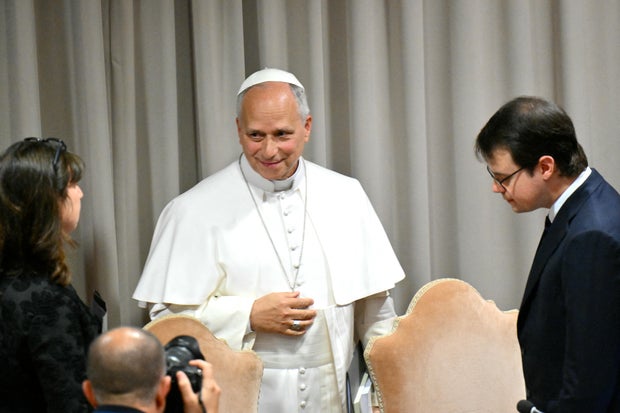
VATICAN-IA-ENCYCLICAL-MAGNIFICA HUMANITAS
Pope Leo XIV speaks with co-founder of U.S. artificial intelligence (AI) company Anthropic, Christopher Olah (right) and the Professor of Catholic Social Thought & Practice at the Durham University (left), Anna Rowlands, at the end of the presentation of the Encyclical Letter “Magnifica Humanitas,” focused on the rise of artificial intelligence, at the Vatican, May 25, 2026.

Alberto PIZZOLI/AFP/Getty

Olah said AI companies work “inside a set of incentives and constraints that can sometimes conflict with doing the right thing,” and he welcomed input from outside, including from the Catholic Church, to “push events in a better direction.”

“The questions raised by AI are bigger than the AI research community,” he said.

Leo said he had accepted an invitation from Olah, “to walk together, to listen and to speak and together to find the way for humanity,” and he was confident that, “together, we can discern the major questions of our time, and so, the future of humanity.” 

While Anthropic has often presented itself as a safety-conscious, “human-first” AI company, the Trump administration recently listed it as a supply-chain risk over its refusal to let the Pentagon use its technology in automated lethal systems or mass domestic surveillance. 

Its models remain integrated in military and intelligence applications, however, as CBS News has witnessed.

When asked whether Anthropic’s reputation as a human-centered AI company had influenced the Vatican’s decision to engage with it, Czerny replied: “I’m sure it did.”

He stressed, however, that dialogue with AI companies should not be mistaken for Vatican endorsement.

“We dialogue with anyone,” Czerny said. “We don’t endorse.”  

The encyclical repeatedly returns to the idea that the dangers posed by AI are not simply technological, but spiritual and existential paralysis.

“We’re overwhelmed,” the cardinal told CBS News. “We feel like we actually have nothing to say … and this paralyzes us.”  

Asked whether the pope worried that people were beginning to treat AI as a substitute for God, Czerny answered: “Yes … many things become substitutes for God and we call them idols.”

Just as the Industrial Revolution transformed labor and capital, the AI revolution is transforming humanity itself, the pope cautioned in his remarks.

Russia and Ukraine have stepped up their aerial war. Civilians are paying the price

(CNN) — The front lines of Russia’s invasion of Ukraine are largely stagnant. But in the skies, the war is ratcheting up.Each sides’ offensive capabilities now appear to be outstripping their air defenses, analysts say. That means more strikes are hitting their targets, more critical and economic infrastructure is being damaged, and more civilians are killed each week.“We definitely see an increased number of (attack) events, an increased number of casualties as well,” said Olha Polishchuk, the Eastern Europe research manager at ACLED, a global conflict monitor. “There has been an escalation also with regard to the variety of targets that are hit.”Ukraine has long been able to hit areas of Russia that are thousands of miles away from the front line, but the sophistication of its drone technologies has increased rapidly in the last year. In late June, Ukrainian President Volodymyr Zelensky announced a 40-day campaign to ramp up drone strikes deep into Russian territory – a push that his top adviser has said will continue.“That is a significant issue for Russia, because obviously the past 40 days have demonstrated that they have a serious weakness when it comes to interception, and Ukraine has been able to reach their targets quite successfully,” said Natia Seskuria, a senior research fellow at the Royal United Services Institute, a UK-based security think tank.Rather than occasional long-range strikes on Russian oil refineries, Ukraine is now carrying out frequent attacks on refineries, oil tankers, power substations and broader energy infrastructure, according to ACLED’s Polishchuk. Kyiv has also increased aerial attacks aimed at disrupting Russian military logistics in the occupied eastern areas.The analysts also noted an increase in attacks targeting the Russian economy more broadly, such as strikes on the warehouses of Russia’s largest online retailer, Wildberries. The Ukrainian government has said the facilities are legitimate military targets because the company supplies Russia’s frontline troops.Kyiv also recently broke through Russian defenses in St. Petersburg and has repeatedly hit Moscow.It appears to be an effort to bring the war home to everyday Russian people and to place more pressure on the business elite, who may have some sway with the Kremlin, to push for an end to the full-scale invasion.In addition, Seskuria said, Ukraine’s long-range strike campaign has a “pragmatic aim to slow down Russia’s summer offensive, in terms of stretching Russia’s resources towards intercepting the drone attacks.”Earlier in the conflict, Russia concentrated its air defense systems at the border with Ukraine and along the front line, Ukrainian military sources previously told CNN. But Kyiv’s strategy has been to target many different locations inside occupied areas of eastern Ukraine and Russia, forcing the Russian military to spread its air defense systems into a more threadbare tapestry.Recent attacks have also exposed how Russia’s air defense systems were not designed to combat drones, but rather to shoot down conventional military aircraft and missiles, analysts previously told CNN. Video captured in June showed Russian soldiers scrambling to respond to one attack by firing off man portable air defense systems (MANPADS) on a busy highway.Ukrainian forces have also slammed Russian-occupied Crimea, with ACLED recording a significant uptick in June of strikes targeting the peninsula’s power and transportation infrastructure.But the increase in air strikes goes both ways.“We’ve seen all of those strikes that Ukraine conducts also mirrored in Ukraine,” Polishchuk said. “So, after the attacks on Wildberries, for example, now a lot of warehouses in Ukraine belonging to the Rozetka electronic store have been targeted.”Meanwhile, on the front line, ACLED recorded a decline in armed clashes in recent months. Russia continues to push forward and capture some small settlements, but overall movement “has been very, very slow,” Polishchuk said.Civilian death toll mountingThe escalation in the air war has led to even more civilian casualties.In June, the United Nations recorded the highest number of civilians in Ukraine killed and injured in a single month since 2022. In Ukraine, at least 1,396 civilians were killed and 7,978 wounded in the first half of this year – a 37% increase compared to the same time period in 2025. The vast majority of those civilian casualties occurred in areas of Ukrainian government control, according to the UN, but some were recorded in Russian-occupied areas.The Russian foreign ministry has said that at least 797 Russian civilians have been killed so far this year. CNN and international monitoring groups are unable to independently verify that figure.Russia’s nightly assaults on Ukraine well exceed the number of attacks it is experiencing at home. Last month, Moscow launched a daily average of 172 strikes on Ukraine, compared to 28 on average launched by Kyiv.And for months, Russia has increased the number of drones, cruise missiles and ballistic missiles it fires in each attack wave, a strategy intended to overwhelm Ukrainian air defenses.Those mass aerial attacks are in addition to small drone attacks targeting civilians in cities close to the front line, who have previously described feeling like victims of a “drone safari” carried out by Russian troops. Russia denies targeting civilians.In July, Russia fired 139 ballistic missiles into Ukraine, more than in any other month this year, according to analysis by the Center for Strategic and International Studies (CSIS). Ballistic missiles are particularly difficult to defend against because they move at a speed and altitude that requires US-made Patriot interceptor missiles, which are both expensive and in short supply.Earlier this week, at least 17 people were killed in Kyiv and surrounding areas as Russia fired more than two dozen ballistic missiles and anti-ship missiles – none of which were shot down.Zelensky has repeatedly appealed to allies for more Patriot interceptors, but the war with Iran has complicated that effort, having diminished stockpiles of US-made weapons. Ukrainian hopes were buoyed when US President Donald Trump promised at last month’s NATO summit to allow Ukraine to manufacture Patriot interceptors on its own soil. But Trump later walked that back.Window for diplomacy?Beyond the Patriot interceptors, some observers have noted that both the United States and Ukraine’s allies in Europe could be doing more to bolster the country’s position, and to enable talks that finally end the four-and-a-half-year war.The US had allocated more than $130 billion (115 billion euros) in support to Ukraine before February 2025, according to the Kiel Institute, a think tank based in Germany. But Congress has not passed any new major financial or military aid packages for Ukraine during the second Trump administration.Ukraine does appear to have some momentum right now, and it’s plausible that some negotiation could happen at a time when Kyiv is in a more confident position, Polishchuk said. “But from what we’ve seen so far, it has been so ineffective to try to negotiate with Russia.”She said it’s more likely that Russian President Vladimir Putin’s war calculation would only change based on internal pressure in Russia, which could increase as its economy suffers.RUSI’s Seskuria also said she doesn’t see a strong window for diplomacy right now.“The problem is that (Putin) no longer has the leverage that he had back in the days when he started negotiating with the United States, and the United States back then had a more favorable position towards Russia,” she told CNN, adding that it would currently be hard for the Kremlin to portray an end to the war as any great victory.“I think the other option is escalation, which is probably more likely.”CNN’s Alex Leeds Matthews and Anna Chernova contributed to this report.The-CNN-Wire™ & © 2026 Cable News Network, Inc., a Warner Bros. Discovery Company. All rights reserved.
Read Next Story