Pentagon begins releasing UFO files: ‘It’s time the American people see’

▶ Watch Video: Trump tells public to “have fun” with UFO document release

Washington — The Pentagon on Friday began releasing more files related to UFOs and UAPs, following through on an order from President Trump to make public government documents about unexplained phenomena.

The release, posted on a new Pentagon “UFO” website, includes 162 files from the FBI, Department of Defense, NASA and State Department. The documents contain eyewitness testimony, photos and reports of sightings of unexplained objects, detailing incidents dating back decades from around the globe. 

“These files, hidden behind classifications, have long fueled justified speculation — and it’s time the American people see it for themselves,” Defense Secretary Pete Hegseth said in a statement.

The president said the disclosure was aimed at providing “Complete and Maximum Transparency.”

“Whereas previous Administrations have failed to be transparent on this subject, with these new Documents and Videos, the people can decide for themselves, ‘WHAT THE HELL IS GOING ON?'” Mr. Trump wrote on Truth Social. “Have Fun and Enjoy!”

Photos and videos from the UFO files

Friday’s release included 120 PDFs, 28 videos and 14 image files. Other photos are contained in PDF documents. The images are mostly still pictures from footage of suspicious objects filmed by military aircraft.

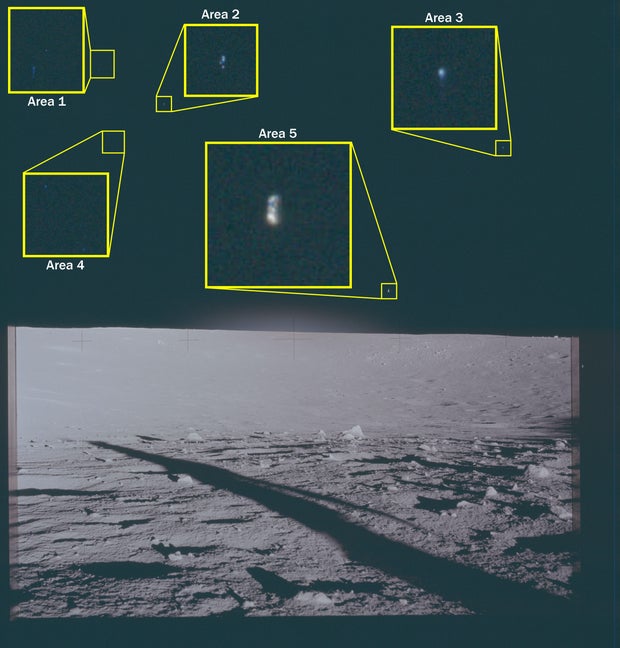
Six of the photos show phenomena observed by NASA astronauts during the Apollo 12 and Apollo 17 missions, captured in photographs taken from the surface of the moon:
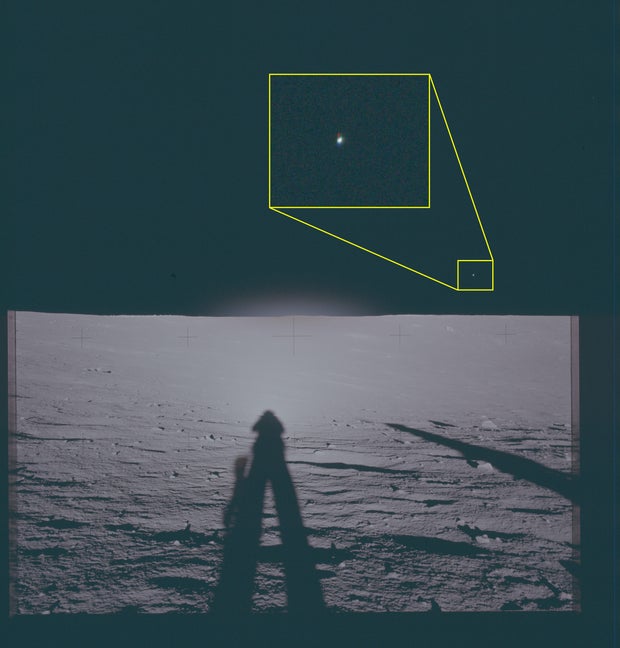
An archival photo taken on the Moon by Apollo 12 astronauts in 1969.

NASA/Pentagon

An archival photo taken on the Moon by Apollo 12 astronauts in 1969, overlaid with boxes showing "areas of interest."
An archival photo taken on the Moon by Apollo 12 astronauts in 1969, overlaid with boxes showing “areas of interest.”

NASA/Pentagon

One Apollo 17 photo, from December 1972, is described as depicting “three ‘dots’ in a triangular formation” in the lunar sky. The Pentagon said the photo had been released previously, but the military and NASA are completing a new review of the original film to try to explain what it shows.

“While this photo has been previously released and discussed by keen observers, there is no consensus about the nature of the anomaly. New preliminary US government analysis suggests the image feature is potentially the result of a physical object in the scene,” the Pentagon caption said. 
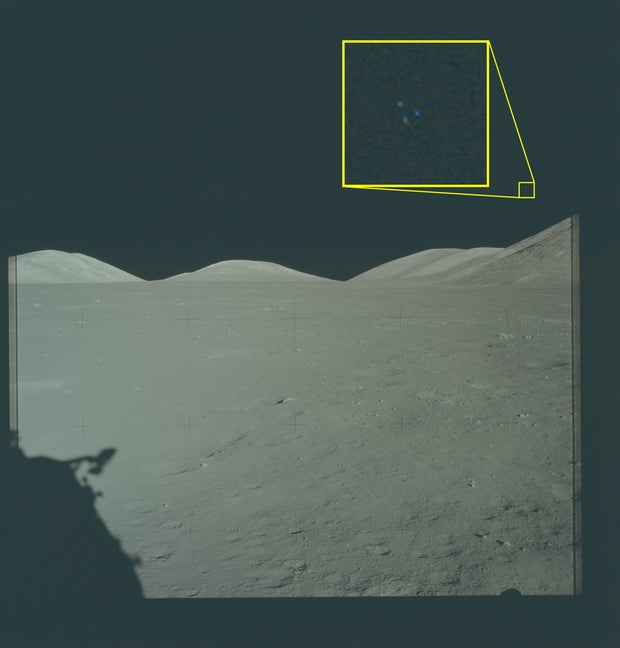
NASA photograph from the Apollo 17 mission showing dots in the sky
The Pentagon’s UFO files included this NASA photograph from the Apollo 17 mission, taken in December 1972, described as containing “three ‘dots’ in a triangular formation” in the lunar sky.

NASA/Pentagon

Another document says Apollo 17 astronaut Jack Schmitt reported seeing “a flash on the lunar surface north of Grimaldi (crater).”

The roughly two dozen videos, which run for a total of 41 minutes, show reported encounters around the world between 2020 and 2026.

Most show footage from an infrared camera tracking a white object that appears as a speck on the screen moving through the air. The report that accompanied a video taken in Greece in 2023 said the object was making multiple “90-degree turns” at approximately 80 miles per hour. 

One of the videos shows an object described as resembling a football in the Indo-Pacific and another from Syria shows two semi-transparent, irregularly shaped orange areas that each appear for two seconds. 

Watch videos of possible UFOs from first batch of files released by Pentagon

41:31

Another image is an FBI photo overlaid by a graphic of an object described by an eyewitness. The composite sketch shows an “apparent ellipsoid bronze metallic object materializing out of a bright light in the sky, 130-195 feet in length, and disappearing instantaneously.” 

An FBI photo with a sketch of an object described by an eyewitness.

FBI/Pentagon

The documents in the UFO files

The release also includes the FBI’s case file detailing reports of unidentified objects and “flying discs” from 1947 to 1968. Spanning 18 separate documents, the case file features “high-profile incident accounts, photographic evidence from sites like Oak Ridge, TN, and technical proposals regarding potential propulsion systems,” according to the Defense Department’s summary.

The Pentagon said the FBI has previously released portions of the case file, known as 62-HQ-83894, but Friday’s version includes fewer redactions and “several newly declassified pages.”

The bulk of the documents feature modern incident reports from members of the military detailing their encounters with strange objects or unexplained phenomena in Iraq, Syria, the Persian Gulf, Strait of Hormuz, Gulf of Aden, Greece and elsewhere. One pilot described seeing a “triangular and metallic UAP” flying at 25,000 ft. over the Mediterranean.

Other documents detail historical encounters, including the famous crash in Roswell, New Mexico, in 1947. One section of the FBI case file includes a memo written by an agent in the bureau’s Dallas field office to FBI headquarters. The agent reports that a major in the Air Force called to tell the office “that an object purporting to be a flying disc was recovered near Roswell, New Mexico.”

“The disc is hexagonal in shape and was suspended from a ball[o]on by cable, which ball[o]on was approximately twenty feet in diameter,” the memo said.

There are also letters addressed to FBI Director J. Edgar Hoover detailing “flying disc” sightings, and correspondence between different FBI offices about the reports. After one sighting in Idaho, the regional office wrote to headquarters asking if there was any advice on how to explain the phenomena because “it is believed continued appearance of such objects without official explanation may result in hysteria, or panic.”

A more recent document detailed the experience of several federal law enforcement agents in an undisclosed location in the western U.S. in 2023. The file, prepared by the Pentagon, reported that teams of agents had seen various orbs and strange figures in the sky or just off the ground. 

One incident involved an orb that the agents described as “similar to the Eye [of] Sauron from Lord of the Rings, except without the pupil, or maybe an orange Storm Electrify bowling ball.” 
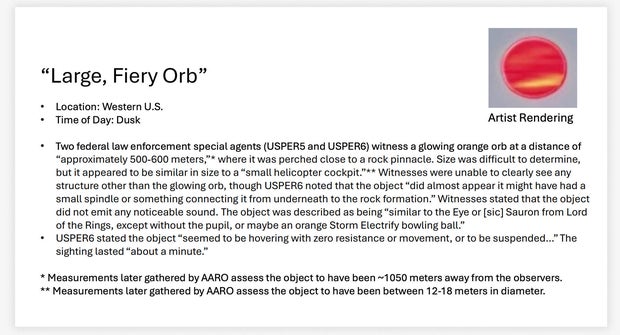
orb.jpg
A report from the Pentagon on federal employees reporting seeing an orb resembling the “Eye of Sauron” in 2023.

Pentagon

Another incident involved agents seeing “orange ‘orbs’ in the sky” that emitted “smaller red ‘orbs’ in groups of two to four.”

“These events were witnessed by multiple teams from varying locations and vantage points over a two-day period,” the file said. “Due to the sequential nature of the events, it is not known whether there was a single orange ‘mother’ orb that released the groups of red orbs or whether there were multiple orange orbs at play.”

The State Department’s files feature cables from diplomats in Papua New Guinea, Kazakhstan, Turkmenistan, Georgia and Mexico to Washington, detailing various UAP incidents in those countries. The dates range from 1985 to late 2025.

A cable from the U.S. Embassy in Tajikistan in 1994 relayed the experience of a commercial air pilot and crew who reported seeing a strange object at 41,000 feet. The group said they saw “a bright light of enormous intensity, approaching them from over the horizon to the east at a great rate of speed and at a much higher altitude than their own.” The crew watched as the object “maneuvered in circles, corkscrews and made 90-degree turns at rapid rates of speed and under very high G’s.”

“To our suggestion that the object might have been a meteor entering and skipping off the earth’s atmosphere, [the crew was] adamant that they had seen thousands of ‘falling stars’ and other space junk entering the atmosphere in their years of flying passenger aircraft for PanAm,” the diplomat wrote. “This, they insisted, was nothing like a meteor.”

The pilot “expressed the opinion, which his crew seemed to support, that the object was extraterrestrial and under intelligent control.” The embassy diplomat concluded: “We have no opinion and report the above for what it may be worth.”

The Pentagon said the materials released Friday detail “unresolved cases, meaning the government is unable to make a definitive determination on the nature of the observed phenomena.” The department welcomed analysis from the private sector. 

Out of the 162 files, 108 contain redactions. The Pentagon said information was withheld to “protect the identity of eyewitnesses, the location of government facilities, or potentially sensitive information about military sites not related to UAP.”

“No redactions have been made to any files released under President Trump’s directive concerning information about the nature or existence of any encounter reported as a UAP or related phenomena,” the statement said.

More releases coming

The Pentagon’s UFO site said new documents will be released on a rolling basis “as they are discovered and declassified, with tranches posted every few weeks.”

In February, Mr. Trump, in a post on Truth Social, directed the Pentagon and other agency heads to release files on UFOs and any “alien and extraterrestrial life.” 

He asked them “to begin the process of identifying and releasing” any relevant files and called for the release of “any and all other information connected to these highly complex, but extremely interesting and important, matters.” 

The Pentagon has tracked reports of what it calls unidentified aerial phenomena, or UAPs, for decades. But the military said in a 2024 report there’s no evidence that any government investigation into UAPs has confirmed the existence of extraterrestrial life. Mr. Trump has said he’s not sure whether or not aliens exist.

The Pentagon started releasing images several years ago after it established a website for its All-domain Anomaly Resolution Office, which was tasked with analyzing reports of unidentified anomalous phenomena. The AARO website was established in 2023. 

Trump consigue una victoria muy necesaria en Carolina del Sur y otras conclusiones de las primarias del martes

Donald Trump demostró su poderío entre los votantes de las primarias republicanas este martes en Carolina del Sur, cuando el equipo de análisis de CNN proyectó que Darline Graham, hermana del difunto senador Lindsey Graham y candidata del presidente en la segunda vuelta de las primarias especiales para el Senado en ese estado, se alzará con la nominación republicana.Ahora que se perfila como favorita para ganar un mandato completo en noviembre, Darline Graham es, en muchos sentidos, una senadora elegida por el propio Trump.El presidente presionó al gobernador de Carolina del Sur para que la nombrara para completar los meses restantes del mandato de su hermano tras su fallecimiento en julio.Posteriormente, Trump instó a Graham en privado y en público a que se presentara a un mandato completo de seis años.Y cuando parecía que su rival en la segunda vuelta, el representante Ralph Norman, podría ganar, Trump visitó Myrtle Beach para movilizar a los leales republicanos en apoyo a la causa de Graham, mientras que su super PAC, MAGA Inc., reveló haber gastado más de US$ 827.000 para apoyar a Graham.La victoria de Graham es ajustada —lideraba por apenas unos puntos porcentuales el martes por la noche—, pero simbólicamente significativa para el presidente en un mes lleno de reveses políticos. Seis de sus candidatos respaldados perdiendo las primarias republicanas.Trump consiguió otra victoria en Oklahoma, donde el republicano al que respaldó ganó la segunda vuelta de las primarias para gobernador, derrotando a un rival que había intentado frenar la construcción de una enorme planta de aluminio que el presidente apoya.Y en una segunda vuelta de elecciones especiales con baja participación en Georgia, los demócratas cubrieron una vacante en la Cámara de Representantes, que estaba dividida por un margen muy estrecho.Estas son las principales conclusiones de las elecciones del martes en Carolina del Sur, Oklahoma y Georgia:Darline Graham subió al escenario en su fiesta de celebración de la victoria el martes por la noche y declaró: “Carolina del Sur es verdaderamente territorio de Trump”.A diferencia de su hermano, que era cercano al difunto senador John McCain y se forjó una reputación como un defensor de una política exterior intransigente e independiente de Trump, el perfil político de Darline Graham estaba completamente ligado al presidente.“Nuestra victoria no habría sido posible sin usted, y le estamos profundamente agradecidos”, manifestó en un mensaje dirigido a Trump.Para Trump, la victoria era muy necesaria: un triunfo en una de sus intervenciones más arriesgadas en las primarias republicanas de este año, tras varias derrotas este mes y a poco más de dos meses de las elecciones de mitad de mandato.Podría servir para recordar a los legisladores republicanos que buscan distanciarse de un presidente impopular los posibles costos políticos de estar en desacuerdo con Trump.Norman reconoció el papel de Trump en el resultado de la contienda, y el martes por la noche les dijo a sus seguidores: “El presidente se involucró. Tiene derecho a hacerlo”.“Nunca entendí por qué se metió en esta contienda”, dijo Norman mientras algunos miembros del público abucheaban al presidente. “Pero así son las cosas, y lo acepto”.Graham se enfrentará en noviembre a la candidata demócrata Annie Andrews, pediatra de profesión.El martes, Andrews retó a Graham a al menos tres debates televisados, afirmando en un comunicado que “ningún nombramiento, respaldo o vínculo familiar da derecho a nadie a seis años” en el Senado.Aun así, Graham parte como clara favorita para ganar en este estado tradicionalmente republicano en las elecciones generales.Trump ha respaldado a un gran número de candidatos este año, pero rara vez ha puesto en juego su propio capital político como lo hizo en Carolina del Sur.Cuando Trump propuso inicialmente a Darline Graham para ocupar el escaño de su difunto hermano, y el gobernador Henry McMaster accedió, parecía un cargo temporal.El puesto ya estaba en la boleta electoral para un mandato completo de seis años en noviembre, por lo que ella habría sido una figura decorativa durante unos meses, hasta que los votantes de Carolina del Sur nominaran y eligieran a uno de los numerosos republicanos experimentados del estado que llevaban décadas esperando una vacante en el Senado.Pero tres días después de su toma de posesión, Trump redobló su apuesta, instándola en las redes sociales a buscar un mandato completo. Y, días después, ella anunció que lo haría.El “respaldo total e incondicional” del presidente no bastó para despejar el camino.Al fin y al cabo, Darline Graham no tenía experiencia política, y su hermano no era precisamente querido entre los votantes conservadores de Carolina del Sur: dos meses antes, solo había obtenido el 57 % de los votos en las primarias contra un puñado de candidatos relativamente desconocidos.Los resultados de las primarias del 11 de agosto sugerían que podría ser derrotada en la segunda vuelta. Terminó primera, pero con poco menos del 33 % de los votos.Había motivos para creer que la influencia de Trump podría ser limitada.Al fin y al cabo, su candidata en las primarias republicanas para gobernadora de Carolina del Sur, la vicegobernadora Pam Evette, perdió ante el fiscal general del estado, Alan Wilson, a quien Trump también respaldó en el último momento cuando era evidente que su candidato preferido iba camino de la derrota.El presidente no podía permitirse el lujo de recurrir a la misma táctica para salvar las apariencias: Norman había respaldado y hecho campaña con la exgobernadora Nikki Haley cuando esta se postuló contra Trump para la nominación presidencial republicana de 2024.La inexperiencia de Graham quedó patente durante un debate con Norman a principios de este mes, cuando se negó a responder a una pregunta sobre Taiwán y el mar de China Meridional, alegando que la seguridad nacional “no era asunto suyo”.Pero Trump impulsó a Graham hasta la meta. El viernes visitó Carolina del Sur y les dijo a los republicanos que él mismo la había presionado para que se presentara a la reelección. “Imaginen, por favor, que estoy en la boleta electoral”, les instó a los votantes republicanos.Trump logró otra victoria en Oklahoma, esta vez por un margen aún menor, y CNN proyectó que su candidato preferido en la contienda por la gobernación, el exsenador estatal Mike Mazzei, ganará la segunda vuelta de las primarias republicanas contra el fiscal general del estado, Gentner Drummond.Ambos compiten por enfrentarse a la líder de la minoría de la Cámara de Representantes de Oklahoma, Cyndi Munson, la candidata demócrata, en la contienda de noviembre para reemplazar al gobernador republicano Kevin Stitt, cuyo mandato está limitado.La contienda fue otra prueba de la influencia de Trump, y surgieron importantes dudas sobre si su respaldo sería suficiente para Mazzei, después de que los candidatos elegidos por Trump en las primarias republicanas para gobernador en Georgia, Iowa y Minnesota perdieran a principios de este año.Un punto clave de la división en las primarias fue la propuesta de construir una planta de fundición de aluminio de US$ 4.000 millones en el puerto de Inola, en Tulsa, que se estima que generaría alrededor de 1.000 empleos en la zona.Trump promocionó la planta, afirmando en Truth Social que “será uno de los mejores proyectos jamás concebidos o construidos, no solo en el gran estado de Oklahoma, sino en Estados Unidos”.Sin embargo, ante la preocupación local por la contaminación y el impacto negativo en la economía ganadera, Drummond presentó una demanda, solicitando a un tribunal federal que bloquee la construcción de la planta.CNN pronostica que el demócrata Everton Blair, expresidente de la junta escolar del condado de Gwinnett, ganará las elecciones especiales para el escaño del distrito 13 de Georgia en la Cámara de Representantes, que quedó vacante tras la muerte del representante David Scott en abril.Pero no conservará ese puesto por mucho tiempo.Blair, quien será el primer miembro abiertamente gay del Congreso por Georgia, derrotó a Marcye Scott, hija del veterano legislador, en la segunda vuelta de las elecciones especiales del martes.Su campaña se basó en la promesa de ser un oponente más firme para Trump y abogar por una agenda de asequibilidad más progresista que la del difunto congresista y su hija.Sin embargo, Blair quedó en un distante tercer lugar en las primarias ordinarias para la Cámara de Representantes a principios de este año, por lo que no estará en la boleta electoral en noviembre.La legisladora estatal Jasmine Clark es la candidata demócrata para un mandato completo de dos años en el distrito, tradicionalmente demócrata, en las elecciones de noviembre.No se presentó a las elecciones especiales porque, según la ley estatal, habría tenido que renunciar a su escaño en la Cámara de Representantes de Georgia, lo que habría costado un escaño a los demócratas justo cuando el gobernador republicano Brian Kemp estaba impulsando, sin éxito, una redistribución de distritos a mitad de la década.Mientras tanto, la victoria de Blair, y la elección especial de la senadora estatal Aisha Wahab en California la semana pasada, ayudarán a los demócratas a reducir aún más la ya de por sí escasa mayoría republicana en la Cámara de Representantes.The-CNN-Wire™ & © 2026 Cable News Network, Inc., a Warner Bros. Discovery Company. All rights reserved.
Read Next Story