▶ Watch Video: Trump tells public to “have fun” with UFO document release
Washington — The Pentagon on Friday began releasing more files related to UFOs and UAPs, following through on an order from President Trump to make public government documents about unexplained phenomena.
The release, posted on a new Pentagon “UFO” website, includes 162 files from the FBI, Department of Defense, NASA and State Department. The documents contain eyewitness testimony, photos and reports of sightings of unexplained objects, detailing incidents dating back decades from around the globe.
“These files, hidden behind classifications, have long fueled justified speculation — and it’s time the American people see it for themselves,” Defense Secretary Pete Hegseth said in a statement.
The president said the disclosure was aimed at providing “Complete and Maximum Transparency.”
“Whereas previous Administrations have failed to be transparent on this subject, with these new Documents and Videos, the people can decide for themselves, ‘WHAT THE HELL IS GOING ON?'” Mr. Trump wrote on Truth Social. “Have Fun and Enjoy!”
Photos and videos from the UFO files
Friday’s release included 120 PDFs, 28 videos and 14 image files. Other photos are contained in PDF documents. The images are mostly still pictures from footage of suspicious objects filmed by military aircraft.
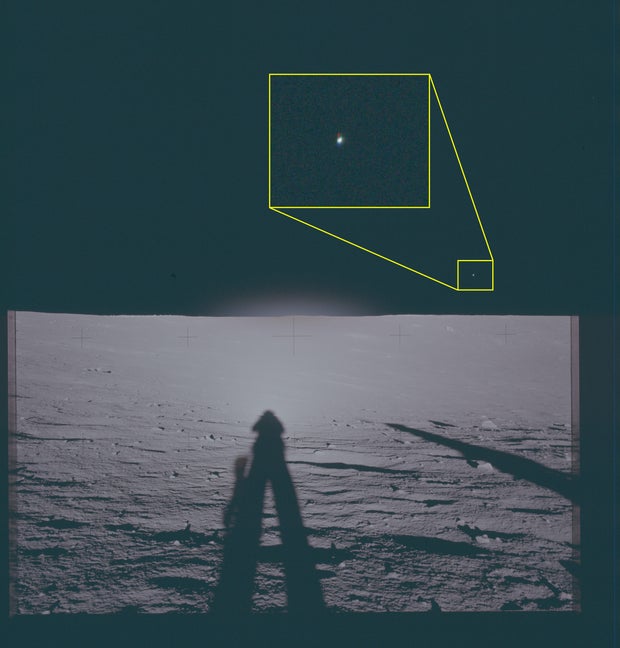
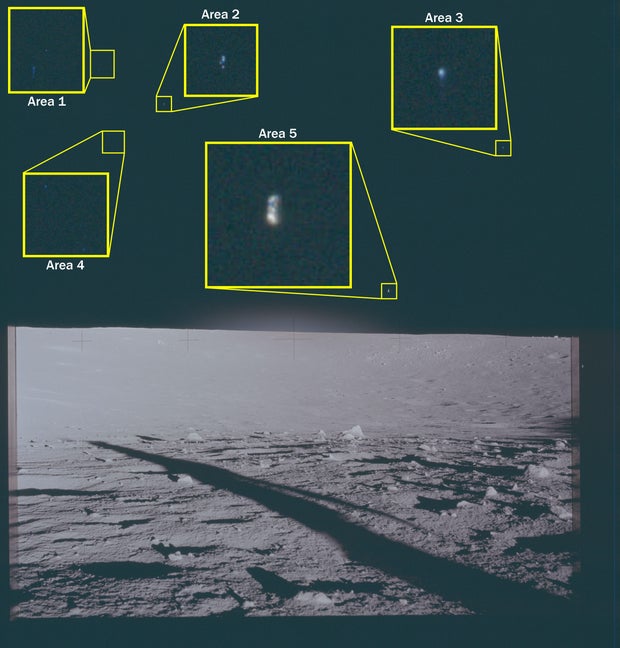
Six of the photos show phenomena observed by NASA astronauts during the Apollo 12 and Apollo 17 missions, captured in photographs taken from the surface of the moon:
NASA/Pentagon
NASA/Pentagon
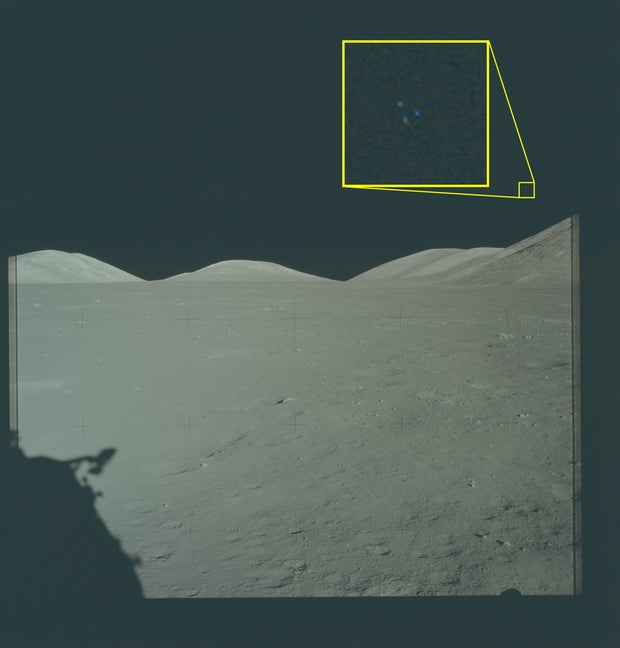
One Apollo 17 photo, from December 1972, is described as depicting “three ‘dots’ in a triangular formation” in the lunar sky. The Pentagon said the photo had been released previously, but the military and NASA are completing a new review of the original film to try to explain what it shows.
“While this photo has been previously released and discussed by keen observers, there is no consensus about the nature of the anomaly. New preliminary US government analysis suggests the image feature is potentially the result of a physical object in the scene,” the Pentagon caption said.
NASA/Pentagon
Another document says Apollo 17 astronaut Jack Schmitt reported seeing “a flash on the lunar surface north of Grimaldi (crater).”
The roughly two dozen videos, which run for a total of 41 minutes, show reported encounters around the world between 2020 and 2026.
Most show footage from an infrared camera tracking a white object that appears as a speck on the screen moving through the air. The report that accompanied a video taken in Greece in 2023 said the object was making multiple “90-degree turns” at approximately 80 miles per hour.
One of the videos shows an object described as resembling a football in the Indo-Pacific and another from Syria shows two semi-transparent, irregularly shaped orange areas that each appear for two seconds.
Watch videos of possible UFOs from first batch of files released by Pentagon
41:31
Another image is an FBI photo overlaid by a graphic of an object described by an eyewitness. The composite sketch shows an “apparent ellipsoid bronze metallic object materializing out of a bright light in the sky, 130-195 feet in length, and disappearing instantaneously.”

FBI/Pentagon
The documents in the UFO files
The release also includes the FBI’s case file detailing reports of unidentified objects and “flying discs” from 1947 to 1968. Spanning 18 separate documents, the case file features “high-profile incident accounts, photographic evidence from sites like Oak Ridge, TN, and technical proposals regarding potential propulsion systems,” according to the Defense Department’s summary.
The Pentagon said the FBI has previously released portions of the case file, known as 62-HQ-83894, but Friday’s version includes fewer redactions and “several newly declassified pages.”
The bulk of the documents feature modern incident reports from members of the military detailing their encounters with strange objects or unexplained phenomena in Iraq, Syria, the Persian Gulf, Strait of Hormuz, Gulf of Aden, Greece and elsewhere. One pilot described seeing a “triangular and metallic UAP” flying at 25,000 ft. over the Mediterranean.
Other documents detail historical encounters, including the famous crash in Roswell, New Mexico, in 1947. One section of the FBI case file includes a memo written by an agent in the bureau’s Dallas field office to FBI headquarters. The agent reports that a major in the Air Force called to tell the office “that an object purporting to be a flying disc was recovered near Roswell, New Mexico.”
“The disc is hexagonal in shape and was suspended from a ball[o]on by cable, which ball[o]on was approximately twenty feet in diameter,” the memo said.
There are also letters addressed to FBI Director J. Edgar Hoover detailing “flying disc” sightings, and correspondence between different FBI offices about the reports. After one sighting in Idaho, the regional office wrote to headquarters asking if there was any advice on how to explain the phenomena because “it is believed continued appearance of such objects without official explanation may result in hysteria, or panic.”
A more recent document detailed the experience of several federal law enforcement agents in an undisclosed location in the western U.S. in 2023. The file, prepared by the Pentagon, reported that teams of agents had seen various orbs and strange figures in the sky or just off the ground.
One incident involved an orb that the agents described as “similar to the Eye [of] Sauron from Lord of the Rings, except without the pupil, or maybe an orange Storm Electrify bowling ball.”
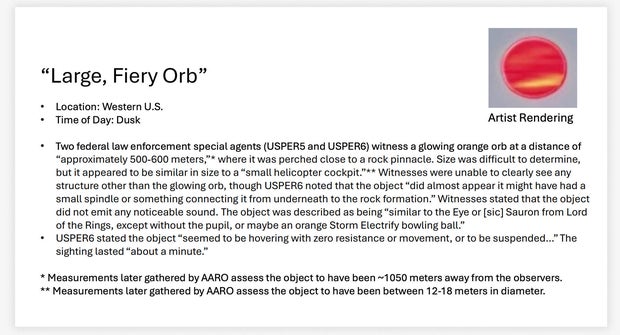
Pentagon
Another incident involved agents seeing “orange ‘orbs’ in the sky” that emitted “smaller red ‘orbs’ in groups of two to four.”
“These events were witnessed by multiple teams from varying locations and vantage points over a two-day period,” the file said. “Due to the sequential nature of the events, it is not known whether there was a single orange ‘mother’ orb that released the groups of red orbs or whether there were multiple orange orbs at play.”
The State Department’s files feature cables from diplomats in Papua New Guinea, Kazakhstan, Turkmenistan, Georgia and Mexico to Washington, detailing various UAP incidents in those countries. The dates range from 1985 to late 2025.
A cable from the U.S. Embassy in Tajikistan in 1994 relayed the experience of a commercial air pilot and crew who reported seeing a strange object at 41,000 feet. The group said they saw “a bright light of enormous intensity, approaching them from over the horizon to the east at a great rate of speed and at a much higher altitude than their own.” The crew watched as the object “maneuvered in circles, corkscrews and made 90-degree turns at rapid rates of speed and under very high G’s.”
“To our suggestion that the object might have been a meteor entering and skipping off the earth’s atmosphere, [the crew was] adamant that they had seen thousands of ‘falling stars’ and other space junk entering the atmosphere in their years of flying passenger aircraft for PanAm,” the diplomat wrote. “This, they insisted, was nothing like a meteor.”
The pilot “expressed the opinion, which his crew seemed to support, that the object was extraterrestrial and under intelligent control.” The embassy diplomat concluded: “We have no opinion and report the above for what it may be worth.”
The Pentagon said the materials released Friday detail “unresolved cases, meaning the government is unable to make a definitive determination on the nature of the observed phenomena.” The department welcomed analysis from the private sector.
Out of the 162 files, 108 contain redactions. The Pentagon said information was withheld to “protect the identity of eyewitnesses, the location of government facilities, or potentially sensitive information about military sites not related to UAP.”
“No redactions have been made to any files released under President Trump’s directive concerning information about the nature or existence of any encounter reported as a UAP or related phenomena,” the statement said.
More releases coming
The Pentagon’s UFO site said new documents will be released on a rolling basis “as they are discovered and declassified, with tranches posted every few weeks.”
In February, Mr. Trump, in a post on Truth Social, directed the Pentagon and other agency heads to release files on UFOs and any “alien and extraterrestrial life.”
He asked them “to begin the process of identifying and releasing” any relevant files and called for the release of “any and all other information connected to these highly complex, but extremely interesting and important, matters.”
The Pentagon has tracked reports of what it calls unidentified aerial phenomena, or UAPs, for decades. But the military said in a 2024 report there’s no evidence that any government investigation into UAPs has confirmed the existence of extraterrestrial life. Mr. Trump has said he’s not sure whether or not aliens exist.
The Pentagon started releasing images several years ago after it established a website for its All-domain Anomaly Resolution Office, which was tasked with analyzing reports of unidentified anomalous phenomena. The AARO website was established in 2023.