
New species of blue octopus discovered 5,900 feet underwater

▶ Watch Video: Scientists connect the health of deep sea creature populations with global climate

On the ocean floor near the Galapagos Islands, a submersible controlled by scientists came across a mysterious octopus as blue as the ocean that “could curl up in the palm of your hand.”

“He’s tiny! It’s blue!” one excited scientist was recorded as saying when she first caught sight of the cerulean cephalopod on footage transmitted from the sub.

The team from the Charles Darwin Foundation had just discovered a new species of octopus about 5,900 feet below the water’s surface, according to research published on Monday.

“Right away, I knew it was something really special,” said octopus expert Janet Voight, who was asked to identify the strange species.

At first the curator at the Field Museum of Natural History in Chicago had to make do with photos of the animal. Then she received its preserved body in the mail.

“When it arrived, I was like ‘Oh! My goodness! It’s beautiful,'” Voight told AFP.
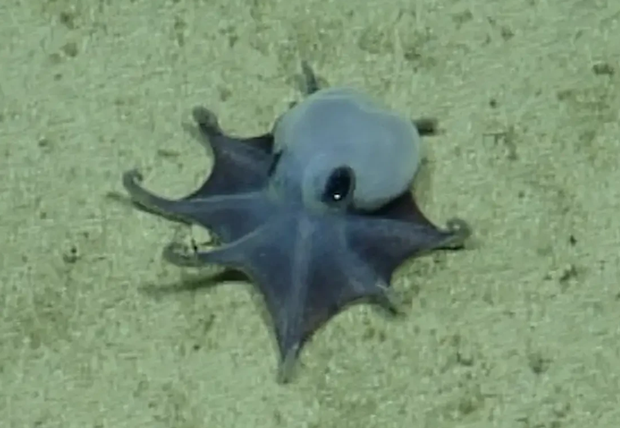
New species of octopus on sea floor
The new species of octopus found deep in the ocean near Isla Darwin.

Charles Darwin Foundation

She was immediately interested because the closest known octopus of that shape lives off the coast of Uruguay — in a different ocean on the other side of South America.

Normally to describe a new octopus species, a specimen needs to be cut open so that its mouth, beak, teeth and other parts can be examined.

“We only had the one specimen, so I didn’t want to take it apart,” Voight said.

Instead, the team at the Field Museum used CT scans to take thousands of X-ray images, then compiled them to make a 3D model of the octopus, revealing its insides.

“There’s nothing like spending the day looking at something no other human has ever seen,” the Field Museum’s X-ray lab head Stephanie Smith said in a statement.

“Deep purple”

The new species, named Microeledone galapagensis, stands out for reasons other than its blue hue, which is believed to be the rarest color in nature.

The octopus appears to be the runt of the Megaleledonidae family, whose members are normally much larger and live in the Southern Ocean surrounding Antarctica.

“Its stubby little arms with only one row of suckers set it apart from most octopus we are familiar with,” Voight said.

Even among “other species with short little arms and a single sucker row, its coloration and smooth skin on the back surface separate it,” she added.

While the octopus is light blue on its back, underneath it is a “very deep purple,” Voight said.

“We think this color pattern helps keep it safe. If the octopus grabs a prey item that emits light, that light may attract predators that might then eat the octopus,” she explained.

“So the octopus puts its dark-colored web over the prey item, keeping itself safe.”

Surprisingly, it is not uncommon to find new species of octopus in the deep sea — particularly in areas that have not been well explored, which is a massive amount of the ocean floor.

“If you took all the land on Earth and pieced it together, you would not cover the Pacific Ocean,” Voight pointed out.

She added that she had last seen a new octopus in 2023, off the coast of Costa Rica.

The first sighting of the new blue octopus was made in 2015 near Darwin Island, named after the English scientist whose visit to the Galapagos helped him form the theory of evolution.

It’s also the first new octopus species that Voight has officially led a team of scientists in describing, in her four-decade career studying octopus evolution, according to the Field Museum.

“These are little octopuses that live in the deep sea, and hardly anybody on Earth has ever gotten to see them. I just feel lucky that I got to work with them,” Voight said.

Voight’s research on the species was published in the journal Zootaxa.

There are around 300 species of octopus worldwide, living in all of the world’s oceans.  

In 2024, a team of scientists said they discovered four new species of octopus in the waters off Costa Rica. 

Now Russia and Ukraine are fighting it out on the gas station forecourt

(CNN) — The gas station was already aflame, when policeman Mykhailo Tsypliakov and his colleagues ran in to help. He heard the buzz of a second drone descending and hit the ground.“I saw a flash, then got up right away,” Tsypliakov said. “I saw that my arm, legs and torso were injured.”He’s one of dozens of victims of Russia’s latest campaign against Ukraine’s civilian infrastructure: fuel stations. Over two hundred have been hit in June and July, which works out at about three a day, according to Ukrainian officials.They’re aimed, Tsypliakov said, “to intimidate, to sow fear and panic. Panic is the scariest thing right now. Because when a person panics, they lose control of themselves.”The attacks have concentrated on gas stations close to the front lines – and within easier reach of Russia’s attack drones. But airstrikes, longer distance drones and closer-range smaller attack UAVs have also added to the toll, hitting targets near the capital Kyiv.Ukrainians see the Russian campaign as a bid to impose the same chaos seen at Russian gas stations, since repeated Ukrainian strikes on Russian refineries, that caused huge queues for fuel around Moscow and other major cities.The widening Russian assault on civilian targets comes at a time when Western officials are warning of a possible escalation from Russian President Vladimir Putin in response to the toll of Kyiv’s long-range drone campaign against Russia’s industrial infrastructure.Images of Russian delivery warehouses and refineries ablaze have punctured the veneer of safety Moscow has tried to maintain four years into the war. Russia has launched record numbers of ballistic missiles in recent weeks and June was the deadliest for Ukrainian civilians since 2022, the United Nations has reported.A CNN analysis located and confirmed at least 30 videos of attacks on gas stations across the country in June and July.Regina Kharchenko, acting mayor of Zaporizhzhia, said the city had been hit with 54 strikes targeting gas stations in a 24-day period until July 27. These strikes killed four and injured 29, she added.“This is deliberate terrorism targeting civilian infrastructure and civilians,” said Kharchenko. “Russia is deliberately targeting facilities that have no military significance, but… are essential to the daily functioning of a big city.”Zaporizhzhia city is increasingly within the range of Russian drones, whose range has extended further from the front line “kill zone” to enable Moscow’s attack craft to harass and kill inside a major population center.Kramatorsk, a town in the Donbas increasingly close to Russia’s inch-by-inch advances, and Kharkiv, a city nearer the Russian border, are also heavily impacted.In Ukraine, where commercial air travel is impossible and whose vast territory is connected by an enormous road and rail network, fuel stations have taken on an outsized value as a place where evacuees, soldiers, haulage drivers, can all pause, regroup and recuperate.Yaroslav Starovoitenko, president of the Ukrainian Oil and Gas Association, said the Russian attacks were aimed at “intimidating” ordinary civilians. “Gas stations became these key points of refuge as people fled the war. Then Russia tried to cause an intentional blackout, cutting off electricity and heating to freeze us out in the winter.”Fuel stations had generators, always on, he said. “These were places where people could drink hot tea, fill up their cars, warm up, and even prepare milk for their babies.”A brief visit to a gas station outside Kyiv suggested the panic was far from universal. Serhiy joked he had been discharged from the military after being seriously wounded on the front line. “If a strike comes here, what’s the difference?”, he said. “It didn’t kill me on the front line, so it won’t kill me here.”Vladyslav, a delivery driver, said: “No one knows where the attack will strike, and no one knows what will happen next. But I’m working. I can’t just not go.”Another driver, Maksym, said “now there are no problems in Kyiv, but of course there will be if they keep destroying them.”Moscow has paraded these attacks online. Russia’s elite drone unit, Rubicon, posted a video this month showcasing nine strikes on gas stations in the Kharkiv and Sumy regions.Ukrainian officials suggested the attacks were aimed at showing Russia was able to inflict similar disruption to Ukraine’s fuel supplies, as they had suffered from long-range Ukrainian targeting of their oil refineries.“People used to joke that Russia is a ‘gas station country,’ but in reality, this ‘gas station country’ has run out of gas. We see huge lines at gas stations [in Russia].” He said the attacks were aimed at “showing their own people, ‘Look, it’s even worse in Ukraine.’”Additional reporting by Daria Tarasova-Markina, Svitlana Vlasova, Kosta Gak and Victoria Butenko.The-CNN-Wire™ & © 2026 Cable News Network, Inc., a Warner Bros. Discovery Company. All rights reserved.
Read Next Story