▶ Watch Video: Researchers predict slightly fewer hurricanes than usual this season
As the globe transitions into an El Niño climate pattern, temperatures in the waters in the Pacific Ocean are on the rise. It comes just as the Eastern Pacific hurricane season officially begins on Friday, May 15.
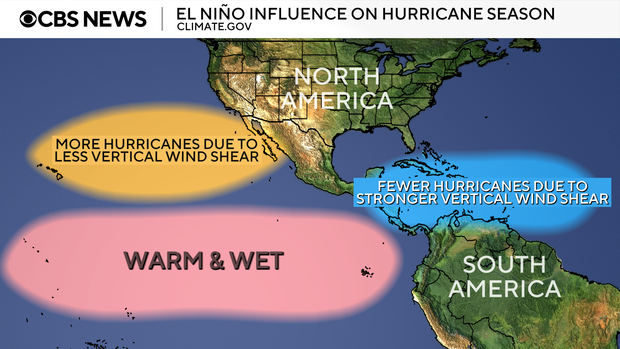
Warm ocean waters are the essential fuel for tropical cyclone development, which makes this incoming El Niño phase perfect conditions for an increased hurricane season in the Eastern Pacific Ocean.
Because it reduces vertical wind shear, meaning change in direction of winds at higher levels of the atmosphere, an El Niño climate pattern allows for tropical systems that develop in the region to avoid getting “blown over” and falling apart. The environment over the warmer Pacific waters helps enable tropical storms and hurricanes to develop and stay fully structured vertically.
Meanwhile, El Nino’s influence in the Atlantic basin nudges conditions in the opposite direction, with relatively cooler waters and more vertical wind shear, which does not make for the most ideal environment for tropical system development.
This does not necessarily mean that we won’t see any Atlantic hurricane systems — just statistically, there may be less than average.
CBS News/Nikki Nolan
The last time an El Niño pattern occurred was in 2023 and we have been in a La Nina pattern ever since, which correlates with the above-average Atlantic hurricane seasons in recent years.
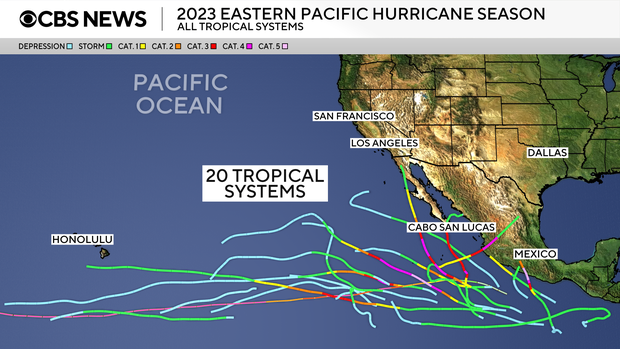
Back in 2023, the Eastern Pacific hurricane season produced 20 tropical systems, 17 of which became named storms. A notable one was Hurricane Hilary, which moved through Baja California and eventually made landfall as a tropical storm. It continued into parts of the southwestern U.S. and had impacts on parts of California, Arizona and Nevada. Hilary was responsible for 3 deaths and more than $900 million in damage in the U.S. and Mexico.
CBS News/Nikki Nolan
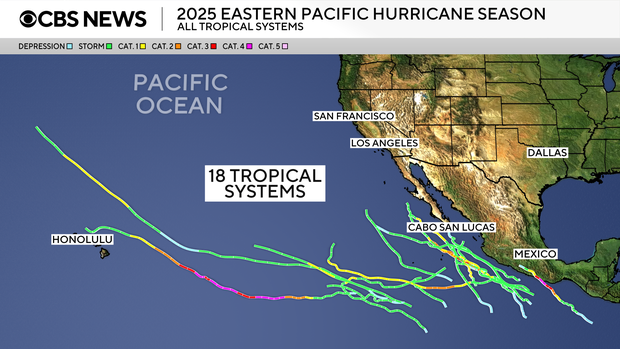
Looking back on last year’s Eastern Pacific hurricane season, 18 tropical systems formed during the La Niña pattern that was in place at the time. The most notable storm of the 2025 season was major Hurricane Kiko, which barreled toward the Hawaiian Islands before weakening in cooler waters and falling apart just north of the islands.
CBS News/Nikki Nolan
Pacific hurricane names
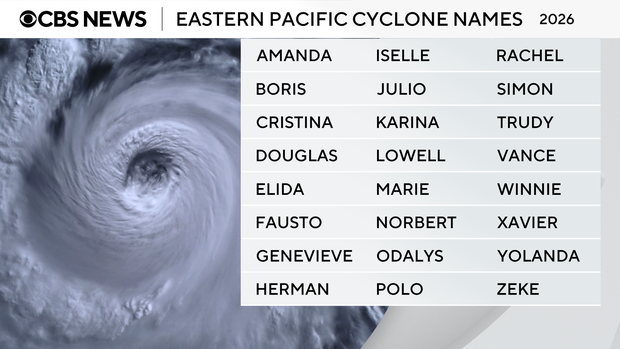
Looking ahead to this season, the first name on the rotating list of hurricane names for the Eastern Pacific is Amanda, followed by Boris, Cristina, and Douglas. The list of designated names rotates every six years.
The National Hurricane Center will begin monitoring the Eastern Pacific for any potential of tropical system development through the end of the season, with Tropical Weather Outlooks updated multiple times a day.
CBS News/Nikki Nolan