
Ebola outbreak in DRC, Uganda ‘will get worse before it gets better’: WHO chief

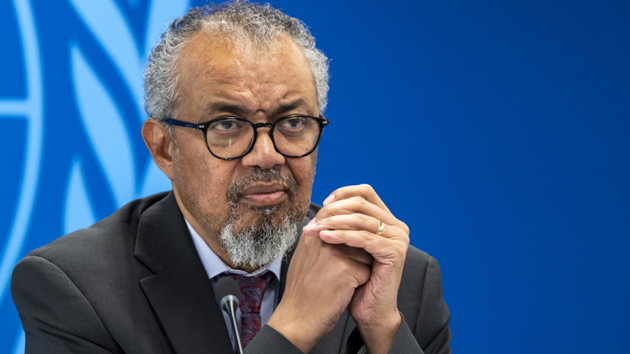
Martial Trezzini/epa/shutterstoc/MARTIAL TREZZINI/EPA/Shutterstoc

(GENEVA, Switzerland) — The head of the World Health Organization warned on Monday that a rapidly growing Ebola outbreak in the Democratic Republic of Congo and Uganda “will get worse before it gets better.”

More than 900 cases and more than 220 deaths have been reported in the DRC, WHO Director-General Dr. Tedros Adhanom Ghebreyesus said during a virtual briefing. Of those totals, 101 cases and 10 deaths have been confirmed.

Additionally, there have been five travel-related cases and a death in Uganda, according to the WHO and the Uganda Ministry of Health.

“We are facing an extremely serious and difficult outbreak. It will get worse before it gets better,” Tedros said on Monday. “But we know this virus, and we know how to stop it. We have stopped every previous Ebola outbreak, and we will stop this one, too.”

Tedros said he wanted to echo comments made by South African President Cyril Ramaphosa about overcoming the outbreak with unity.

“The question is just how quickly we can do it, and how many more lives will be lost before we do,” Tedros added.

Tedros’ comments come amid a hospital in northeastern Congo facing growing tension as officials have trouble following safety rules following the death of a well-known religious leader.

Dr. Richard Lokudi, director of the Mongbwalu General Referral Hospital in Ituri province — one of three provinces where the Ebola outbreak is concentrated — told ABC News the facility is under heavy tension after the body of a confirmed Ebola victim, who was also a major religious figure in the region, was brought there.

Lokudi said that family members and groups of young people are demanding the body be returned.

Because the patient was a confirmed Ebola case, authorities are insisting on a “safe and dignified burial” under outbreak protocols, and the body is being temporarily kept at the hospital until burial on Monday.

Lokudi said police and military forces have been securing the hospital and firing warning shots to disperse protesters gathered outside.

He added that the gunfire around the hospital has left him exhausted and stressed.

Last week, Tedros classified the Ebola outbreak as a public health emergency of international concern — one level below a pandemic in the United Nations agency’s alert system.

The WHO continues to consider the national risk assessment as “very high” while the regional level risk remains “high” and the global risk level remains “low,” Tedros said on Monday.

The outbreak has led to multiple countries, including the U.S., India, the U.K. and Australia, putting travel restrictions in place.

Entry to the U.S. is restricted to foreign travelers who have recently been in the DRC, Uganda and South Sudan.

Meanwhile, U.S. passport holders and U.S. nationals returning to the U.S. from the three countries will be funneled to Dulles Airport in Virginia to be screened for symptoms and interviewed about possible exposure.

Enhanced screening efforts have also begun at Hartsfield-Jackson Atlanta International Airport as of Saturday morning and efforts at George Bush Intercontinental Airport in Houston will begin late Tuesday.

Lawful permanent residents (green card holders) who have been in any of the three countries over the last 21 days are barred from entering the U.S. temporarily.

Tedros said on Monday that WHO teams are on the ground in the outbreak zones assisting with response including contact tracing, establishing treatment centers and infection prevention and control. Tedros added that he will be traveling to the DRC on Tuesday.

The WHO chief said that several aspects of this outbreak make it “especially challenging,” including the delays in detecting the outbreak.

“[It] means that we are now playing catch-up with a very fast-moving epidemic,” he said on Monday.

US doctor infected with Ebola critically ill but says he is ‘cautiously optimistic’
He said that due to recent fighting in the provinces facing the brunt of the outbreak, it means tens of thousands of people are displaced and there is “significant distrust of outside authorities among the local population.”

An additional challenge is that there are no approved vaccines or treatments for the strain of Ebola responsible for the outbreak: Bundibugyo virus.

Tedros said the WHO has recommended prioritizing two monoclonal antibodies to advance in clinical trials and recommended evaluating the antiviral obeldesivir in a clinical trial as post-exposure prophylaxis for those who are high-risk contacts.

ABC News’ Eric M. Strauss contributed to this report.

Copyright © 2026, ABC Audio. All rights reserved.

Trump has a Carter-style Iran problem as the economy drags before the midterms

(CNN) — President Donald Trump is staring down two stark liabilities that threaten to damage his Republican Party in the midterms and to ruin his second term-legacy.Somehow he’s maneuvered himself into a more vulnerable spot regarding Iran than any president since Jimmy Carter. As in the 1979-80 hostage crisis, the Islamic Republic is exerting political pressure that it can dial up on the US leader ahead of a national election. A week ago, Trump’s team predicted a deal to reopen the Strait of Hormuz was imminent. But Tehran, now dictating terms to the US global superpower, has imposed tough new conditions.At the same time, Trump faces a separate but related problem at home. The war’s impact on energy prices is further souring voter perceptions of the economy. He’s entered the doom loop in which presidents and officials scan data for silver linings but voters see only indifference to their plights. Twists like Friday’s bad jobs report are untimely for the GOP with November fast approaching.As the political environment darkens for Republicans, their leader seems oblivious. Many of Trump’s weekend social media posts might have been scripted by his foes to portray an out-of-touch president. He posted a picture with South African golf legend Gary Player, and another of the sculpting of a new green at one of his courses. He posted about a futuristic drone port on the proposed White House ballroom, the Reflecting Pool renovation, and two statues in Washington newly coated with glistening golden paint. He also claimed to be a slayer of inflation, but he looked more like a president desperately trying to leave a physical legacy rather than one brimming with ideas for national renewal.The weekend did deliver a victory for Trump: The Senate narrowly confirmed his former personal lawyer Todd Blanche as US attorney general. But this is a win that will appeal more to the president than to voters. And Republicans left town after proving their own warnings that Trump’s top-priority voting restrictions bill can’t pass. And the president’s grim August took another rough turn abroad, when Israeli Prime Minister Benjamin Netanyahu rejected another supposed triumph — a plan to disarm Hamas in Gaza.Are Democrats handing Trump a lifeline?Such political challenges would typically spell trouble for incumbent presidents in midterm elections. And as CNN’s Aaron Blake pointed out Sunday, multiple polls now show that Trump has squandered the traditional GOP advantage in two areas: national security and the economy.Trump’s thwarting of convention has always been a political strength, and he’s less than two years past the greatest political comeback in US history. But the dynamics of November’s election may not favor him. He’s always been more effective politically as an outsider, as in 2016 and 2024. He is the political establishment now, and previously when he’s been forced to defend his own record, as in the 2018 and 2020 elections, he has foundered.The president is also in denial about how voters are feeling. “They are not angry at me, but they’re angry at Republicans,” Trump told Punchbowl News last week.But in recent weeks, Democrats may have given him an opening. Primary wins by progressive and democratic socialists are fueling Trump’s claims that he is resisting a tide of left-wing extremism. In a parallel to the GOP’s tea party insurgency earlier in the century, Democrats may risk winnable seats by nominating candidates who alienate more moderate, suburban voters who tend to decide elections.Progressives, however, believe that the jumbled political circumstances create the conditions for a breakthrough among voters who aren’t just down on Trump but who also disdain the moderate Democratic establishment — especially after the failed campaigns of Joe Biden and Kamala Harris allowed Trump to regain the White House.Progressive Michigan Senate nominee Abdul El-Sayed on Sunday homed in on Trump’s vulnerability on the economy as he pivoted from a bitter primary in a state that could decide who runs the Senate. “Differences that we hashed out are so much smaller than the similarities that we share: a responsibility to stand up to Donald Trump and the ways that he’s used his power for his own gain, for his family’s finances, rather than to improve your family’s finances,” El-Sayed told CNN’s Jake Tapper on “State of the Union.”Iran digs in to defy TrumpIn 1980, Iran exerted leverage over a US election after holding 52 Americans in Tehran in a standoff that eventually lasted 444 days. Forty-six years later, it’s not people being held hostage — but the Strait of Hormuz oil exporting route. This means the regime has another election-season pressure point as US voters — as they did with Carter — turn on a president over the economy.Average national gasoline prices are back above $4 a gallon, according to AAA. Voters are angry about high prices and are struggling against longer-term affordability trends in housing and healthcare.Trump officials have repeatedly stressed that the burden will quickly ease once the strait opens. But, paradoxically, their comments may only bolster Iran’s negotiating position. Tehran has toughened its demands, including the ending of a US maritime blockade and the departure of American forces from the region; it also wants US compensation for the war and a lifting of sanctions.This not a deal Trump can accept, so Iran may be overplaying its hand. But if Trump loses patience and relaunches the war, he’ll be doubling down on a deeply unpopular conflict and inviting a worse economic backlash.The president is trying to recapture the initiative. He told Axios he’s now waiting for the economic impact of the US blockade to kick in. “We are low-keying it,” Trump said Sunday. “We are only semi-negotiating with them.”In effect, therefore, Trump — after devastating Iran’s military, setting back its nuclear program in last year’s air strikes and hammering its defense industrial base — is betting on the US economy’s greater endurance to get him out of his strategic dead end.Many analysts believe Iran is more willing to impose suffering on its people as its radical leaders pursue their existential struggle with the US. Maybe the regime will collapse. But it seems unlikely on Trump’s short political timeline.White House insists the ‘economy is booming’Republicans can’t wait for domestic relief from the war. Official data Friday showing the economy lost 23,000 jobs in July was a fresh blow to the White House and Republican reelection campaigns — and to all the Americans out of work. But the administration is not wrong to argue the economy is fundamentally resilient — even as high food and housing prices, and wages that don’t seem to keep up, mean most people don’t recognize Trump’s economic “golden age.”This gap between a White House’s perception of the economy and the experience of regular Americans is a perennial political trap that is often triggered by discordant rhetoric.“The bottom line is that, if you look at the overall economy, then things are really, really booming,” Kevin Hassett, director of the National Economic Council, told CNN’s Tapper. Hassett argued that job losses last month reflected the end of temporary work from the World Cup finals and teachers taking July off. He insisted the economy was creating high-quality jobs and that prices were moderating.But calibrating an economic message is among the trickiest tasks in politics. It defeated the Republican presidential campaign of John McCain in 2008; Democrats’ midterm campaigns under President Barack Obama in 2010; and the failed campaigns of Biden and Harris in 2024.And the economy is just one of Trump’s problems.He told Axios that that the war “will work out. It always works out. It’s like a chess game.” But on Iran and across the broader political spectrum, his endgame is impenetrable.The-CNN-Wire™ & © 2026 Cable News Network, Inc., a Warner Bros. Discovery Company. All rights reserved.
Read Next Story