
The 2026 Atlantic hurricane season begins June 1, and as coastal residents watch the forecast and wait to see what nature has in store, the National Oceanic and Atmospheric Administration is releasing its outlook for the months ahead.
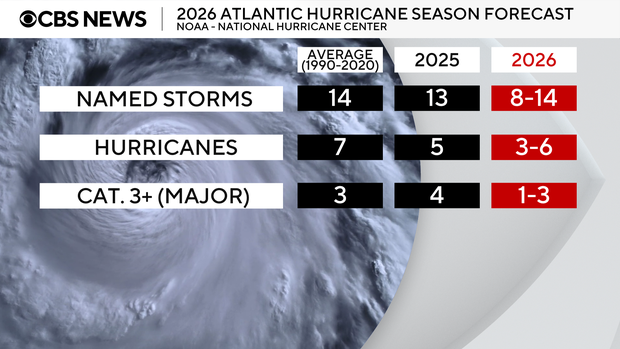
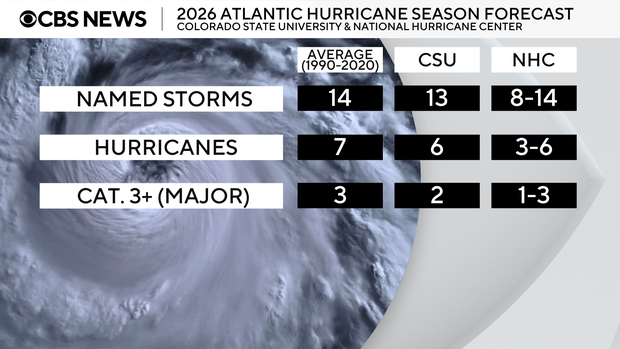
NOAA is predicting a below-average season this year, with eight to 14 named storms. Of them, three to six are expected to become hurricanes, including one to three major hurricanes of Category 3 strength or higher, agency officials announced Thursday.
They stressed that a below-average forecast should not keep people in hurricane-prone areas from taking it seriously and getting prepared.
“Even though we’re expecting a below-average season in the Atlantic, it’s very important to understand that it only takes one,” said NOAA administrator Neil Jacobs. “We have had Category 5 storms make landfall in the past during below average seasons.”
Jacobs and National Weather Service director Ken Graham praised technological advancements that, they said, will take storm preparedness to the next level.
“We’ve never been as prepared for hurricane season as we are now,” said Graham. NOAA encompasses the Weather Service, which directly handles hurricane forecasts.
NOAA estimates there’s currently a 55% chance that activity during hurricane season will be below-normal, a 35% chance it will be near-normal, and a 10% chance it will be above-normal, Jacobs added.
Nikki Nolan/CBS News
A storm receives a name if its maximum sustained wind speeds reach at least 39 mph, and it becomes a hurricane if those winds climb to 74 mph. Hurricanes are classified as “major” when they reach wind speeds of at least 111 mph. That strength places them in Category 3 or higher on the Saffir-Simpson Scale used to rate storm intensity.
The Atlantic hurricane season runs through Nov. 30, with activity typically peaking between August and October. That window tends to see the greatest number of storms develop, and a season’s most intense storms often develop in those months, too.
NOAA’s outlook will be updated several times throughout the summer to reflect any changes in the forecast over time.
How accurate was NOAA’s 2025 hurricane forecast?
NOAA’s hurricane predictions are generally fairly accurate, although not always exact.
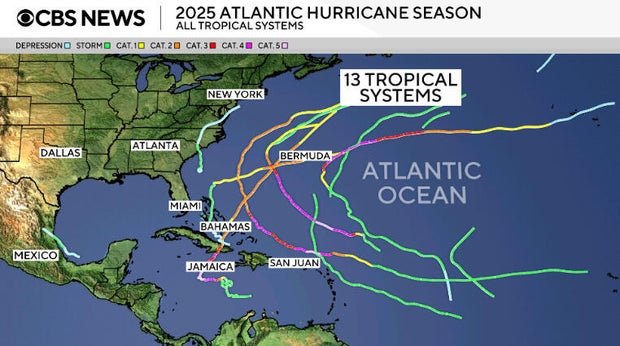
The agency’s 2025 outlook originally predicted last year’s hurricane season would include 13 to 19 named storms, six to 10 hurricanes and three to five major hurricanes. The forecast was adjusted slightly downward in August to predict 13 to 18 named storms, five to nine hurricanes and two to five major hurricanes.
In the end, there were 13 named storms overall in 2025, including five hurricanes, four of which were major.
CBS News
That was a bit quieter than an average season, which has 14 named storms, seven hurricanes and three major hurricanes.
Impact of El Niño on 2026 hurricane season
The upcoming hurricane season may be influenced by the transition into El Niño, an oscillating climate pattern that affects weather conditions in the United States and has historically been associated with fewer Atlantic storms.
However, as CBS News meteorologist Nikki Nolan wrote in a recent El Niño forecast, its emergence “does not necessarily mean that we won’t see any Atlantic hurricane systems — just statistically, there may be less than average.”
On the West Coast, the effect goes in the other direction: the warmer Pacific waters in an El Niño help enable tropical storms and hurricanes in the Pacific to develop and stay fully structured vertically.
NOAA’s Climate Prediction Center said last week that there’s at least an 82% chance El Niño will arrive by July. Scientists are still monitoring conditions that will help them determine how strong it will be.
NOAA’s 2026 outlook is being released about six weeks after another major hurricane forecast from Colorado State University’s Tropical Cyclones, Radar, Atmospheric Modeling and Software Team. The CSU forecast predicted slightly less activity than usual in the Atlantic basin this year, with researchers estimating that the upcoming season would see 13 named storms, including six hurricanes and two major hurricanes. Like NOAA, they will release updated forecasts periodically in the coming months.
Nikki Nolan/CBS News
2026 Atlantic hurricane season storm names
Every year, the World Meteorological Organization preemptively compiles a list of names that will be assigned to tropical storms and hurricanes that develop during the upcoming Atlantic season. The roster includes 21 names, each starting with a different letter of the alphabet. If more than 21 storms form in a single year, which happens occasionally, then a supplemental list of names will also be used.
Here’s the main list of names for 2026:
- Arthur
- Bertha
- Cristobal
- Dolly
- Edouard
- Fay
- Gonzalo
- Hanna
- Isaias
- Josephine
- Kyle
- Leah
- Marco
- Nana
- Omar
- Paulette
- Rene
- Sally
- Teddy
- Vicky
- Wilfred