
A tool to help keep dementia in check

▶ Watch Video: A tool to help keep dementia in check

If you worry about your risk of dementia, Lauren Sprague knows your fear. Her father had a stroke when she was in high school. What followed was a long, slow descent into memory loss and dementia. He died at just 63.

“So, since I was 16 years old, pretty much every day of my life I worry, ‘Is today the day that the same thing could happen to me that happened to my dad?'” Sprague said. “It’s an incredible fear to walk around with.

“Every day of my children’s lives up until now, I’ve worried that that could be me,” she said.

Then she went to see Dr. Jonathan Rosand, who told us, “Time and again I would get the question, ‘Doctor, what can I do to take good care of my brain so that I don’t end up like my mother, my brother, my father?'”

Rosand is a neurologist at Massachusetts General Hospital in Boston. He explained to Sprague it was possible to cut the risk of dementia by making changes to daily habits, from choices about what you eat, to the amount of physical activity you get every day. “It turns out that these modifiable risk factors probably account for at least 40% of all dementia cases,” Rostand said.

A committee of experts from around the globe has concluded that about 40 to 45% of dementia cases could be prevented or delayed by addressing 14 modifiable risk factors:

  • Physical inactivity
  • Smoking
  • Excessive alcohol consumption
  • Air pollution
  • Traumatic brain injury
  • Hearing loss
  • Untreated vision loss
  • High blood pressure
  • Diabetes
  • Obesity
  • Low education attainment
  • Social isolation
  • High cholesterol
  • Depression 

Rostand said that it’s a very common conception that if dementia or Alzheimer’s is in one’s family, that they are doomed. “But the truth is there’s so much we can do,” he said.

The idea that exercise and diet are important is not new, of course. But what is new is a tool from Rosand and his team to help you understand exactly how much and what kind of lifestyle changes are beneficial. It starts with a simple questionnaire free to everyone online, called the Brain Care Score.

“The Brain Care Score is a tool for any of us to use in our daily lives that lists out the modifiable risk factors for dementia, stroke and depression,” Rostand said.
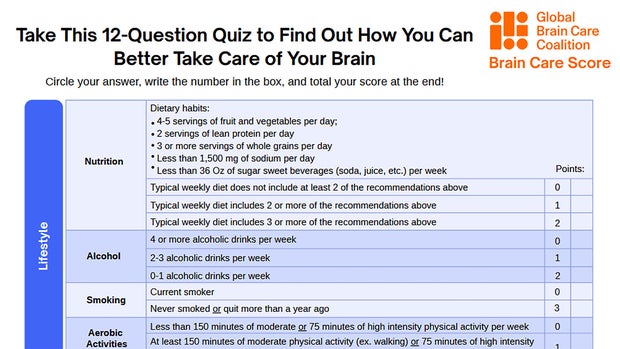
brain-care-score-gbc-1920.jpg
The Brain Care Score allows you to identify traits and lifestyle habits that can impact your brain health. 

Global Brain Coalition

The healthier your habits, the higher your score. And to improve your score, you pick which habits you want to focus on changing. Rostand said, “It’s a guide to where you can go next. And in our work with patients, it really does give a choice, and a sense of freedom.”

A groundbreaking study from June 2025 found that a five-point higher Brain Care Score is associated with a 43% lower risk of developing heart disease, and a 31% lower incidence of most common cancers (including lung, colorectal, and breast cancer).

It’s evidence that what’s good for the brain is good for the rest of the body, too.

So, where to start? For Lauren Sprague and her husband, Scott, change started in the kitchen. They doubled down on greens and cut out highly-processed foods. (This added one point to her score.) They spend more time outdoors, which helps with fitness and stress relief. (That can add 2 more points.) She also takes time to sing and create, adding meaning, more stress relief, and purpose (while adding 2 more points).

Sprague said, “The Brain Care Score really gave me the prescription that I needed. And the wonderful thing about it is, it is a recommendation, but there is nuance, and it can be customized, which is wonderful.”

And Rosand is hoping this is one prescription that we all can share. He said, “The key message we want to convey with the Brain Care Score is, it is you. It is each of our viewers. It is everyone who wants to take a step forward. It’s up to you and you’re in control.”

     
For more info:

     
Story produced by Amol Mhatre. Editor: Emanuele Secci. 

‘We will retaliate like an earthquake:’ How Iran could respond to Trump’s economic ‘D-Day’

(CNN) — As Washington launches its latest plan to cripple Iran’s economy, the Islamic Republic has threatened a regional and global response designed to raise the stakes for the United States and the world.In a news conference on Monday, Treasury Secretary Scott Bessent announced that the US will target a complex network built by Iran over years to allow its entities to evade Washington’s wide-ranging sanctions. The move comes after six months of a war launched by the US and Israel that has since reached a stalemate amid a lack of diplomatic resolution.The sweeping secondary sanctions unveiled by Bessent include penalties for Iranian trade partners in sectors that the Islamic Republic uses to prop its economy, such as digital assets, technology and shipping. But the much-anticipated announcement of Trump’s “economic D-Day” measures left many underwhelmed after Washington decided to hold off on imposing major new measures, instead focusing largely on expanding and stepping up enforcement of existing sanctions, while warning that stricter penalties could follow for countries that did not cut ties.Instead of succumbing to the threats, Iran is touting its ability to inflict reciprocal pain, warning of expanded strikes on regional oil producers and European countries, and even teasing the weaponization of its nuclear program.“We’ve been playing chess for a long time…we’ve also learned to play poker,” Iran’s Foreign Ministry spokesperson Esmail Baghaei told reporters on Monday. “Now, for some time, we’ve been playing a combination of the two.”Here’s how Iran could respond to the US economic escalation:Driving the price of oil even higherFor months, Iran has blocked vessels from using the Strait of Hormuz, preventing regional countries from exporting oil and gas through a route that before the war accounted for a fifth of global supplies. Iran’s proxy in Yemen, the Houthi group, has recently opened a new front in the Red Sea, targeting Saudi oil exports and infrastructure.Now, the Islamic Republic’s top military officials are threatening to strike energy targets beyond the Strait of Hormuz, potentially hitting some of the emerging oil shipment routes that bypass the waterway.“If the economic war continues, not a single drop of oil will be exported, neither through the Strait of Hormuz nor from anywhere in the Persian Gulf,” Mohsen Rezaei, the leader of Iran’s Supreme National Security Council, wrote on X. “We will retaliate in an earthquake-like manner,” he said later in a televised interview.Any resulting attacks or disruption to shipping could drive global oil prices higher, likely raising gasoline prices at US pumps.Aided by the US Navy, Saudi, Kuwaiti, Qatari and UAE oil companies have started turning transponders off in their oil tankers to evade detection by Iranian authorities, and have been exporting oil with some success, although crossings are well below pre-war figures.Saudi Arabia has rerouted about 5 million barrels of oil per day through its East-West pipeline that allows it to export via the Red Sea instead of Hormuz. Middle Eastern oil producers have rerouted another 2 million barrels per day around the strait.Iran has signaled that it has those tankers in its crosshairs, publishing a list of 45 vessels it says are failing to comply with the rules it seeks to impose on Hormuz shipping, and warning that vessels violating its protocols will face restrictions on future passages, including “fines, detention, or confiscation.”Expanding the geographic scope of the warTehran could also target locations farther afield with its missiles.On Monday, Iran’s Foreign Ministry pointed to US refueling aircraft leaving Bulgarian territory, warning that Tehran could target the European Union nation, which is also a NATO member.“Iran has the legitimate right to target the point of origin and source of any act of aggression,” Baghaei told reporters on Monday, adding that Tehran has “made clear that any action regarded as supporting US and Israeli military aggression against Iran constitutes, under international law, participation in an act of aggression.”Over the course of the war, Iran has struck 11 countries, mostly in the Gulf region. But it is also believed to have attacked a base used by British forces in Cyprus and has apparently demonstrated an ability to reach islands used by American forces deep in the Indian Ocean, hundreds of miles away.An attack on a US-allied EU nation and NATO member like Bulgaria would mark a significant escalation.“Iran will regard any country’s participation in or support for America’s economic war against the Iranian people as an act of war,” Rezaei said.Revising the nuclear doctrineIran has repeatedly maintained that its nuclear program is peaceful and that it does not seek to build a bomb, despite claims by Israel and the US that have led to multiple attacks on Iranian nuclear facilities.Following the US-Israeli killing of Supreme Leader Ayatollah Ali Khamenei – who had banned nuclear weapons – the narrative among some official circles in Iran has gradually been shifting toward withdrawing from the Nuclear Non-Proliferation Treaty (NPT), which commits members to never building a bomb.Around half a ton of highly enriched uranium – which can be used to build a weapon – remains buried inside Iran, with US intelligence assessing that Tehran has escalated efforts to seal off the cache.Iran’s parliament is debating a bill to withdraw from the NPT, according to Iranian lawmakers. On Sunday, Rezaei issued a rare statement touting the possibility of the country developing a nuclear weapon.“The whole world is saying, ‘So the NPT has no effect?’” he told the state broadcaster in an interview, adding, “when America is carrying out such a war, people ask: Why shouldn’t we pursue nuclear weapons ourselves?”Adaptation and deterrenceExperts say Washington’s collective measures of blockade, sanctions and military action are unlikely to lead to Iran abandoning its core negotiating positions of economic relief and acknowledgement of its control over the Strait of Hormuz.“Iran retains an ability to regionalize the costs imposed on it by threatening energy flows, infrastructure and regional commerce,” Sina Toossi, senior fellow at the Center for International Policy in Washington, D.C., told CNN. “The more comprehensive Washington tries to make the economic blockade, the more countries it needs to cooperate, and potentially the more actors Tehran will pressure in response.”For now, Toossi said, Iran’s response will become a combination of economic adaptation and escalation deterrence.“Build alternative lifelines where possible, while making clear that an attempt at complete economic strangulation will not be cost-free for the region.”The-CNN-Wire™ & © 2026 Cable News Network, Inc., a Warner Bros. Discovery Company. All rights reserved.
Read Next Story