
3 evacuated from hantavirus cruise as Spain says it will dock in Tenerife

▶ Watch Video: What’s next for those aboard hantavirus cruise ship?

Three patients suspected of having the hantavirus were evacuated from the MV Hondius cruise ship Wednesday and were receiving medical care in the Netherlands, the World Health Organization and the cruise operator said. The three are German, Dutch and British nationals, including a British crew member, according to the WHO.  

The rare outbreak of the virus has killed three people from the cruise.

The cruise operator, Oceanwide Expeditions, said in a statement on Thursday that two medical aircraft had landed in the Netherlands carrying the individuals evacuated from the ship the previous day, and that “all three individuals, two symptomatic and one asymptomatic, are now in the care of medical professionals.”

The U.K. Health Security Agency confirmed in a statement Wednesday that one British national had been evacuated from the cruise ship to receive care in the Netherlands. The UKHSA also said it’s aware of two other people who were aboard the MV Hondius who had since independently returned to the U.K. Neither is currently reporting symptoms, and they’ve been advised to self-isolate, the agency said in its statement, adding: “The risk to the general public remains very low.” 

The Spanish government reaffirmed Wednesday that the vessel would dock in the Canary Islands, despite local officials contesting the plan.

“I will not make any decision without a mandatory report from the Port Health Authority and the Maritime Authority,” Pedro Suarez, the head of the port authority in Tenerife, in Spain’s Canary Islands, told Radio Canaria on Thursday. “The final decision is mine.”

Oceanwide said in its statement Thursday that it was continuing “to monitor the progress of m/v Hondius, which departed Cape Verde at 19:15 CET yesterday (6 May) and is sailing for the Canary Islands, specifically the port of Granadilla (Tenerife). This is expected to take 3-4 days.”

It said there were no symptomatic individuals on board the vessel and that it was “in close and continual discussion with relevant authorities regarding our exact point of arrival, quarantine and screening procedures for all guests, and a precise timeline.”

The plan announced Tuesday, coordinated between the Spanish government and the WHO, had been for the ship to head to the Canary Islands for a “full investigation” and “full inspection” after the three patients were evacuated. But the leader of the archipelago’s regional government, Fernando Clavijo, rejected the idea Wednesday morning, saying he had requested a meeting with Spain’s socialist Prime Minister Pedro Sanchez. 

In a social media post, Clavijo, a member of Spain’s conservative political opposition, wrote: “The Canary Islands always acts with responsibility, but it cannot accept decisions taken behind the backs of the Canary Islands institutions and without sufficient information to the population.”
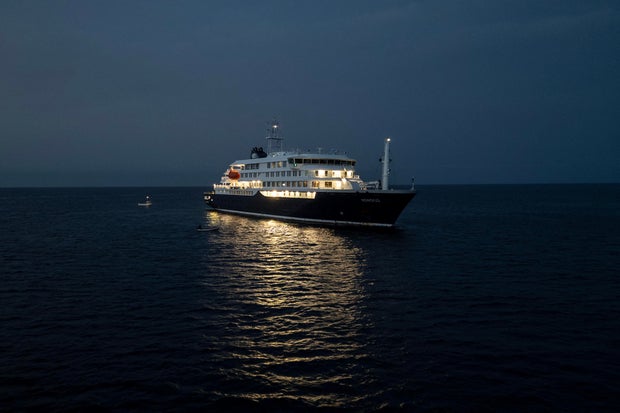
CAPE VERDE-HEALTH-TOURISM
The cruise ship MV Hondius off the port of Praia, the capital of Cape Verde, on May 6, 2026.

AFP via Getty Images

At a later news conference, however, Spain’s health minister Monica Garcia Gomez doubled down on the plan, saying the ship would dock in Tenerife, “within three days.” 

“A joint system for health assessment and evacuation will be put in place to repatriate all passengers, unless their medical condition prevents it,” she told reporters.
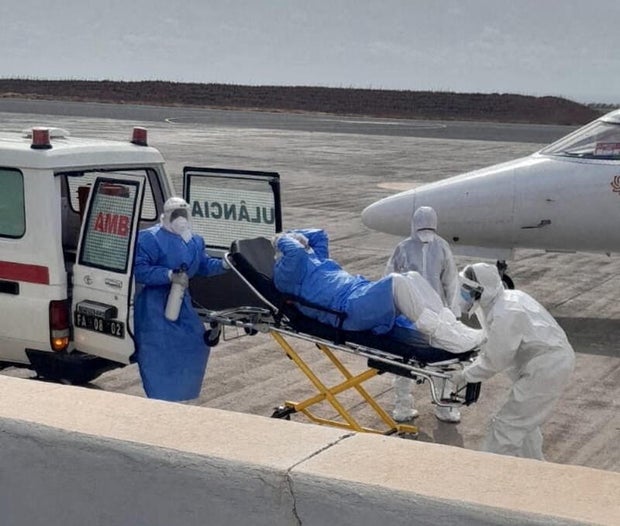
Evacuation operation of suspected hantavirus cases from cruise ship
An evacuation of suspected hantavirus patients following an outbreak on the cruise ship MV Hondius, in Praia, Cape Verde, May 6, 2026.

Tedros Adhanom Ghebreyesus via X/ Reuters

Dr. Jay Bhattacharya, acting director for the U.S. Centers for Disease Control and Prevention, said in a statement Wednesday night that the CDC has been “coordinating with domestic and international partners” since it learned of the outbreak.

The CDC was “preparing medical support” for all Americans aboard the cruise ship, Bhattacharya disclosed. Oceanwide Expeditions has said there are 17 American passengers still aboard the Hondius.

Two Georgia residents who were passengers on the Hondius, but have since returned to Georgia, are being monitored but have shown no signs so far of infection, the Georgia Department of Health reported Wednesday.

“The safety and health of the affected American travelers is our number one goal,” Bhattacharya said. 

South African authorities confirmed on Wednesday that they had identified the so-called Andes strain of the hantavirus in two people who had previously been on the cruise. The Andes strain, which is found primarily in Argentina and Chile, can be transmitted from human to human, unlike other strains of the virus.

Swiss authorities announced Wednesday that a man who previously traveled on the ship and returned home at the end of April had also tested positive for the Andes strain of the virus, adding that there was “currently no risk to the Swiss public.”  

The French Ministry of Health, meanwhile, told the country’s BFM TV network a French “contact case” had been confirmed. The man is believed to have traveled on the same flight as one of the two patients evacuated to Johannesburg for treatment in late April.

There is currently one British national in intensive care in South Africa after being on the cruise, but the French authorities were likely referring to the other patient evacuated to Johannesburg, a 69-year-old Dutch woman who the WHO said got off the ship with “gastrointestinal symptoms” on April 24 and died two days later after her condition “deteriorated during a flight to Johannesburg.” 

That brings the total number of suspected or confirmed cases to nine, including three who have died, five confirmed as receiving treatment and the French man, about whom few details have been given.

Oceanwide Expeditions said two infectious disease specialists were heading Wednesday from the Netherlands to the cruise and would “remain with the vessel after its anticipated departure from Cape Verde.”

Evacuation operation of suspected hantavirus cases from cruise ship
A person in protective clothing walks next to an ambulance during an evacuation of suspected hantavirus patients, following an outbreak on the cruise ship MV Hondius, in Praia, Cape Verde, May 6, 2026.

Danilson Sequeira / REUTERS

The Dutch-flagged MV Hontius, a luxury cruise liner, left Ushuaia, Argentina, on April 1. It has been anchored off Cape Verde, an island off Africa’s west coast in the Atlantic, since Sunday. 

Argentina’s health ministry said in a statement Wednesday that it was reconstructing the itinerary of the Dutch couple, who had traveled through southern Argentina and Chile before the expedition. It will also conduct rodent capture and analysis in Ushuaia, the statement said.

So far, no cases associated with the outbreak had been identified in Argentina, the health ministry said.

Ann Lindstrand, the WHO representative in Cape Verde, told CBS News’ Ramy Inocencio on Tuesday that there was no risk of a pandemic-level threat with the hantavirus given the low likelihood of human-to-human transmission.

Bhattacharya echoed that guidance Wednesday, saying that hantavirus “is not spread by people without symptoms, transmission requires close contact, and the risk to the American public is very low.”

Lindstrand said she was in contact with a volunteer doctor on the boat who told her the passengers were “coping surprisingly well,” though they were anxious to know what their next port of call would be.

“We have heard from quite a few people on the boat,” Maria Van Kerkhove, WHO director of epidemic and pandemic preparedness and prevention, said Tuesday. “We just want you to know we are working with the ship’s operators. We are working with the countries where you are from. We hear you. We know that you are scared.”

¿Qué sigue en la batalla legal entre Paramount y Warner Bros. Discovery?

Está en marcha una batalla legal por la fusión entre Paramount y Warner Bros. Discovery, la empresa matriz de CNN.Una coalición de 12 fiscales generales estatales ha presentado una demanda antimonopolio y ha expuesto sus argumentos; los ejecutivos de Paramount han respondido con dureza, calificando la demanda de “equivocada tanto en los hechos como en el derecho”.Ahora los estados solicitan una orden temporal de no innovar —una TRO, por sus siglas en inglés— y una medida cautelar preliminar para congelar a Paramount.Aquí van algunas —parciales, tentativas y con salvedades— respuestas a las preguntas más urgentes sobre el acuerdo.Está en la recta final. Los reguladores de todo el mundo han aprobado el acuerdo o, al menos, han optado por no interponerse.Paramount espera unas pocas aprobaciones finales, incluida la de la Comisión Europea, que fijó el 22 de julio como fecha límite para una decisión. Eso es el próximo miércoles, así que el CEO de Paramount, David Ellison, está básicamente listo para tomar el control de WBD.El Reino Unido también es una incógnita. Pero esta demanda estatal es el mayor obstáculo para la fusión. Por eso, Los Angeles Times calificó la demanda como un “último intento desesperado por descarrilar un acuerdo que transformaría Hollywood”.La orden “garantizaría que la fusión propuesta se detenga mientras dure el litigio”, dijo el fiscal general de California, Rob Bonta, a Kaitlan Collins de CNN el lunes por la noche.Si un juez está de acuerdo e impone esa orden, Paramount no podría completar el acuerdo por el momento. Los estados seguirían buscando una medida cautelar preliminar, que congelaría a Paramount. Paramount apelaría.El escrito dice que los estados “tienen interés en hacer cumplir las leyes antimonopolio y sus ciudadanos enfrentan el riesgo de un daño profundo e irreversible en ausencia de una medida cautelar… En cambio, no existe un daño cognoscible para Paramount y Warner Bros. por pausar su fusión mientras el tribunal resuelve este caso”.Paramount, por supuesto, discrepa. La empresa también dijo el lunes que retrasar el acuerdo perjudicaría a los trabajadores del entretenimiento.Muy pronto. El escrito dice que el tiempo es esencial, ya que Paramount “podría cerrar la transacción tan pronto como el 22 de julio”.Así que un juez analizará los argumentos de la demanda y evaluará si concede la TRO. Funcionarios estatales de justicia me dicen que esperan una decisión dentro de la próxima semana.Para conceder una TRO, un juez tiene que determinar que los demandantes tienen una “probabilidad de éxito en el fondo del asunto” y que la transacción causaría un “daño irreparable”.Si un juez no se deja convencer por la demanda y no está dispuesto a imponer la orden, Paramount seguirá adelante con la fusión y los estados podrían retirar la demanda.Este martes, el caso fue asignado al juez P. Casey Pitts, nombrado por Biden en 2023 y anteriormente integrante de un bufete especializado en litigios laborales y de interés público.Algunos de sus fallos han sido noticia nacional: a principios de este mes, Pitts impidió que el Departamento de Justicia obtuviera las identidades y los historiales médicos de menores transgénero tratados en el hospital infantil de Stanford; y en junio, prohibió al Gobierno federal realizar arrestos en tribunales de inmigración.Porque es una metáfora corporativa conveniente y deliciosa. Una vez que dos empresas se fusionan, los huevos están revueltos, y todo cocinero sabe que eso es difícil de deshacer.En su argumento a favor de una TRO el lunes por la noche, los estados citaron un fallo de hace una década en Pensilvania que detuvo la fusión de un sistema hospitalario y que decía que más tarde sería “extraordinariamente difícil” dar marcha atrás.En este caso, argumentaron los estados, una vez que Paramount–WBD se consuma, “los despidos, las cancelaciones de contenido y los daños a la competencia comenzarían de inmediato”.Funcionarios estatales de justicia me dicen que la fusión se pausaría, como mínimo, hasta septiembre y, probablemente, hasta finales de año, mientras ambas partes se preparan para el juicio.Hay que tener en cuenta que Paramount ha prometido cerrar el acuerdo para finales de septiembre, y que una tarifa por demora entraría en vigor a partir de octubre.Cuando una coalición similar de estados demandó para impedir que Nexstar adquiriera Tegna en marzo, un juez emitió una TRO ocho días después y lo pausó todo. Desde entonces ha habido varios acontecimientos, y la fusión sigue en suspenso, con una fecha de juicio fijada para julio de 2027.Sin embargo, cada caso es distinto, y algunos analistas han especulado que a los fiscales estatales podría resultarles más difícil demostrar un perjuicio antimonopolio en el caso Paramount–WBD.Depende de a quién se le pregunte. Dave Michaels y Joe Flint, de The Wall Street Journal, escribieron este martes que “la demanda de los estados plantea preocupaciones coherentes sobre el impacto del acuerdo en los mercados del cine y la televisión por cable, pero no parece un caso ganado, según expertos en antimonopolio”.Las demandas antimonopolio giran en torno a cómo se define el mercado y cómo se determina el daño. Esta se centra en el mercado de películas de estreno masivo, un submercado de grandes éxitos de taquilla muy esperados y la concesión de licencias a canales de cable.Abiel Garcia, socio del área antimonopolio de Kesselman Brantly Stockinger, dijo: “Mi lectura es que los dos mercados de distribución cinematográfica son argumentos más sólidos que la concesión de licencias de canales básicos de cable, pero los tres tienen cifras de HHI problemáticas, lo que significa que, de acuerdo con las alegaciones de la demanda, se presume que son combinaciones anticompetitivas que perjudicarán la competencia”.La empresa afirma que la demanda “distorsiona el derecho antimonopolio asentado” y tergiversa el estado del mercado de medios. Dice que gigantes como Netflix han perjudicado a Hollywood y que la compañía resultante de Paramount–WBD podrá competir mejor contra Netflix y otras “plataformas dominantes de streaming y tecnología” que han perjudicado el mercado de la exhibición en salas y el empleo.Posiblemente. Estas batallas legales implican muchos giros. Paramount ya ofreció concesiones a Bonta para evitar una demanda, pero Bonta y sus homólogos claramente querían más.En su rueda de prensa del lunes, Bonta dijo: “A menudo he dicho que prefiero, y estoy muy abierto a, resolver los problemas en la sala de juntas en lugar de en los tribunales”.Los críticos del acuerdo esperan que la demanda obligue a Paramount a abandonar por completo sus planes de fusión, aunque eso parece difícil de imaginar y dejaría a WBD en una posición débil.En la batalla política y de relaciones públicas, sí. En la batalla legal, no. La demanda se centra realmente en el presunto daño a la industria del entretenimiento, no a la industria de las noticias. Pero funcionarios estatales de justicia están preocupados en privado por la posibilidad de que Paramount sea propietaria de CNN y la combine con CBS News.Bonta citó las pérdidas de empleo previstas, al decir que “esta fusión significará menos periodistas informando al electorado” y “menos documentalistas” y cineastas “arrojando luz sobre historias importantes que con demasiada frecuencia quedan sin contar”.Voces conservadoras destacadas como Katie Miller y Clay Travis argumentaron el lunes que los estados están demandando debido a CNN. “Esta es una demanda para proteger a CNN en beneficio de los liberales”, tuiteó Miller.Bonta lo desestimó por completo en su rueda de prensa al decir: “Me enteré de eso por primera vez en ese artículo” y “no sé de dónde salió”.Más tarde, Belloni grabó un podcast con Bonta y le preguntó si, si Paramount “aceptara vender CNN, ¿sería suficiente para usted?”. Bonta respondió tajantemente: “No”.“No creo haber dicho eso nunca”, añadió Bonta. “No creo que eso sea ni remotamente suficiente para abordar los perjuicios anticompetitivos de los que hemos estado hablando”.Expertos de la industria expresaron escepticismo sobre esa posibilidad. Todd Spangler, de Variety, escribió que “la logística y las repercusiones de sacar de California las producciones cinematográficas y televisivas de Paramount–Warner Bros. serían abrumadoras”.El lunes por la noche, Bonta le dijo a Collins que el informe de Semafor “parecía un intento desesperado de último minuto de chantajear a los reguladores y a los estados para que no hicieran su trabajo” y para que no presentaran la demanda.“Su maniobra no funcionó”, dijo Bonta, “porque vamos a hacer cumplir la ley antimonopolio de manera justa y firme”.¿Ganarán o perderán los estados? Deberíamos saberlo —al menos sobre el estado de una TRO— bastante pronto.The-CNN-Wire™ & © 2026 Cable News Network, Inc., a Warner Bros. Discovery Company. All rights reserved.
Read Next Story