
2 humpback whales swam record-breaking distance, photos reveal

▶ Watch Video: Humpback whales created a mesmerizing Fibonacci spiral of bubbles to capture fish in Antarctica

A pair of humpback whales swam between the eastern shores of Australia and breeding grounds in Brazil, research published on Wednesday found. The distances of the journeys are the greatest ever recorded.

The work by a team of international scientists used tens of thousands of images taken of whale tales to identify the two vast sea-dwelling mammals and reveal they had popped up on both sides of the world.

One was spotted in Queensland in 2007 and then appeared near Sao Paulo, Brazil, in 2019 — a distance across oceans of about 8,823 miles.

Another was seen off the coast of Bahia in Brazil before being sighted 22 years later in Hervey Bay, Australia, about 9,383 miles away, according to the study published in Royal Society Open Science

The pictures represent the longest distance ever seen between two pictures of the same humpback whale, researchers said.

Such vast journeys by the whales — which can grow up to 55 feet long — are exceedingly rare, they added.

“Despite their rarity, these exchanges matter for the long-term health of whale populations,” Griffith University PhD researcher and report co-author Stephanie Stack said.

“Occasional individuals moving between distant breeding grounds can help maintain genetic diversity across populations,” she added.

They “may even carry new song styles from one region to another — humpback whale songs are known to spread culturally across ocean basins, much like music trends in human populations.”

The study drew on nearly 20,000 photographs collected between 1984 and 2025 from eastern Australia and Latin America, contributed by both scientists and citizen scientists. The photos were run through an automated image-recognition algorithm, and the team was able to identify two humpback whales that had been photographed in both regions. 

“This kind of research highlights the value of citizen science,” Dr. Cristina Castro of Pacific Whale Foundation said in a statement. “Every photo contributes to our understanding of whale biology and, in this case, helped uncover one of the most extreme movements ever recorded.” 
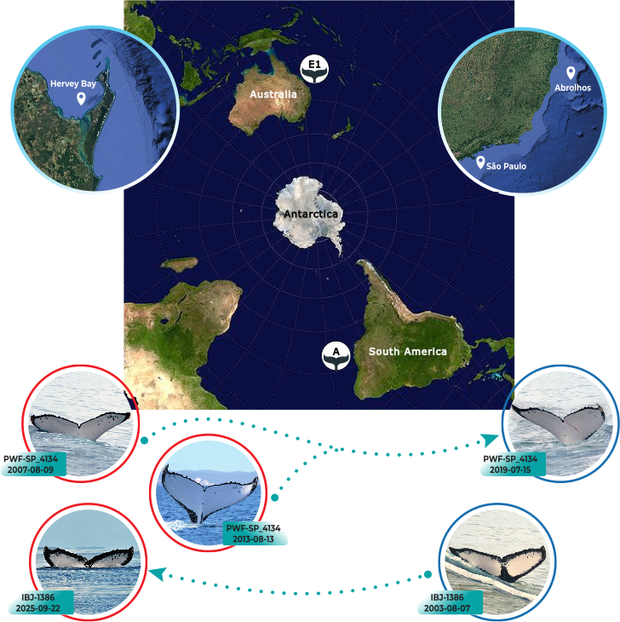
whales-rsos-260251-f001.png
Two humpback whales have set new records for the longest-known distances travelled for their species by embarking on a journey of over 14,000 kilometres between Brazil and Australia, scientists said Wednesday.

Royal Society Open Science

Researchers said the work also leant further credence to a theory about humpback whale patterns known as the “Southern Ocean Exchange.”

That hypothesis suggests the mammals sometimes travel to feeding grounds in the Antarctic but then take a different journey home — ending up in a completely new breeding area.

“Climate-driven changes to the Southern Ocean, including shifts in sea ice and the distribution of Antarctic krill (the whale’s main prey), may be making such crossings more likely over time,” Griffith University said.

Due primarily to commercial whaling, humpback whales were listed as endangered in the U.S. in the 1970s, according to NOAA, and a final moratorium on commercial whaling was established in 1985. Currently, four out of the 14 distinct population segments are still protected as endangered, and one is listed as threatened, NOAA says.

Senate approves bill to fund government into December

Washington — The Senate approved a continuing resolution on Saturday to keep the government funded through Dec. 11, sending the bill to the House as Congress looks to avoid a government shutdown ahead of the midterm elections this fall. In a 90 to 6 vote, the Senate approved the measure, which would keep the government funded at current levels with some exceptions for six weeks beyond the Sept. 30 end of the fiscal year. It now goes to the House, where lawmakers have pursued a different approach. Before leaving town for its August recess, the House approved a separate continuing resolution that would also fund the government into December. But the GOP-led bill was passed with widespread opposition from Democrats. In the Senate, which has a 60-vote threshold to advance most legislation, GOP leaders pursued a bipartisan approach to the funding extension — acknowledging the need for support across the aisle. Top Republican and Democratic appropriators in the Senate announced on Sunday an agreement on a stopgap funding bill. Democrats touted, among other wins, a provision in the bill closing a loophole preventing the administration from transferring funds to Border Patrol, after they refused to fund immigration enforcement agencies earlier this year. GOP Sen. Susan Collins of Maine, the chair of the Senate Appropriations Committee, praised the stopgap funding measure for avoiding "any poison pills." Democrats had sought additional provisions that could have imperiled its passage. But one provision could still pose hurdles in the House, should it take up the bill when it returns from recess later this month. The bill includes language to temporarily prevent political appointees in the administration from implementing a proposed rule about federal grants. Democrats have warned that the rule will allow the administration to cancel grants and "take even more federal funding hostage," and have sought to permanently ban the rule. But even the temporary ban could cause the measure to lose support among Republicans. If House Speaker Mike Johnson moves forward with the Senate bill, it could pick up support from Democrats to propel it to passage. But whether pressure from members of his own conference pushes him to pursue a different course remains to be seen.The Senate approved the measure as it churned through a number of priorities while preparing to depart for a five-week August recess. The House is set to return from its recess on Aug. 31, at which point the lower chamber will have a matter of weeks to coalesce behind a plan to keep the government funded. For the bulk of lawmakers, following two record breaking government shutdowns within the last 12 months, the appetite for another funding lapse appears low. And with the midterm elections quickly approaching, both sides of the aisle appear inclined to push off the fight for now. 
Read Next Story