
2 humpback whales swam record-breaking distance, photos reveal

▶ Watch Video: Humpback whales created a mesmerizing Fibonacci spiral of bubbles to capture fish in Antarctica

A pair of humpback whales swam between the eastern shores of Australia and breeding grounds in Brazil, research published on Wednesday found. The distances of the journeys are the greatest ever recorded.

The work by a team of international scientists used tens of thousands of images taken of whale tales to identify the two vast sea-dwelling mammals and reveal they had popped up on both sides of the world.

One was spotted in Queensland in 2007 and then appeared near Sao Paulo, Brazil, in 2019 — a distance across oceans of about 8,823 miles.

Another was seen off the coast of Bahia in Brazil before being sighted 22 years later in Hervey Bay, Australia, about 9,383 miles away, according to the study published in Royal Society Open Science

The pictures represent the longest distance ever seen between two pictures of the same humpback whale, researchers said.

Such vast journeys by the whales — which can grow up to 55 feet long — are exceedingly rare, they added.

“Despite their rarity, these exchanges matter for the long-term health of whale populations,” Griffith University PhD researcher and report co-author Stephanie Stack said.

“Occasional individuals moving between distant breeding grounds can help maintain genetic diversity across populations,” she added.

They “may even carry new song styles from one region to another — humpback whale songs are known to spread culturally across ocean basins, much like music trends in human populations.”

The study drew on nearly 20,000 photographs collected between 1984 and 2025 from eastern Australia and Latin America, contributed by both scientists and citizen scientists. The photos were run through an automated image-recognition algorithm, and the team was able to identify two humpback whales that had been photographed in both regions. 

“This kind of research highlights the value of citizen science,” Dr. Cristina Castro of Pacific Whale Foundation said in a statement. “Every photo contributes to our understanding of whale biology and, in this case, helped uncover one of the most extreme movements ever recorded.” 
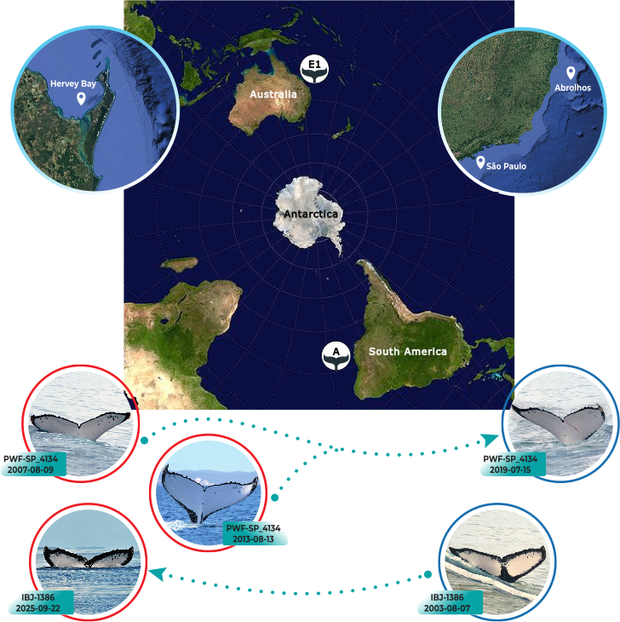
whales-rsos-260251-f001.png
Two humpback whales have set new records for the longest-known distances travelled for their species by embarking on a journey of over 14,000 kilometres between Brazil and Australia, scientists said Wednesday.

Royal Society Open Science

Researchers said the work also leant further credence to a theory about humpback whale patterns known as the “Southern Ocean Exchange.”

That hypothesis suggests the mammals sometimes travel to feeding grounds in the Antarctic but then take a different journey home — ending up in a completely new breeding area.

“Climate-driven changes to the Southern Ocean, including shifts in sea ice and the distribution of Antarctic krill (the whale’s main prey), may be making such crossings more likely over time,” Griffith University said.

Due primarily to commercial whaling, humpback whales were listed as endangered in the U.S. in the 1970s, according to NOAA, and a final moratorium on commercial whaling was established in 1985. Currently, four out of the 14 distinct population segments are still protected as endangered, and one is listed as threatened, NOAA says.

‘Decades in Sports’: How the 1980s Miami Hurricanes became one of the most hated teams in sports history

(CNN) — Editor’s note: Watch CNN Original Series “Decades in Sports” on the CNN app. Across six episodes, the series explores the defining moments, athletes and cultural shifts that shaped sports over the past six decades, from the television revolution and Civil Rights Movement of the 1960s, right up to the impact of social media on today’s biggest stars.There have been plenty of dominant teams in the 150-plus-year history of college football, but few have left a bigger mark on the sport than the Miami Hurricanes did during the 1980s.The Canes were a team that went against the grain, trash-talking in a way that constantly got under their opponents’ skin, celebrating wildly after big plays and dancing in the end zone after touchdowns with a swagger that stood out as much as their bright orange jerseys.“That made them such a phenomenon,” says John U. Bacon, author of Fourth and Long: The Fight for the Soul of College Football, as the Hurricanes’ bold, brash and arrogant style transformed college football into something closer to theater.As Bacon also highlights in the series, “The Hurricanes were the bad boys of college football.” However, their impact was felt far beyond the gridiron, as the 1986 squad was even labeled the most hated team of all time by Sports Illustrated.For context, the 25-team list devised by Sports Illustrated featured some of the most polarizing teams in US sports history, such as the 1988-89 Detroit Pistons (widely known as the “Bad Boys”), the 2010-11 Miami Heat (universally recognized as the team that kickstarted the “superteam” era in the NBA) and the 2007 New England Patriots (who became the ultimate villains of the NFL after the infamous “Spygate” scandal.But it was this college football program which topped them all. As Bacon says, “They were more popular in Miami than the Dolphins, and the Dolphins had (1984 NFL MVP) Dan Marino.”Why Miami was so hatedThe Canes’ boisterous antics were not just empty calories – they backed it up when they stepped onto the field.Like many polarizing sports teams throughout history, Miami garnered attention because it won. Winning made the Hurricanes easy to root against, but also impossible to ignore.However, what truly set them apart is how they embraced the role of the villain.Before facing defending national champion and top-ranked Oklahoma in September 1986 in front of over 70,000 fans at the Orange Bowl, the Hurricanes famously defied protocol and refused to shake hands with the Sooners, sparking a heated exchange between the top two teams right in front of the TV cameras.Game officials intervened and even threatened to throw a penalty flag if Miami snubbed the pre-game handshake. But the Hurricanes didn’t budge and backed up their pre-game antics by beating the Sooners 28-16.Their “style ruffled a lot of feathers,” says Dr. Todd Boyd, Professor of Cinema and Music Studies at USC. But the more people disliked Miami, the more the team seemed to embrace it.Later that same season, they took it a step further.When landing in Tempe, Arizona, for the 1987 Fiesta Bowl against Penn State, which served as the national championship game, the Hurricanes famously stepped off their plane wearing full camouflage military fatigues in an attempt to intimidate the Nittany Lions.It didn’t work on that occasion, as Miami fell 14-10 in the title game. But the following year, the “Bad Boy” Hurricanes came out on top, going unbeaten and taking down the Oklahoma Sooners – again – 20-14 to win the national championship.As Van Lathan – journalist and podcaster at The Ringer – says in the series, “The 80s were an anti-hero decade.”Lathan went on to highlight that, during that time, “We are re-examining what is OK in the name of coming out on top. This is a post-Watergate America … and whatever it takes, we are going to win.”No one embodied that shift more than this group from South Florida: It was win by any means necessary.As sports journalist and podcaster Bomani Jones highlights: “It became the dominant culture of the sport.”However, none of this would have been possible without a coach who not only allowed his players the space to go about their business in such a controversial manner, but one who encouraged the brash and boisterous behavior they took to stadiums across the country: Jimmy Johnson.The Jimmy Johnson effectWhen Johnson arrived in South Florida in 1984, he had pretty big shoes to fill.Howard Schnellenberger – who helped build Miami’s college football program into one of the elite programs over five seasons – had just departed after leading the Hurricanes to their first national championship, upsetting the unbeaten, top-ranked Nebraska Cornhuskers 31-30 at the Orange Bowl.However, despite Schnellenberger being the original architect of Miami’s success, it was under Johnson that the Hurricanes truly peaked.After going 18-7 in his first two seasons, Miami went 34-2 in his final three, winning the national championship in 1987 and narrowly losing one 14-10 to Penn State in 1986 after Johnson led the Hurricanes to the first undefeated regular season in program history.But it was the culture Johnson cultivated in South Florida that made his tenure so memorable.There was a shift happening in sports in the 1980s, with players becoming more brash and expressive. It is something that is celebrated today but was highly frowned upon at the time.Johnson’s genius was not only in recognizing that shift, but also in allowing his players to be their authentic selves out on the field, because as Jones highlights in the series: “The Florida boys are different, (and) they have a really good time when they play their football.“Normally, when you get a lot of players who like to dance when they score a touchdown and like to talk a bunch of sh*t when they play, you have a coach who is trying to tamp that down and get them to behave a little bit more respectably…“Jimmy Johnson loved it! He loved it as much as they did. He’s like, ‘As long as we win, you can do whatever you want.’”On its face, it sounds simple, but it was highly effective and it was an era that redefined what a college football powerhouse could look like. They were rough around the edges, bold, brash and arrogant – but that’s what made them who they were.Better to be remembered for something than not remembered at all. And no one will forget the 1980s Miami Hurricanes, the “Bad Boys of college football.”The-CNN-Wire™ & © 2026 Cable News Network, Inc., a Warner Bros. Discovery Company. All rights reserved.
Read Next Story