
Using the ocean to power data centers

▶ Watch Video: Using the ocean to power data centers

There are two global problems you probably don’t like to think about. First, burning gas and coal is still heating up the planet. Second, the thousands of AI data centers popping up all over the country consume enormous amounts of power, which produces even more carbon pollution – and drives up our electric bills. And as Garth Sheldon-Coulson says, this is not going to stop. “We’re still at the beginning of this demand,” he said.

Sheldon-Coulson, the CEO and co-founder of Panthalassa, in Vancouver, Wash., hopes to address both problems at once with wave energy. “The ocean is really unlimited in terms of how much energy is available,” he said. “It will really be the cheapest energy on the planet.”

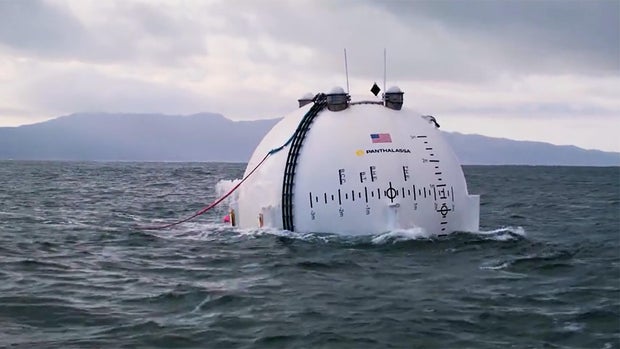
He likened Panthalassa’s test model, the Ocean-2, to a floating hydroelectric dam. “As it goes up and down with the waves, it causes water that’s in that tube to be forced up into the top. Once it’s in the ball, the water is forced through a turbine. The turbine spins, and that’s what makes the electricity.”
wave-energy-panthalassa-ocean-2-1920.jpg
A test of the Panthalassa Ocean-2 wave energy converter, which would generate electricity to power sea-based data centers. 

Panthalassa

Using a model of Panthalassa’s latest design, the Ocean-3, Sheldon-Coulson explained the most surprising part: there’s no anchor – and no cables. It’s a self-propelled system that is not tethered to the ocean floor. “It’s like a little Roomba, except it’s enormous,” he said.

garth-sheldon-coulson-ceo-and-co-founder-of-panthalassa-with-model-of-ocean-3.jpg
Garth Sheldon-Coulson, CEO and co-founder of Panthalassa, with a model of the Ocean-3.

CBS News

There’s no cable to bring power back to shore, either. In essence, these are floating data centers. They generate power from the waves; process AI computing tasks on the spot; and send us the answers by satellite.

“When you deploy many of our systems, they work together basically as a data center,” Sheldon-Coulson said. “So, we think of it as a really good alternative to data centers on land.”

Panthalassa has all of the private funding it needs, because it offers AI companies a quicker, cleaner way to get power than building data centers on land. Construction of the Ocean-3s is well under way. 

Sheldon-Coulson expects them to be operating off-shore by around August of this year. Their advantages? “Clean, no fuel, no land use, no getting in the way of other activities on land, and very fast to scale,” he said.

Eventually, the company hopes to deploy thousands of them, far out at sea.

“It is really exciting that we’re working on something that is coming along right at the right time, in a way that’s much cleaner, much more sustainable, and quite scalable, so that we can really meet that demand as it comes,” Sheldon-Coulson said.

    
For more info:

    
Story produced by Annie Iezzi. Editor: Emanuele Secci.


See also:

Juez ordena suspender el impuesto a las segundas residencias de Mamdani tras la demanda de los propietarios

Un juez de Staten Island bloqueó temporalmente el lunes la controvertida implementación del impuesto a las segundas residencias del alcalde de Nueva York, Zohran Mamdani, suspendiendo así la aplicación de una de sus principales promesas de campaña: gravar a los ricos.La orden del juez suspende la aplicación del recargo a las segundas residencias de alto valor en la ciudad mientras avanza una demanda presentada por un grupo de propietarios. El grupo alega que la ciudad incluyó erróneamente sus residencias principales en la lista de contribuyentes sujetos al impuesto.Bajo la orden de restricción temporal, la ciudad debe eliminar el registro público de contribuyentes y tiene prohibido emitir notificaciones adicionales mientras la orden esté vigente. La próxima audiencia está programada para el 31 de agosto.El juez declaró que las notificaciones de impuestos enviadas a los propietarios causaron un daño irreparable, ya que no explicaban por qué se les había incluido en la lista de contribuyentes sujetos al recargo ni advertían que quienes no solicitaran una exención estarían sujetos al impuesto.El fallo se produjo horas después de que Mamdani, en una conferencia de prensa el lunes por la mañana, prometiera defender enérgicamente la postura de la ciudad ante los tribunales.El impuesto sobre segundas residencias aplica un recargo a las viviendas no principales en la ciudad de Nueva York valoradas en al menos 5 millones de dólares, así como a los condominios y cooperativas valorados en un millón de dólares o más. Este impuesto se promulgó como parte del presupuesto estatal y se convirtió en ley en mayo, con el objetivo de reducir el déficit presupuestario de la ciudad. La gobernadora Kathy Hochul anunció la propuesta junto con Mamdani en abril y la promulgó.La demanda, presentada el viernes ante el Tribunal Supremo del estado en el condado Richmond, fue interpuesta por tres propietarios —Simon Hedley, Rachel O’Brien y Carmine Morano— quienes alegan que la ciudad identificó erróneamente sus viviendas como potencialmente sujetas al recargo, a pesar de que son sus residencias principales, según un comunicado de prensa.La demanda no cuestiona la legalidad del impuesto en sí, sino que impugna la publicación por parte de la ciudad de un registro fiscal que incluía los nombres, direcciones y valores de más de 900.000 propiedades residenciales de la ciudad de Nueva York —incluidas aquellas no sujetas al impuesto—, así como las notificaciones enviadas a algunos residentes. Aproximadamente 17.000 propietarios recibieron cartas alertándoles de que podrían estar sujetos al recargo.“Estamos muy satisfechos con la decisión del juez, que ha reivindicado los derechos de millones de propietarios de viviendas en la ciudad de Nueva York que fueron sometidos a un proceso del que nunca debieron haber formado parte”, declaró Randy Mastro, abogado de los demandantes.The-CNN-Wire™ & © 2026 Cable News Network, Inc., a Warner Bros. Discovery Company. All rights reserved.
Read Next Story