
Using the ocean to power data centers

▶ Watch Video: Using the ocean to power data centers

There are two global problems you probably don’t like to think about. First, burning gas and coal is still heating up the planet. Second, the thousands of AI data centers popping up all over the country consume enormous amounts of power, which produces even more carbon pollution – and drives up our electric bills. And as Garth Sheldon-Coulson says, this is not going to stop. “We’re still at the beginning of this demand,” he said.

Sheldon-Coulson, the CEO and co-founder of Panthalassa, in Vancouver, Wash., hopes to address both problems at once with wave energy. “The ocean is really unlimited in terms of how much energy is available,” he said. “It will really be the cheapest energy on the planet.”

He likened Panthalassa’s test model, the Ocean-2, to a floating hydroelectric dam. “As it goes up and down with the waves, it causes water that’s in that tube to be forced up into the top. Once it’s in the ball, the water is forced through a turbine. The turbine spins, and that’s what makes the electricity.”
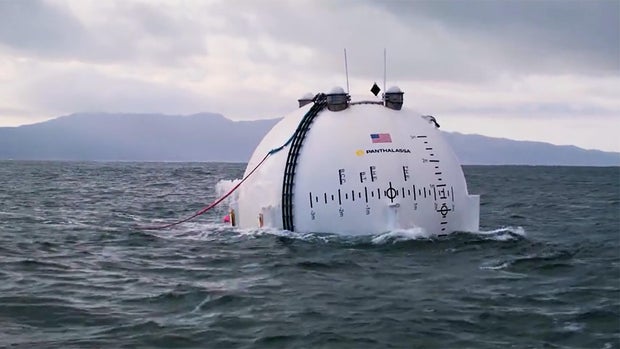
wave-energy-panthalassa-ocean-2-1920.jpg
A test of the Panthalassa Ocean-2 wave energy converter, which would generate electricity to power sea-based data centers. 

Panthalassa

Using a model of Panthalassa’s latest design, the Ocean-3, Sheldon-Coulson explained the most surprising part: there’s no anchor – and no cables. It’s a self-propelled system that is not tethered to the ocean floor. “It’s like a little Roomba, except it’s enormous,” he said.

garth-sheldon-coulson-ceo-and-co-founder-of-panthalassa-with-model-of-ocean-3.jpg
Garth Sheldon-Coulson, CEO and co-founder of Panthalassa, with a model of the Ocean-3.

CBS News

There’s no cable to bring power back to shore, either. In essence, these are floating data centers. They generate power from the waves; process AI computing tasks on the spot; and send us the answers by satellite.

“When you deploy many of our systems, they work together basically as a data center,” Sheldon-Coulson said. “So, we think of it as a really good alternative to data centers on land.”

Panthalassa has all of the private funding it needs, because it offers AI companies a quicker, cleaner way to get power than building data centers on land. Construction of the Ocean-3s is well under way. 

Sheldon-Coulson expects them to be operating off-shore by around August of this year. Their advantages? “Clean, no fuel, no land use, no getting in the way of other activities on land, and very fast to scale,” he said.

Eventually, the company hopes to deploy thousands of them, far out at sea.

“It is really exciting that we’re working on something that is coming along right at the right time, in a way that’s much cleaner, much more sustainable, and quite scalable, so that we can really meet that demand as it comes,” Sheldon-Coulson said.

    
For more info:

    
Story produced by Annie Iezzi. Editor: Emanuele Secci.


See also:

Young Americans have higher credit scores today than before Covid

New York (CNN) — Kelly Klein graduated from college with $100,000 in student loans that she feared would haunt her forever.“I expected I’d never pay off my student debt,” said Klein, who is 31 years old.But flash forward 10 years and Klein is now debt-free, her retirement account is flush and her credit score is pristine.“Every commission check I earned for the first six years went to paying off my debt. Every single penny,” said Klein, who is based in Nashville, Tennessee, and works as a loan officer at a community development financial institution.While millions of Americans are hurting from high prices and low hiring, new research suggests the finances of younger generations are displaying surprising resilience.Americans between the ages of 18 and 29 have higher credit scores today than they did just before Covid-19, according to FICO research shared first with CNN.Not only that, but that youngest generation’s 17-point increase in average credit scores since 2019 is the biggest among any age group FICO measured. The second biggest increase in credit scores over that timeframe was for the 30-to-44 cohort, otherwise known as Millennials.Most of the gains occurred during the initial stages of the health emergency when student loan payments were paused.Experts say younger Americans have benefited from access to better education about the importance of protecting credit scores to hold down payments later in life.“Gen Z is pretty savvy about credit. And they are more aware of credit scores, in part because there have been so many economic headwinds during their lives,” said Matt Schulz, chief credit analyst at LendingTree.‘A lot more knowledge’Overall FICO scores fell slightly between April 2025 and April 2026. However, credit scores for Gen Z are up by one point over that timeframe and roughly half have a very strong FICO score of 700 or above.Klein, who is a Millennial, said she learned valuable lessons about finance and investing from experts on social media. Klein also said she joined a free webinar on opening a brokerage account and familiarized herself with tax strategies and how to maximize credit card rewards.“We have a lot more knowledge than previous generations did. A lot of it was gate-kept, especially from women, and tailored toward men. Luckily, I feel like financial education is more available,” she said.Another factor: Younger borrowers are at or near the beginning of their credit journeys, giving them the most room to grow their credit scores. FICO said it doesn’t take into consideration age when scoring borrowers, but it does evaluate how long someone has been able to successfully make payments on time.As consumers take on different kinds of debt — moving from just credit cards and student debt to car loans and mortgages — they open themselves up to being better borrowers. That’s a key factor in determining credit scores.Schulz compared younger Americans increasing their credit scores with a new driver borrowing Mom or Dad’s car.“The first few times they might put some real restrictions on you. But if you show you can handle it over time, they might not think at all about letting you borrow the car. Credit is very similar,” Schulz said. “Having time and experience handling credit responsibly leads to credit scores being higher.”K-shaped economy is evidentMore emphasis on being responsible borrowers may help explain why, at a high level, average credit scores for younger Americans have held up better than might be expected in today’s economic environment, where high-income earners have seen their wealth grow faster than low-income earners.As of April, nearly half (49.6%) of borrowers aged 18-29 had a strong credit score of 700 or above, according to FICO. That’s up from 41.4% in April 2020.However, there are disparities beneath the surface that underscore the K-shaped economy.For instance, FICO said the score distribution for 18-29 year olds has shifted toward both higher and lower scores “rather than clustering in the middle.”In other words, high credit scores today for young people are higher than in 2019 — but so are low ones.“There’s a lot of fragmentation among Gen Z. Many of them are thriving. Some are struggling and relying on support from parents. We’re definitely seeing a K-shaped economy,” said Tommy Lee, senior director at FICO.3.2 million borrowers are behind on student debtOne pressure facing younger Americans is the spike in housing costs driven by elevated mortgage rates and record-high home prices.The average monthly mortgage payment for a first-time homebuyer is 57% higher than in 2019, according to FICO.Another arguably bigger factor is the return of student debt payments and credit bureau reporting after a Covid-era pause.As of April, about 3.2 million Americans of all ages with a student loan payment due (or 14%) had a recent delinquency (30 days or more past due) reported in the prior six months, according to FICO.Those borrowers who fell behind on their student loans and were deemed delinquent saw their FICO score decline by an average of 38 points.By contrast, another 4.9 million borrowers either resolved a delinquency or moved into another repayment status, such as starting a repayment plan. Those consumers experienced an average credit score increase of 16 points, according to FICO.Schulz, the LendingTree expert, stressed that missed payments carry severe consequences that can haunt borrowers for many years — especially when they need to get a mortgage.“It really only takes one payment 30 days or more late to really do damage to your credit score,” he said.The-CNN-Wire™ & © 2026 Cable News Network, Inc., a Warner Bros. Discovery Company. All rights reserved.
Read Next Story