
Mysterious ‘golden orb’ found in deep sea in 2023 is finally identified

▶ Watch Video: A dive to the deepest parts of all five oceans

Scientists have solved the mystery of a “golden orb” found thousands of feet underwater by researchers from the National Oceanic and Atmospheric Association in 2023, the agency said on Wednesday

The orb was found in the Gulf of Alaska, by a remotely operated underwater vehicle. The device was over two miles underwater when it spotted a “strange, golden, mound-shaped object with a hole in it, stuck to a rock,” NOAA said. It was collected and sent to the Smithsonian National Museum of Natural History for study. 

Allen Collins, the director of NOAA Fisheries’ National Systematics Laboratory and a zoologist, said that he thought “routine processes” would allow scientists to identify the object. But the orb proved trickier. 
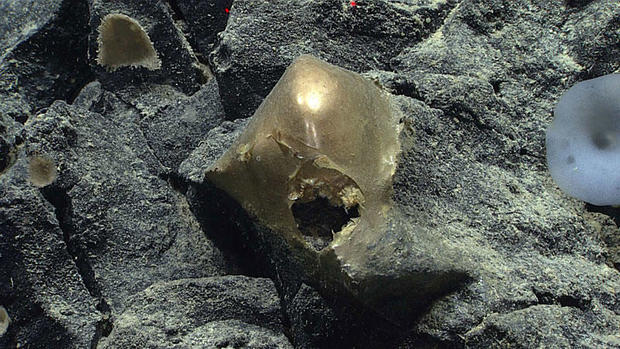
orb-800.jpg
Scientists with NOAA discovered an unidentified golden orb-like organism while operating a remote deep-sea diving vessel off the coast of Alaska on August 30.

NOAA

“This turned into a special case that required focused efforts and expertise of several different individuals. This was a complex mystery that required morphological, genetic, deep-sea and bioinformatics expertise to solve,” Collins said. 

First, scientists studied the physical structure of the orb. They found it didn’t have animal anatomy, but that it was a “fibrous material” covered with stinging cells, like an anemone or coral might be. Those cells were identified as spirocysts, a specialized cellular structure that can capture prey. Such cells only exist on one group of aquatic invertebrates, called cnidarians. 

The research team realized that the cells looked similar to the ones seen in a specimen collected in 2021. They compared the golden orb to that specimen, and found they were the same species. 

Initial DNA testing on the golden orb and the 2021 specimen was inconclusive, but whole-genome sequencing showed that both were “genetically almost identical” to a kind of cnidarian called Relicanthus daphneae. More analysis allowed the team to determine that the orb “had once been part of the base of a giant sea anemone,” NOAA said in a video explaining the process

The golden object that caught everyone’s eye is usually hidden underneath the anemone, NOAA said, but somehow, this one “seems to have been left behind.” Scientists still don’t know what happened to the top of the anemone. In the video, NOAA suggested it might have died or moved to a new home. 

The full anemone has a pink-colored, cylindrical body that can grow to up to three feet across, according to researchers. Its tentacles can be up to six feet long. It stinging spirocysts are the largest among all known cnidarians.

“So often in deep ocean exploration, we find these captivating mysteries, like the ‘golden orb,'” said NOAA Ocean Exploration acting director William Mowitt. “With advanced techniques like DNA sequencing, we are able to solve more and more of them. This is why we keep exploring—to unlock the secrets of the deep and better understand how the ocean and its resources can drive economic growth, strengthen our national security, and sustain our planet.” 

ICE plans to spend up to $20 million on electrical shock gloves for agents

(CNN) — Immigration and Customs Enforcement agents and officers may soon be equipped with gloves that deliver electrical shocks, which the manufacturer says are intended to de-escalate encounters with individuals.ICE is planning to spend between an estimated $10 and $20 million to purchase the devices, known as CTG 5 G.L.O.V.E, which stands for Generated Low Output Voltage Emitter, according to a notice published Monday by the Department of Homeland Security.The devices would be delivered by March 31, 2027, according to the contract previewed on DHS’ portal for forecasting contract opportunities. It’s unclear how many DHS intends to purchase, the cost per glove and when officers would begin using them.The notice comes as agencies enforcing immigration arrests face scrutiny over what critics call aggressive and dangerous tactics, and amid pressure from the Trump administration to make around 2,000 arrests a day.The DHS portal referred to the devices as “a Conductive Distraction and De-escalation Device which will be issued to Homeland Security Investigations (H.S.I.) and Enforcement Removal Operations (ERO) officers and agents.”The Department of Homeland Security and the device manufacturer, Compliant Technologies LLC, did not immediately respond to CNN’s requests for comment.DHS told the Associated Press, which was first to report the story, that it was working on a response to its inquiry but had no immediate statement. Jeff Niklaus, the founder and CEO of Compliant Technologies, told AP by email that the company was unable to comment.Compliant Technologies markets the G.L.O.V.E as a “wearable de-escalation device” that can be shifted into electrical mode. According to a user manual for the CTG4 and 5 models on Compliant Technologies’ website, the gloves can deliver a maximum voltage of up to 380V that “inhibits/ distracts the subject from performing coordinated muscle movement.”The manual says no more than two gloves should be applied to a subject at one time and they should not be used for more than 15 seconds in many instances. If an incident occurs in which “the officer(s) or the public has become endangered,” it is suggested the gloves are used as necessary until “control and compliance” is gained, or to use a higher level of force.The gloves must come into direct contact with the skin and are not effective through clothing or hair, the user manual states.On its website, the company says the gloves are intended to “supplement existing tools for law enforcement, corrections, security, EMS and the military,” and called it an “’invisible partner’ to enhance the user’s effectiveness when operating within their agencies’ already established tactics, techniques and procedures.”The company warns the gloves should not be used as a “punishment” or on high-risk individuals including those who are pregnant, elderly people, small children and severely disabled individuals. The company also warns against deploying for “verbal defiance or belligerence.”Anyone who uses the gloves must be certified and recertified every other year to continue using them, according to the user manual.The DHS notice said the solicitation for a no-bid contract could be published as early as Friday.‘Compliance within three seconds’Similar devices have been used before in some law enforcement and corrections operations.In 2024, CNN affiliate KOKH reported the Oklahoma County Jail planned to begin using electric gloves produced by the same company, which could zap inmates at a rate of at least 210 volts.Compliant Technologies’ Oklahoma distributor, Justin Morris, said at the time the way the technology is used isn’t capable of causing injury.“We’re only grabbing enough motor units across the skin to stimulate the peripheral nervous system. Just the sensory portion of that. So, we don’t cause any injury with our device,” Morris said, according to KOKH, adding “we usually get compliance within three seconds.”John Peters, president of the Institute for the Prevention of In-Custody Deaths, who is studying how the device has been used, told the AP that the feeling is “immediate and sharp, and it will distract you. I call it like a bee sting.”“If the officer is getting any type of resistance from the person, this is certainly an effective tool,” Peters said. “For smaller officers or weaker officers or older officers, I think it has a great advantage” because it can produce faster takedowns and shorten confrontations, he added.Oklahoma County Jail’s then-CEO told KOKH in 2024 that the device is ideal for her majority female staff.The devices have, however, also been used in prior incidents resulting in criminal charges, according to South Carolina’s The State newspaper, citing the South Carolina Law Enforcement Division.In 2022, two corrections officers at the Laurens County Detention Center were charged in with beating and shocking an inmate with “a wearable G.L.O.V.E. stun device” in two separate incidents, according to SLED, the newspaper reported.Kica Matos, the president of the National Immigration Law Center slammed the proposal to equip ICE officers and agents with the gloves.“This is a rogue agency with an $80 billion slush fund that allows them to concoct and fund new ways to visit cruelty upon our communities,” she told CNN, describing the possible arming of agents with the gloves as “disgusting and barbaric.”Civil rights advocates, including from the American Civil Liberties Union, also expressed alarm at the plan.Jenn Rolnick Borchetta, deputy project director on policing at the ACLU, told the AP the public should have no confidence that ICE officers will use the devices appropriately and she questioned why the devices would be necessary for civil immigration enforcement.“ICE spent the last year showing this country they are too quick to use force. Now they will be able to deploy electric shocks with the slight push of a button that maybe nobody else can see them do,” she said. “Introducing gloves that can so easily be used to deliver terrible pain in encounters is a recipe for harm to the public.”The-CNN-Wire™ & © 2026 Cable News Network, Inc., a Warner Bros. Discovery Company. All rights reserved.
Read Next Story