Mars rover carries out chemistry experiment never done beyond Earth

▶ Watch Video: Curiosity Mars rover turns 10

NASA’s Curiosity rover has discovered more building blocks of life on Mars after carrying out a chemistry experiment never before conducted on another planet, scientists said Tuesday.

The organic molecules are not definitive evidence of past life, the NASA-led team emphasized, because they could also have formed on the red planet or crash-landed on meteorites.

But it proves that these important clues to Martian history have been preserved on the surface for more than 3 billion years, they added.

Back then, the surface of Mars was thought to have been dotted with huge lakes and rivers full of liquid water, a key ingredient for life as we know it.

“The ongoing characterization of organic matter on Mars is a pillar of modern robotic exploration, as space agencies send rovers and landers to explore Mars’ past and present habitability and to search for signs of life,” the authors wrote in the study published on Tuesday in the journal Nature Communications.

Curiosity landed in a former lake bed called the Gale crater in 2012, and has been searching for signs of possible past life since.

The car-sized rover carried two tubes of a chemical called TMAH, which can break apart organic matter to see what it is made out of.

“This experiment’s never been run before on another world,” Amy Williams, an astrobiologist working on the Curiosity mission, told AFP.

The team was under pressure because they only had “two shots to get it right,” added Williams, the lead author of a new study describing the results.

The experiment, conducted in 2020, detected more than 20 organic molecules, including several that had never before been confirmed on Mars.
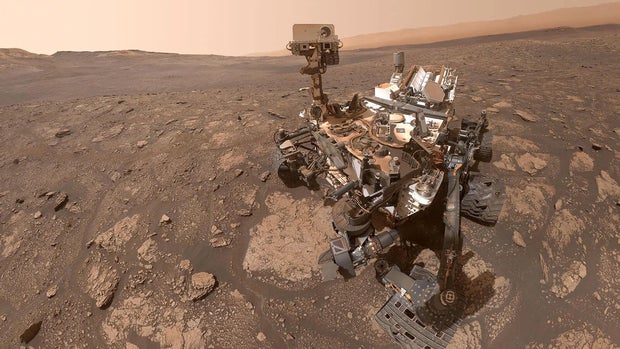
NASA rover adds to the list of organic compounds detected on Mars
NASA?s Curiosity Mars rover took this selfie at a location nicknamed “Mary Anning” after a 19th-century English palaeontologist in this image released by the U.S. space agency on Nov 12, 2020. 

NASA/JPL-Caltech/MSSS

These included a molecule called benzothiophene, which has also been found in meteorites and asteroids.

“The same stuff that rained down on Mars from meteorites is what rained down on Earth, and it probably provided the building blocks for life as we know it on our planet,” Williams said.

Another molecule containing nitrogen “is a precursor to how DNA is eventually built,” she added.

“We cannot yet say that Mars ever harbored life, but our findings further support the evidence that Mars was a habitable world around the time that life on Earth originated,” Williams told Reuters.

Future missions

But none of this can prove that life — even tiny, microbial organisms — once flourished on Mars.

One way to potentially make such an “extraordinary claim” would be to bring some Martian rocks back to Earth so scientists can study them more closely, Williams said.

NASA’s Perseverance rover has already collected a bunch of rocks for such a mission, called Mars Sample Return.

However the mission has effectively been canceled by the administration of President Trump following a vote in Congress in January.

Last year, Perseverance uncovered rocks in a dry river channel that may hold potential signs of ancient microscopic life on Mars.

Future missions could still benefit from Curiosity’s demonstration that experiments using the TMAH chemical work on other worlds.

The European Space Agency’s Rosalind Franklin rover, which has a much longer drill than Curiosity, will take the chemical to Mars.

After years of delays, NASA announced last week the ESA’s rover is now scheduled to blast off toward the red planet in late 2028.

The chemical will also be on board the Dragon rotorcraft, which is planned to launch in 2028 on a mission to explore Saturn’s moon Titan.

The latest discovery by Curiosity follows a series of recent images taken by the rover.

Last June, Curiosity captured the first close-up images of a part of Mars scientists say provide evidence of how water once flowed on the red planet. The ridges look like spiderweb patterns from space and had previously only been observed from orbit, NASA said.

Five months prior, the rover captured new images showing colorful clouds in the sky over Mars.

Nigel Farage wins election in which his main rival was a trash can

(CNN) — When voters in the English seaside constituency of Clacton went to the polls on Thursday, they ostensibly had more choice than in any other election in British history.Thirty-four candidates stood in this by-election, the equivalent of a US special election, making the ballot paper 3 feet long. But almost all the country’s half-dozen major political parties declined to participate, with only the populist hard-right Reform UK party fielding a candidate – its leader Nigel Farage.Farage was ultimately re-elected by a substantial margin, winning 22,239 votes. He had declined to attend the results ceremony, citing a police warning about a campaign to disrupt it.His main opponent, Count Binface – a self-described intergalactic space warrior dressed as a trash can – won a creditable 9,455 votes.But this election, rather than helping to solve Farage’s problems as he perhaps hoped, has only added to them.The country’s chief anti-immigrant activist and Brexit architect, Farage was already the member of parliament (MP) for Clacton but resigned from parliament – triggering the by-election – after facing unprecedented scrutiny over his finances. Those challenging him were Binface and 32 other fringe or novelty candidates.The spectacle promptly became an object of ridicule, derided as a “circus” by commentators, while the claims over Reform’s finances refuse to go away. At the same time, Farage faces both a split in his natural coalition of voters and a more formidable opponent in Britain’s new center-left prime minister, Andy Burnham. Such headwinds are unfamiliar for Reform, which had previously been in the ascendancy, leading national opinion polls and enjoying historic gains in local elections.Novelty candidatesFarage resigned as Clacton’s MP six weeks ago, as a steady drumbeat of allegations surrounding his and his party’s financing forced him to confront questions he hadn’t previously had to answer in his political career.He has consistently denied any wrongdoing, and said: “I’ve decided the people of Clacton should be the judges of my actions” when triggering the by-election.Farage sought to frame the contest as him taking on the establishment. But, said Tim Bale, a professor at Queen Mary University of London who studies right-wing politics, “it’s not worked because the other political parties … declared they wouldn’t stand, meaning the … framing has been him versus a bunch of novelty candidates.”And holding an election has opened Farage to criticism over its cost, which is expected to be around £250,000 ($338,000). The public is legally bound to pay that, despite Farage’s protestations that Reform would foot the bill.Before Farage resigned, he was facing an investigation by the parliamentary standards committee and that inquiry will resume now he has been re-elected. If it finds he breached parliamentary guidelines, that will trigger a process which could ultimately lead to another by-election. The other major parties would be expected to field candidates in that vote.Challenge from the rightWhile Farage is caught in this election spin-cycle, the grip he holds over his voter base is also faltering. Reform is now facing a challenge from its right flank as the newly established party Restore Britain – founded by former Reform MP Rupert Lowe – siphons off a small but significant portion of voters.Lowe, who has a longstanding feud with Farage, was forced out of the party last year and subsequently started his own, egged on by US billionaire businessman Elon Musk. Now sensing an opening, Lowe has sought to form an alliance with Farage, conditioned on Farage accepting some of Restore’s more extreme policies. Farage has not so far appeared keen to bury the hatchet.“A pact would be tricky because Restore’s policies are so extreme that adopting them would make Reform less attractive to voters who aren’t really into the whole far-right package,” Bale told CNN.All this comes against the backdrop of a new national government. Labour leader Burnham is more popular than his predecessor Keir Starmer and has already proven his ability to take on Reform during his successful return to parliament earlier this summer.In this by-election, Farage has only proven his ability to defeat an intergalactic space warrior with an upturned trash can on his head. Of course, Count Binface is not actually from space; he is a satirical character created by the comedian Jon Harvey, and has stood in several other elections.“Until August 13th, I want it to be absolutely clear that there is nowhere at all that matters to me more in the cosmos than Clacton,” he told CNN’s Max Foster from his “starship,” which he said he had transformed using a holodeck “to create the precise look of a budget hotel in Clacton.” Farage did not respond to an interview request from CNN.Binface’s manifesto is packed with national in-jokes, like promising to “cut your taxes, and raise everyone else’s,” nationalize the singer Adele and impose a “windfall tax on cosy crime novels written (or ‘written’) by celebrities.”Outlandish costumesBinface is just one in a long line of satirical candidates dating back more than six decades, who have become a unique staple of British elections. Almost anyone can run for parliament in the UK – only a £500 ($675) deposit and 10 supporters of the bid are needed – allowing for people to make their joke, or point, without too much trouble.The tradition took hold in 1963, when a young musician later known as Screaming Lord Sutch stood in a by-election. He would contest 41 parliamentary seats in all, including against three sitting prime ministers, and founded the Official Monster Raving Loony Party in 1982, according to its website.None of the party’s candidates — think Nick the Incredible Flying Brick and its current leader, Howling Laud Hope — have ever been elected to Westminster. But it inspired others to follow in its footsteps, and its three candidates in Clacton together took 61 votes.Behind the jokes, some campaigns have carried serious messages, like a man dressed as a fox advocating for animal rights who stood shoulder-to-shoulder with Burnham when the former Manchester mayor returned to parliament in June.Several of the late Sutch’s policies, such as lowering the voting age from 21 to 18 and legalizing commercial radio, were eventually enacted. Still, some have derided the spectacle of novelty candidates.As for Binface, his vow to be a unity candidate was not enough to win, despite his pre-vote bravado.The-CNN-Wire™ & © 2026 Cable News Network, Inc., a Warner Bros. Discovery Company. All rights reserved.
Read Next Story