
Humanoid robot beats human half-marathon world record in Beijing

▶ Watch Video: Video shows humanoid robot setting record in half-marathon in Beijing

A humanoid robot aptly named Lightning made history on the streets of Beijing over the weekend, beating the human half-marathon world record by several minutes.

Dozens of robots lined up for the Beijing E-Town Robot Half Marathon on Sunday, tackling the 13-mile (21-kilometer) race separate from human runners.

Developed by Chinese smartphone company Honor, Lightning completed the half-marathon in just over 50 minutes, besting the human world record for the distance of over 57 minutes.

A Lightning humanoid robot by Honor crosses the finish line of the second Beijing E-Town Half Marathon and Humanoid Robot Half Marathon in Beijing, China, April 19, 2026.

Reuters/Maxim Shemetov

Lightning’s creators were delighted with the result. Du Xiaodi, a development engineer at Honor, was quick to draw comparisons with other industries.

“Looking ahead, some of these technologies might be transferred to other areas,” said Du. “It’s similar to how the automotive industry initially developed through competitions.”

The event tested robots in real-world conditions, from balance and endurance to navigation. Some ran autonomously, while others were controlled remotely, all competing on a parallel course to avoid collisions with human athletes.

It wasn’t flawless. A few robots stumbled or veered off course, and one was carried away on a stretcher after breaking to pieces in a fall.

Humanoid Robot Half Marathon in Beijing
Staff carry a humanoid robot that crashed after the finish line of the second Beijing E-Town Half Marathon and Humanoid Robot Half Marathon in Beijing, China, April 19, 2026.

Maxim Shemetov / REUTERS

But the progress was striking compared to last year, when most struggled to even finish the race.

Some spectators weren’t worried by the failures.

“I’m very excited,” said Sun Zhigang. “First of all, it’s the first time robots have surpassed humans, and that’s something I never imagined.”

“Their performance is quite impressive,” Jiang Liangzhi said. “I didn’t expect the speeds to be this fast already, and they’re all very stable.”
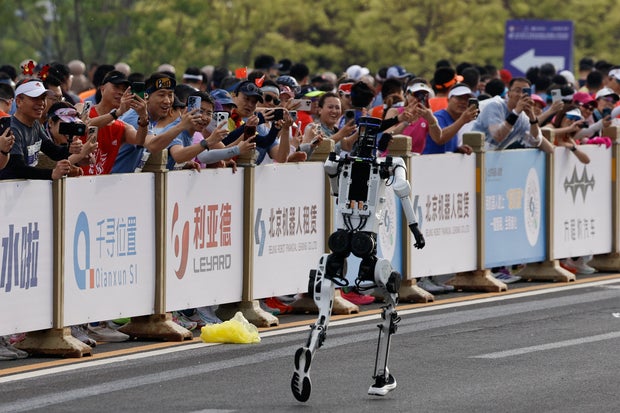
Runners participating in the second Beijing E-Town Half Marathon take pictures of the Tiangong Ultra 2026 humanoid robot participating in the Humanoid Robot Half Marathon in Beijing, China, April 19, 2026.
People take pictures of the Tiangong Ultra 2026 humanoid robot participating in the Humanoid Robot Half Marathon in Beijing, China, April 19, 2026.

Reuters/Tingshu Wang

Organizers said the marathon isn’t really about speed. It’s about pushing robotics technology beyond the lab with potential applications in manufacturing, logistics and even emergency response.

Chinese companies are pushing ahead with the development of robot technologies for both civilian and military uses, but Beijing’s robot half-marathon shows just how fast the future is moving from science fiction to sporting reality.

Second Beijing E-Town Half Marathon and Humanoid Robot Half Marathon in Beijing
Team members celebrate next to winning robot Lightning during a medial ceremony after the second Beijing E-Town Half Marathon and Humanoid Robot Half Marathon in Beijing, China, April 19, 2026.

Maxim Shemetov / REUTERS

How the Secret Service is cracking down on card-skimming scams

▶ Watch Video: See how the Secret Service is cracking down on card-skimming scams Many Americans may have encountered a predatory scam — and may not even know it. The U.S. Secret Service says the use of skimming devices, which capture account details and personal identification numbers from bank and government benefits cards, is on the rise. The devices can be set up in seconds on debit and credit card readers. CBS News joined the Secret Service, which investigates financial crimes as well as protecting the president, for a ride-along while agents searched for skimmers at hundreds of retailers across Los Angeles. Once the device is in place on a card terminal or ATM, it collects data every time a card is swiped. Often, a wireless transmitter hidden inside the skimmer sends the data to the scammer. Secret Service analyst Vince Porter told CBS News that officials believe a single skimmer can net up to $1 million in stolen funds.The devices are tough to recognize and harder to remove — in some cases, law enforcement has to pry the skimmer off, leaving residue behind. There's no way to know how long a device has been in use, Porter said. In 2025 alone, the Secret Service removed more than 400 illegal skimming devices, which the agency said accounts for just a fraction of the devices out there. A CBS News investigation has found 32 active federal probes spanning 15 states.The agency and law enforcement partners have noticed an increase in skimming activity in the past two years. As the crime becomes more common, the losses increase. Skimming costs financial institutions and consumers more than $1 billion each year, according to Secret Service estimates. Michael Peck, Assistant Special Agent in Charge of the Secret Service's Criminal Investigative Division, said that groups of organized criminals from outside the country are responsible for the scam. The groups enter the U.S. from Eastern Europe, Asia and Central and South America, Peck said, with many crossing the U.S.-Mexico border to enter the country. One subject was apprehended after traveling down from Canada on a Jet Ski, Peck told CBS News. "A one-stop crime" Criminals often target stores that take EBT cards, which hold government benefit money. A single government assistance card can receive thousands of taxpayer dollars from federal and state programs, including food stamps and Section 8 housing payments, each month. Many government assistance cards have to be swiped, leaving them without the added security of tap-and-pay or a chip. When stores advertise acceptance of these funds, they can become a target, Porter said. "It's a one-stop crime," he said. Victims often have little recourse. Once the benefits are stolen, they can be nearly impossible to recover because of the number of agencies involved in distributing the funds. Mary Bowen, a mother of six who relies on assistance, said she can't pay her rent or buy groceries because her benefits were stolen last week. "It just disappeared. I don't even have cash in here," Bowen said. "Literally, I've been getting food from my friends because they took everything. They took it all from me." As part of this operation, law enforcement visited 328 businesses and inspected 1,749 devices in California. They seized 16 skimmers, preventing an estimated $16.6 million in fraud loss, according to the Secret Service. Similar operations have been carried out in dozens of U.S. cities. Scams are most likely to be found in major cities like Los Angeles. But even in small towns, skimmers can pose a threat. To stay safe, avoid swiping as much as possible, Peck said. Government benefit cards usually need to be swiped, putting them at a disadvantage. But for those who have the option, using tap-and-pay is "the best way to protect yourself as a consumer," Peck said. 
Read Next Story