
▶ Watch Video: A robotics activist’s remarkable crusade
Restaurateur Tommy Fello was driving from his Ohio establishment to his house on Christmas Eve when he started veering off the road. Fello, then 71, had been awake since 4 a.m. local time preparing a holiday buffet for his family. He chalked the disturbance up to a flat tire. Driving slowly and relying on the vehicle’s autocorrect feature, he was able to complete his journey home safely.
But when Fello stepped out of the truck, he couldn’t get his balance.
“I finally realized it wasn’t the truck that was veering. It was me that was veering,” Fello said. He went indoors and talked to his wife and daughter, who said he looked unwell. About five minutes later, they called 911. Paramedics took him to an area hospital, where he lost all movement in his left arm and leg.
“They were literally just like appendages on me. I could not feel them and could not do anything,” Fello said.
A clot-busting drug reversed the stroke, but the numbness on the left side of his body, including his face, remained. He struggled to swallow, eat or drink. Physical and occupational therapy produced only minor improvements.
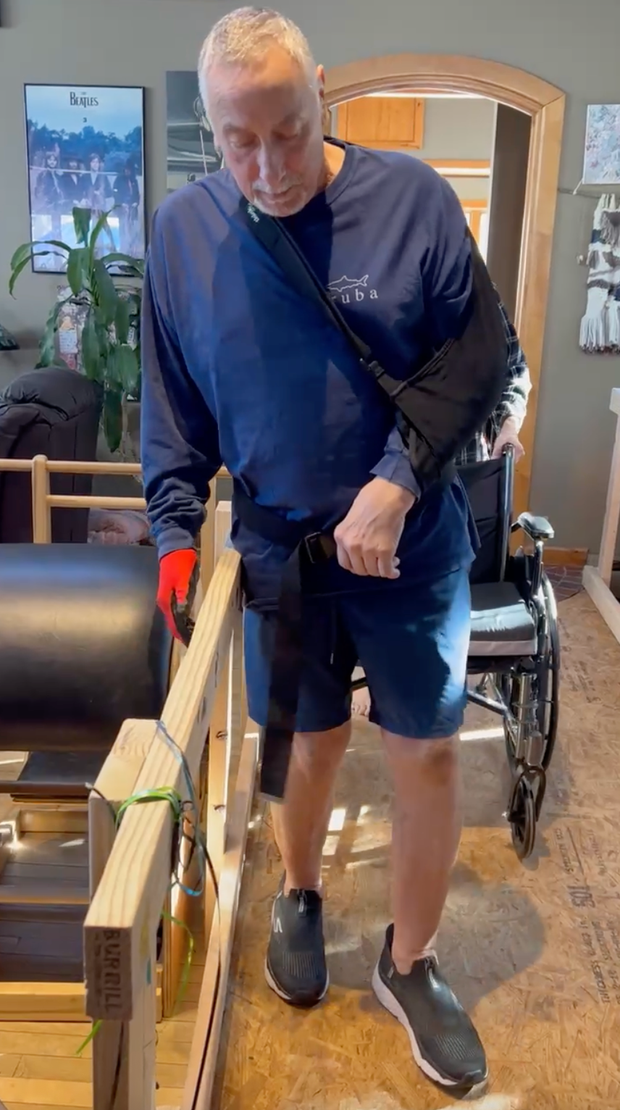
Thomas Fello
Dr. Sharon Covey, Fello’s occupational therapist and the founder of the Center for Stroke and Hand Recovery, Inc., told CBS News that his arm was essentially stuck in a bent position with his fingers curled when he met her in January 2024. The position and tension in the limb caused Fello constant pain. Working in his restaurant was out of the question.
“It was very scary. You take for granted so many of the things you do, and even the common, simplest things become like a chore,” Fello said. “We mark all these small victories … Being able to lift up your arm or pick up a cup is a gigantic accomplishment. Those little accomplishments are gigantic to a stroke victim. They encouraged me to keep going on. But there was always a thought in the back of my mind: ‘Is this as good as it’s going to get?'”
A “first-of-its-kind technology”
One day, another recovering stroke patient suggested Fello look into an implant called the Vivistim System. The FDA-approved implant, developed by the medical device company MicroTransponder Inc., uses vagus nerve stimulation during rehabilitation to improve hand and arm function for stroke victims. The vagus nerves are the body’s longest cranial nerve, with one on each side of the body, according to the Cleveland Clinic. They regulate the body’s involuntary functions.
The Vivistim Therapy system involves a physical or occupational therapist sending wireless signals to the device. That signal delivers a brief, gentle pulse to the vagus nerve while the stroke patient performs rehabilitative tasks. The stroke patient also does at-home exercises.
Dr. Erez Nossek, a neurosurgeon and director of the cranial bypass program at NYU Langone, told CBS News that the vagus nerve stimulation can enhance the brain’s ability to rewire itself, known as neuroplasticity. That increased neuroplasticity can result in “greater and faster improvements in motor function for stroke survivors,” Nossek said in emailed remarks.
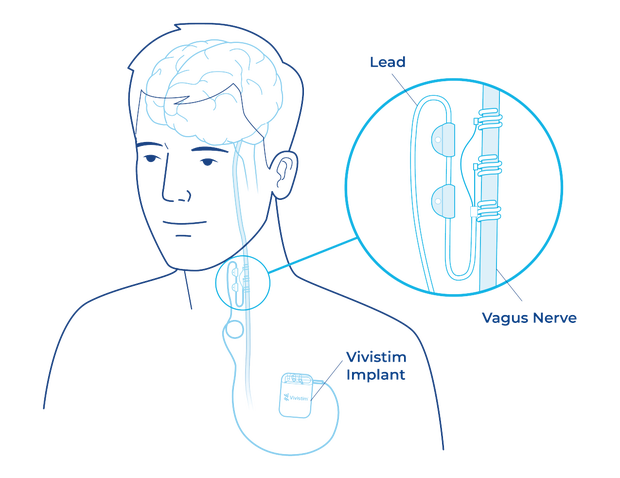
MicroTransponder, Inc.
“There is no other FDA-approved technology proven to boost neuroplasticity for stroke survivors, creating new connections in the brain, which is theirs to keep, even after the device is no longer in use,” Nossek said. “This is (a) first-of-its-kind technology that is redefining what is possible for this patient population.”
A 108-person trial published in The Lancet in 2021 found that the device generated two to three times greater improvement in hand and arm function for stroke survivors when compared with just rehab. Stroke patients who have limited hand and arm function six months or more after their stroke and are considered to have “moderate to severe deficits” qualify for the device, the company said in a fact sheet.
Implant aids in recovery
Fello turned to the Cleveland Clinic, where he met cerebrovascular neurosurgeon Dr. Mark Bain. He studies stroke recovery, especially in the cases of patients like Fello, whose rehab progress has plateaued months after the stroke. Bain determined that Fello was a candidate for the Vivistim System. Fello became the first Cleveland Clinic patient to receive the implant on April 29, 2025.
“It didn’t really scare me to try and do it. I was anxious to see how it worked,” Fello said.
The device was placed during an hour-long procedure. The vagus nerve sits just below the carotid artery, so Bain and his surgical team made a small incision to place the leads of the implant and hid the scar in a fold of Fello’s neck. The key-fob sized implant was placed under Fello’s clavicle. Bain said the procedure itself is low-risk, with “less than 1% chance of any complications.” Two weeks after the surgery, the device was turned on and Fello returned to his rehabilitative work with Covey.
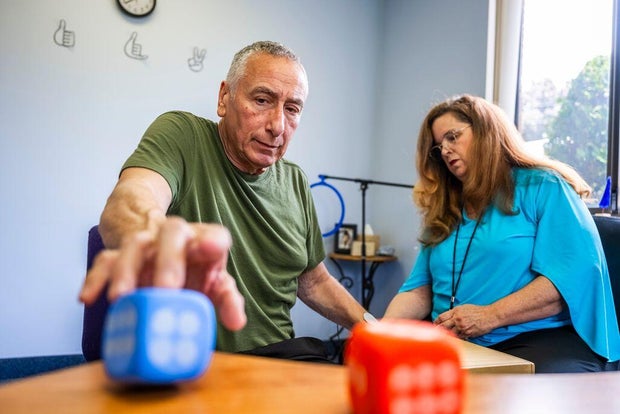
Cleveland Clinic
Covey said Fello has made huge progress since the device was implanted four months ago. She said he has no pain or tension in the limb, and is beginning to practice using his left arm to carry items. The task is difficult, she said, but isn’t “something he could have done before.” Fello, now 72, said he’s been thrilled by the progress he’s made in a short time.
“I’m very, very happy to do it, very proud to do it, and I’m glad I did it,” he said.
“The sky’s the limit”
About 800,000 people in the United States experience an ischemic stroke each year, Bain said. Vivistim and other new technologies may offer hope to the patients like Fello who struggle to recover with just rehabilitation, Bain said.
“I think over the next probably five to 10 years, what you’re going to see is an explosion of procedures, devices and things in rehab that will help people, once they’ve had strokes, to get their lives back,” Bain said. “In the future, I think the sky’s the limit for what we can expect for stroke recovery.”
At the time of his conversation with CBS News, Bain had given seven other stroke patients a Vivistim implant. Covey said at her practice, there are eight patients with the implant receiving the paired therapy course. MicroTransponder Inc. declined to say how many patients have received the implant, but shared a map that shows dozens of surgeons and rehabilitation therapists that provide the therapy.
“I think this is the newest, most effective strategy for people getting their affected limbs back,” Covey said. “This is the first real technique that has been available, at least in the last 20 years, for stroke rehab. The theories that we use as practitioners to increase somebody’s use of their affected arm are 50 to 75 years old. So this is a new technology that’s really going to turn the stroke recovery world upside down.”