
When Amber Meade twisted her ankle and broke a bone in her foot, she expected recovery to be easy. She needed surgery to shave down the damaged bone and make sure the nerves and tendons in her foot were where they should be.
The procedure seemed to go smoothly, but in the weeks that followed, she began to feel debilitating pain. A second surgery found that a screw placed in her foot had been pressing on the head of one of her nerves. That screw was moved, and a nerve decompression was performed but the pain didn’t stop.
“It would just turn black and blue, swell up really big, and I just was unable to put any weight on it,” 41-year-old Meade said.
The pain upended everything. She left her job as a surgical assistant since she could no longer stand for long periods. She was unable to take part in family activities with her two young sons. Even light breezes could trigger the pain. Resting under a blanket was unbearable, making sleep difficult. Meade compared the sensation to “walking on a hot bed of Legos constantly, while getting stabbed with a pencil.”
Meade spent months seeing different specialists. Finally, after nearly a year, a doctor suggested Meade might have something called complex regional pain syndrome. It was the first time Meade had heard of it. It would take even longer before she could find a treatment that helped her pain.
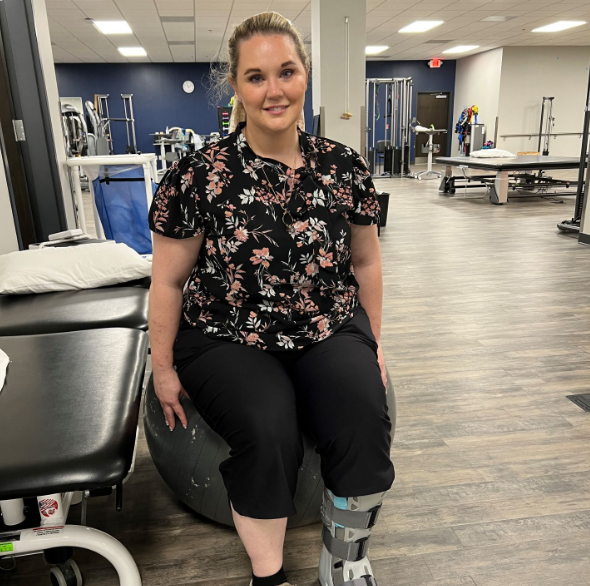
Amber Meade
What is complex regional pain syndrome?
Complex regional pain syndrome, or CRPS, is a chronic disorder with no cure, said Dr. Rohan Jotwani, an interventional pain specialist and anesthesiologist at NewYork-Presbyterian and Weill Cornell Medicine. Jotwani was not involved in Meade’s care. CRPS can occur after surgery, like Meade’s, or from other injuries to the nerve.
“For some patients, they’ll have an injury to a nerve and it will get better with time. For some patients, that injury will actually develop into its own chronic pain disorder,” Jotwani said.
Diagnosing the condition is difficult, Jotwani said. No test or scan can definitively identify it, and because it is a rare condition, many doctors may not be familiar with it, he added.
Physicians have to rely on clinical criteria. Telltale hallmarks for the condition are extreme levels of pain at the source, even when nothing should be causing it – like when a bedsheet causes pain, as Meade experienced. CRPS patients may also experience swelling, changes in temperature and skin color or texture changes. They may even begin to lose function in the affected area.
Diagnosing complex regional pain syndrome is only the start, Jotwani said. Actually treating the condition requires a “multi-pronged approach” that can vary from person to person. Treatment typically starts with physical therapy. Patients may also take medication to decrease nerve signals in the area, so they feel less pain, or try interventional techniques like a nerve block. Meade tried multiple options, but nothing was improving her pain.
“Doing regular therapies was not working. I even heard, at 33, that I was getting older and that ‘sometimes we just hurt more.’ I thought that was comical,” Meade said.
Treating complex regional pain syndrome
In 2022, long after Meade’s pain started, a doctor suggested she see physical therapist Dr. Anita Davis, who specializes in treating the condition and leads the comprehensive pain rehabilitation program at Brooks Rehabilitation in Florida. The pair worked to develop a physical therapy routine that would work for Meade.
“Before me, she had all of the traditional exercises … and those things were just not possible with that much pain in her foot,” Davis said. “As healthcare providers, we ask patients to rate the pain from zero to 10. These folks are typically going to be at the top of the scale, even on a good day. When I ask her to do something that’s painful on top of her existing pain, it’s just crazy to think about doing that.”
They also worked on relaxation and emotional exercises to cope with the mental load of the constant pain.
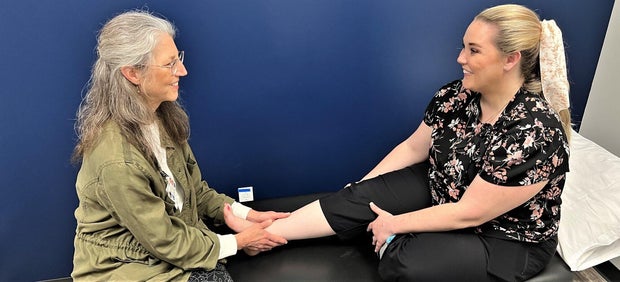
Brooks Rehabilitation
“Pain management for Amber … isn’t just the physical aspects,” Davis explained. “Anything that enhances relaxing the nervous system is valuable.”
The protocol led to some improvements for Meade, but while CRPS patients can have “symptoms subside for a length of time,” it is “a lifelong condition,” Davis said.
“There’s not a cure for it,” Davis said.
Working towards a less painful future
Meade said she still feels pain and discomfort, and is at risk of flare-ups when the weather changes or if she steps the wrong way. In addition to working with Davis, she is taking medication and receiving ketamine infusions every few months. She said the combination of ketamine treatment and physical therapy allows her to “do a lot more than I have been able to.” The effects of the infusion usually last around four weeks. Meade uses that period to work on strengthening her body.
“I try to make some headway in my physical health before that starts going down, because I know it’s going to,” Meade said. “The pain is a lot less when my physical health is better.”
Meade said even without the effects of the infusions, she is dealing with less pain than before her diagnosis and treatment. She can focus on her day-to-day activities. She sleeps better and can walk on the beach, one of her favorite activities. She can’t do too much running around with her kids, but she can play catch and help with homework most days. Meade said she hopes to improve her functionality and eventually go back to work and be more active, but for now, she is grateful for what she has gained.
“I want to try to get to that point where I have less and less flares, and get up to doing what everybody enjoys doing: Working, coming home, having something to work towards, going on vacations,” Meade said. “Every time I have a good day, we work a little bit harder.”