
Conductor John Mauceri is no stranger to health struggles. He was diagnosed with psoriatic arthritis in 2017, then chronic lymphocytic leukemia and interstitial lung disease in 2019. Medication treated the conditions and sent the cancer into remission, but he has remained on the lookout for recurrence.
In December 2023, Mauceri, then 78, contracted COVID-19. He struggled to climb the stairs and developed a “troublesome” cough. He went to the emergency room at NYU Langone, where he has previously received medical care. An X-ray found viral pneumonia and severe lung disease. Doctors removed three liters of liquid from his left lung. The only relief, he said, was that there was no trace of cancer. He left the hospital about a week later.
Within weeks, new symptoms quickly emerged. First, his left ankle swelled. Then the swelling continued up his leg. As the weeks passed, the swelling entered his abdomen and inched down his right leg. At one point, Mauceri was gaining a pound every day. He was also dealing with fatigue and shortness of breath. He couldn’t conduct.
“I was wearing somebody else’s body, at least from my waist down. I couldn’t wear normal clothes,” Mauceri said. “Putting shoes on was hard. I couldn’t walk through my house.”

John Mauceri
No one on his care team could identify what was causing the symptoms.
“I had an oncologist, I had a pulmonologist, a rheumatologist. I had a lot of doctors, and they all thought it was somebody else’s domain,” Mauceri said.
Searching for a diagnosis
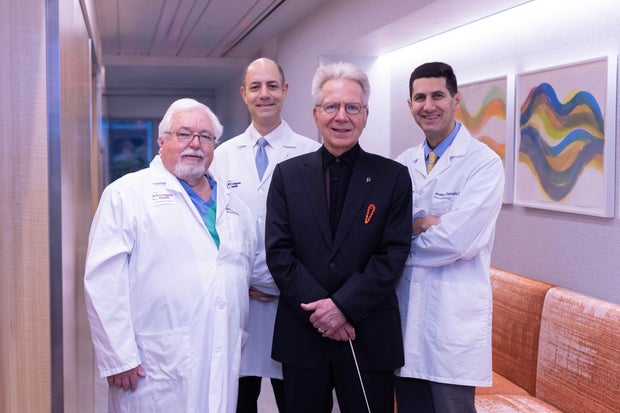
Dr. Adam Skolnick, a cardiologist at NYU Langone and one of Mauceri’s doctors, said the team first looked for more common causes for the swelling. Mauceri underwent MRIs and other tests. An exam found his lymph system was working normally. Cardiac catheterization, where a thin tube is guided through the heart, found no signs of heart disease. There were no signs of blood clots, cancer recurrence or other likely conditions.
Meanwhile, the swelling was beginning to strain Mauceri’s body, putting him at risk of multi-organ failure.
While studying the images of Mauceri’s heart, Skolnick began to form a theory. But “the only definitive way to fully diagnose and treat Mr. Mauceri would be through surgery to open the chest,” the doctor said.
What is pericardial constriction?
Skolnick thought Mauceri might have pericardial constriction, which occurs when the sac around the heart, or the pericardium, is thickened by scarring. That prevents the heart from fully opening. It can create pressure, resulting in swelling in the legs and abdomen.
It’s a rare condition that is usually acquired because of a prior illness, Skolnick said, including viral infections like COVID-19.
Since there are no tests that look at the pericardium specifically, Mauceri would have to undergo open-heart surgery to confirm the diagnosis. The condition would also be treated in that same surgery. After Mauceri’s care team eliminated all other possible options, they decided it was time to go into the operating room in June 2024.
Haley Ricciardi
Mauceri accepted that the surgery was his only option.
“There was no alternative,” he said. “I said, ‘Well, let’s just do it.'”
A high-risk surgery
Dr. Eugene Grossi, a cardiothoracic surgeon and leader of NYU Langone Heart’s robotic surgery team, performed Mauceri’s surgery. When he opened the conductor’s chest, he found that Mauceri’s “heart was trapped” inside a thick shell of scarring. Typically, the pericardium is like a paper bag. Mauceri’s was like shoe leather, Grossi said.
“You don’t think about it, but your lungs expand with every breath you take. Your chest wall opens. Your lungs expand. The heart does also, because it has to be able to accept the blood that’s coming back from your arteries and veins. And his was just trapped,” Grossi explained. That entrapment leads to fluid retention, creating swelling, Grossi said.
Under the scarring, Mauceri’s heart was functioning well. With the diagnosis made, Grossi and the surgical team had to scrape the pericardium and attached scar tissue carefully off the heart. Removing the pericardium creates no lasting health issues, but the procedure, called a pericardiectomy, is a delicate one.
“It’s almost like the heart is a hard-boiled egg, and we’re peeling off the shell,” Grossi said.
Mauceri’s procedure went smoothly, his doctor said. Once the pericardium was removed, Mauceri’s urine output bag began to fill, proving to the surgeons that the pressure was off and blood was pumping smoothly.
“Every day is a miracle”
After Mauceri was released from the hospital, he quickly began losing weight. He said he feels like he’s in the best shape he’s been since college.
“This is extraordinary because not only did I survive it, but I’m stronger than ever as a result of it,” Mauceri said.

John Mauceri
His health struggles didn’t end immediately. Shortly after the heart surgery, he was hospitalized again for a blockage of the small intestine. That was quickly treated, again at NYU Langone, but it slowed his recovery. It wasn’t until December 2024, more than a year after he was diagnosed with COVID-19, that Mauceri was able to conduct an orchestra again.
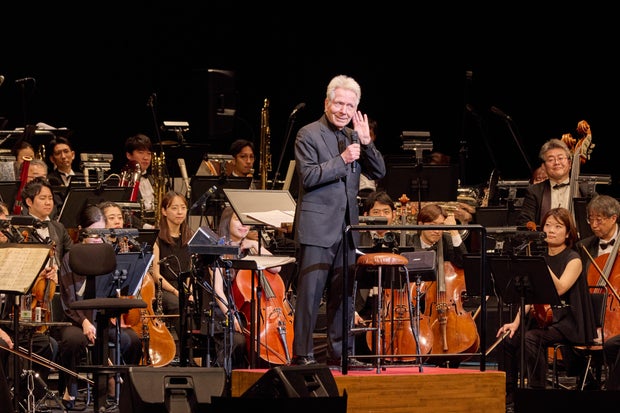
Mauceri conducted back-to-back performances in London and Paris, getting used to being onstage again. In May, he traveled to Japan to conduct in Tokyo. The 13-hour flight and long performance days felt like the first test of his endurance after his illnesses, he said. The performance was a raging success.
Takayuki Shimizu
Mauceri said he has no plans to slow down now that he’s back to work. In between spending time with his family in New York City, he plans to travel the country for other concerts, including at the Hollywood Bowl in October, shortly after his 80th birthday.
“I was conducting as if I wasn’t on the cusp of being 80 anymore,” he said. “I was allowed to do that because my doctors gave me this added time in my life where I can do that. So every day is a miracle. Every day I’m grateful for what they did.”