
Sundance Film Festival moving to Boulder

▶ Watch Video: Sundance Film Festival moving to Boulder

The iconic Sundance Film Festival will be moving from Park City, Utah to Boulder, Colorado, starting in 2027, the festival and the Colorado Governor’s Office announced on Thursday.

The search for a new host city has been years in the making, with the festival announcing the search in 2023 and several cities, including Boulder, as possible new hosts being announced last year.

“Colorado is thrilled to welcome the Sundance Film Festival to its new home in Boulder starting in 2027,” Colorado Gov. Jared Polis said in a statement. “Here in our state we celebrate the arts and film industry as a key economic driver, job creator, and important contributor to our thriving culture. Now, with the addition of the iconic Sundance Film Festival, we can expect even more jobs, a huge benefit for our small businesses including stores and restaurants.”
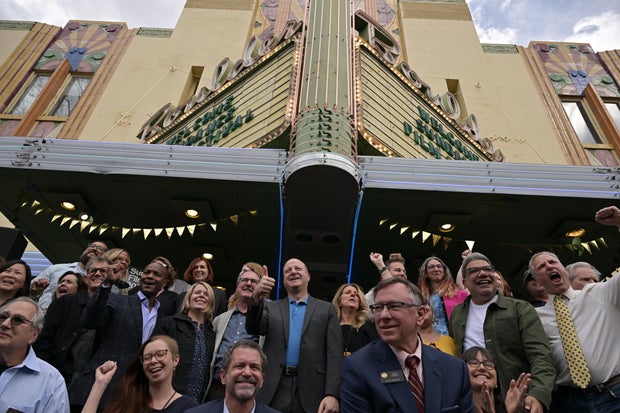
sundance film festival
Gov. Jared Polis, center, stands for a photo during a press conference at the Boulder Theatre to announce that the Sundance Film Festival will be moving to Boulder in 2027 at the Boulder Theatre on Thursday, March 27, 2025.

Hyoung Chang/The Denver Post via Getty Images

“This decision was informed by a detailed evaluation of the key components essential to creating our Festival. During the process, it became clear that Boulder is the ideal location in which to build our Festival’s future, marking a key strategic step in its natural evolution,” Sundance Institute Board Chair Ebs Burnough said.

The Sundance Film Festival takes place every January. The Boulder Film Festival will likely be pushed back by about a month, officials behind that festival previously told CBS News Colorado.

Utah was home to the international film festival for 42 years, but festival organizers said the festival has outgrown its home.

Since entering the selection process, state and local leaders in Colorado have mounted considerable efforts to get the festival moved to Boulder, citing the city’s concentration of artists, its history of culture, and the revenue benefits to the city and state.

“I founded the Sundance Institute with a commitment to discovering and developing independent artists, with the Sundance Film Festival serving as the platform for stories to help expand audiences and broaden the landscape,” Robert Redford, Sundance Institute president and founder, said in a statement. “This move will ensure that the Festival continues its work of risk taking, supporting innovative storytellers, fostering independence, and entertaining and enlightening audiences. I am grateful to the Boulder community for its support, and I look forward to seeing what the future holds for the Festival there.”

As part of Boulder’s efforts to attract Sundance, the state legislature is considering up to $34 million in refundable tax credits, which would kick in by 2027, when Sundance is set to relocate here. Some state lawmakers oppose that move, however, with one saying it was unfair to ask the entire state to subsidize what would largely only benefit one community.

Nonetheless, the efforts didn’t stop there. City leaders in Boulder previously said that local hotels have already committed to capping room price increases during the 11-day event.

“Our walkable downtown, iconic venues, and beautiful landscape at the base of the Rocky Mountains sets the stage for the Sundance Film Festival to flourish in its next chapter,” said Charlene Hoffman, CEO of Visit Boulder. “It’s been a remarkable experience getting to share our vibrant community with the Sundance Institute and we eagerly await the Festival’s debut in beautiful Boulder, Colorado with excitement and gratitude.”

A study by the State of Utah found Sundance had nearly 73,000 attendees in 2024, generating $132 million in economic output, $14 million in tax revenue, and $70 million in wages.

“Boulder is an art town, tech town, mountain town, and college town. It is a place where the Festival can build and flourish. This is the beginning of a bold, new journey as we invite everyone to be part of our community and to be entertained and inspired,” the Sundance Institute’s acting CEO Amanda Kelso said. “We can’t imagine a better fit than Boulder.”

The Buffalo Bills’ new stadium has some seats with obstructed views. What’s worse are the ticket prices

(CNN) — The Buffalo Bills play their first preseason game at their new Highmark Stadium on Saturday, but season ticketholders got a sneak peek at an open practice last week.Some weren’t happy.Social media was flooded with photos showing obstructed views of the field from some seats. Even though a handful of fans were upset over sightlines, there is an even bigger problem: how costly attending games will be in the new $2.2 billion stadium.That includes higher ticket prices and personal seat licenses (PSLs), which just give fans the right to buy season tickets, not the tickets themselves. PSLs cost $750 to $50,000 per seat. That comes on top of the $850 million in taxpayer money already paid to fund construction.Season ticketholder Angelica James, whose seats between the 20- and 30-yard lines wasn’t blocked, said she chose to go with worse seats this year for the same cost as last season. However, she’s not angry at her team.“It’s not just the Bills,” she said. “It’s everyone in the world is trying to make money.”Five other National Football League teams are planning new stadiums in the next five years, in Hammond, Indiana (for the Chicago Bears); Cleveland; Kansas City; Tennessee; and Washington, DC. They are all likely to arrive with their own PSLs, higher ticket prices and more premium seats, meaning fewer cheap ones.The NFL’s last building boom at the start of this century raised the average cost of tickets by 30% during the first year of a new stadium, according to Victor Matheson, professor of economics at the College of the Holy Cross who specializes in the business of sports. He expects this next round will increase ticket prices by the same percentage, if not more, as well as more expensive PSLs.PSLs are automatically included in new NFL stadiums, Matheson said, because they are big money makers. Under NFL rules, teams need to share ticket revenue with the rest of the league. But they can keep all of money earned from PSLs. Every NFL team with a new stadium has used them since the Carolina Panthers first introduced them at Ericsson Stadium in 1996.The Bills raised an estimated $250 million from the sale of PSLs for its new 60,000-seat stadium, according to Kurt Badenhausen, sports business reporter for Sportico. That comes out to an average of about $4,000 per seat.That’s what fans pay on top of the season ticket prices, which in the case of Highmark, can be double to comparable seats in the old stadium.James and her husband, Cameron, were prepared to pay for PSLs along with somewhat higher ticket prices. But when they attended a meeting for season ticketholders, they discovered the seats they had purchased for $4,300 each last year would now cost $8,610. “In our minds, even if it was $10,000 each for the PSL, and the tickets had gone up a little bit, that we would have been okay with that. But we walked out of that meeting being completely shocked,” she told CNN.She and her husband decided to not re-up their club seats that came with various amenities, including coverage from weather and a private bar and bathroom. Instead, they downgraded to general admission seats at the same cost with PSLs of “only” $6,000 each.For fans who don’t downgrade, however, new stadiums do have more bells and whistles, like wider seats and better concourses and concessions. Part of the reason new stadiums have higher ticket prices is because the fans are hypothetically getting a lot more for their money, according to Marc Ganis, a sports business consultant who works with the NFL and numerous teams.“At least theoretically, everything related to the fan experience will be better,” he said.However, new amenities require more room. That leads to fewer overall seats, and the cheap ones are being eliminated. For example, the Bills’ old stadium had a capacity to seat 71,600 versus 60,000 in the new one.But it’s mainly strong demand for tickets, along with fewer seats, driving prices higher. The Bills website shows no season tickets are left for sale.“Demand for live audience experiences came back with a vengeance after Covid, and it and it seems to have persisted,” Matheson said. “The number of tickets being sold in the NFL has stayed pretty constant over the last two decades because we haven’t added new franchises and stadiums aren’t getting any bigger.”Following the complaints about obstructed views, Bills team executives told the media that many of those seats are being sold for events like concerts, not games. Less than 1% of fans, they added, had complained.But for any fan with a railing or a cable in their sightlines, they are going to be unhappy after shelling out additional dollars.“It might be a small percentage of people, but its still a lot of people,” said Sportico’s Badenhausen. “For those 600 or so fans, it’s a 100% of their seats being obstructed.”The-CNN-Wire™ & © 2026 Cable News Network, Inc., a Warner Bros. Discovery Company. All rights reserved.
Read Next Story