Two sudden deaths within days of each other at Michigan’s only women’s prison are intensifying scrutiny of medical care and conditions at the Huron Valley Correctional Facility in Ypsilanti, as attorneys allege chronic staffing shortages and failures in treatment.
The Michigan Department of Corrections confirmed that Rebecca Fackler, 57, died on Sunday, following the Thursday death of Khaira Howard, 28.
The department confirmed that in both cases, life-saving measures were conducted by staff as well as EMS when they arrived. Both deaths are under investigation, but the state says it does not suspect foul play.
Howard had been in a medical observation cell. Records indicate was sent to prison last year for stealing credit cards from the mail and other financial crimes
Her attorney said she had been eligible for parole since March 5, but the department failed to enroll her in the programming required for release, delaying her parole, which was rescheduled to the week of May 25.
“These deaths did not occur in isolation,” her attorney, David Champine, said in a statement to Bridge Michigan.
He pointed to reports submitted to the Legislature showing a history of vacant health care positions at Michigan prisons, creating what he called a “clear deficit in healthcare within the MDOC system.”
Champine said his firm, which is representing over 900 women in an ongoing civil rights litigation, also received reports that Fackler recently had surgery and sought medical care but the corrections staff prohibited her from going to a health care unit.
“These women deserved better. Their families deserve answers.”
Prison records indicate Fackler was sentenced to 3 to 20 years for home invasion in 2000, then charged with four counts of assault at the prison in 2012.
The deaths are the first two since the start of the year. In November Jennifer Jean Wallace, 54, died of sepsis from a bacterial infection while in custody. It was later revealed that Wallace received the wrong medication and her medical care was delayed.
“The department takes the safety and security of those under our supervision very seriously and has comprehensive processes and medical protocols for health emergencies,” Jenni Riehle, spokesperson for the department, said in an emailed statement.
“This includes processes for assessing patient health by qualified onsite staff, requesting outside emergency medical services if needed, and conducting life-saving measures,” Riehle said.
Conditions at the facility have been under scrutiny in recent months after state Rep. Laurie Pohutsky, D-Livonia, visited the prison in February. She told the House Oversight Committee that she saw black spots in the seams of the shower.
Pohustky said that her office received a letter from Howard in March that alleged she had to clean toxic mold at the facility without proper safety equipment.
Since her testimony, Pohutsky said her office receives letters each day from women voicing concerns.
“The response to these two deaths is indicative of a broader issue within the department and within the corrections facilities where the people who are incarcerated there are in the care of the state but they’re being disregarded,” Pohutsky told Bridge Michigan.
“They are being treated as if they are less than humans and there is an assumption that the general public does not care.”
Pohutsky is calling for Director Heidi Washington’s resignation, saying the department and Huron Valley have “cultural” and “systemic” issues.
Lawmakers weigh emergency notification bill
The recent deaths come as Michigan lawmakers weigh legislation aimed at improving communication between prisons and families during medical emergencies.
State Sen, Sen. Mary Cavanagh, D-Redford, introduced a bill this year to require the department to provide those in custody emergency contact and medical release forms to better notify families in case of trouble.
The bill is set to be taken up on Thursday by the Senate Civil Rights, Judiciary and Public Safety Committee.
Longstanding mold complaints
Scrutiny over conditions at Women’s Huron Valley Correctional Facility has also extended beyond staffing and medical care, fueling renewed calls for clemency in a case tied to longstanding allegations of mold exposure.
Advocates and lawmakers are pressing Gov. Gretchen Whitmer to grant clemency to Krystal Clark, who they say is suffering from severe medical conditions tied to mold exposure.
Photos of Clark shown during the February committee hearing show a fuzzy black substance coming from her ears.
“They try to act like the back of my ears was growing something else … due to post-traumatic stress disorder,” Clark said in a video that was played during a press conference on her behalf in April.
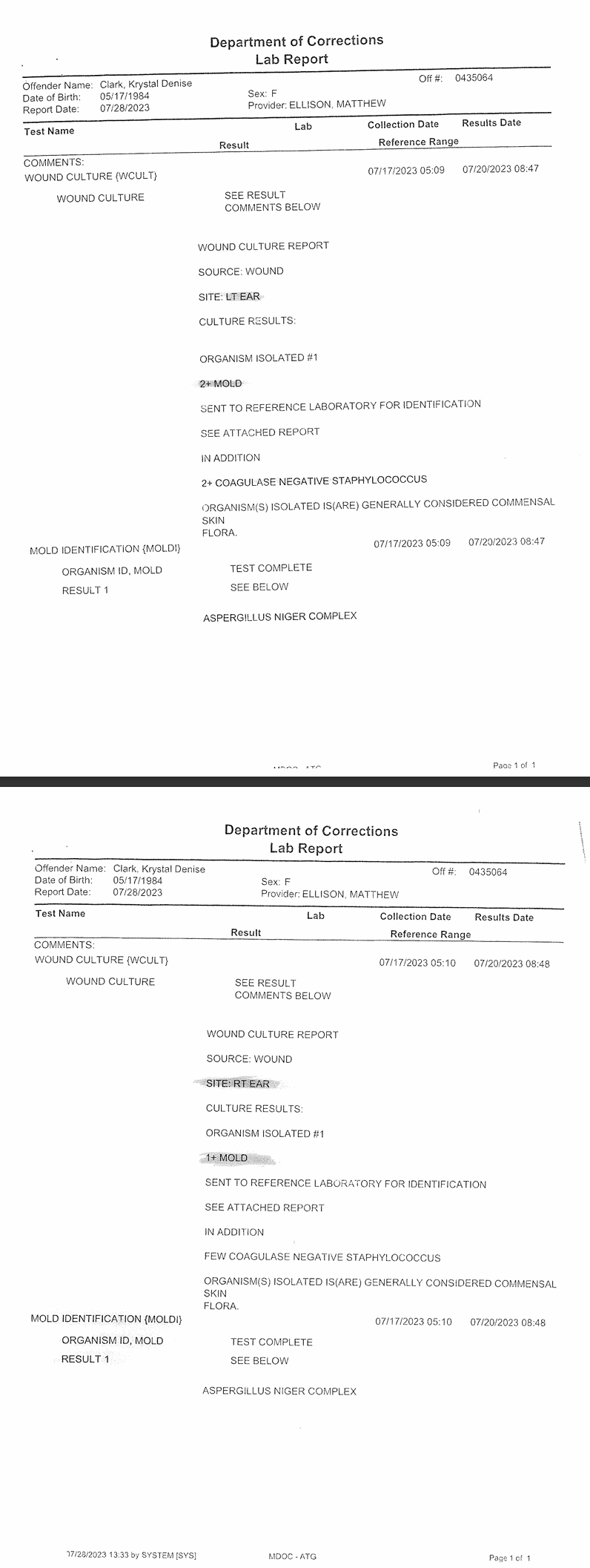
Clark first made a formal complaint about the mold in 2016 and repeatedly did so during medical visits. Her medical record, which Bridge Michigan obtained from her spokesperson, indicates that she tested positive in June 2023 for Aspergillus niger, a common black mold typically found in moist, damp areas.
She also tested positive for other bacteria linked to black mold exposure.
A r ecent report from the Michigan Department of Corrections indicated multiple air circulators need replacing and bathrooms require better ventilation.
Riehle, spokesperson for the department, said an independent review of the facility found “expected results typically found in large settings where individuals live and work.”
“Claims suggesting that the facility has dangerous, systemic, black, or toxic mold conditions are simply false,” Riehle added.
Clark has been incarcerated at the Women’s Huron Valley Correctional Facility since 2011 and was sentenced to 17-30 years for armed robbery, assault with intent to do great bodily harm, 2nd-degree home invasion and other related charges.
She will be eligible for parole after May 9, 2027.
While the state parole board reviews applications and makes recommendations, Whitmer has the constitutional authority to grant clemency, including pardons and commutations.
___
This story was originally published by Bridge Michigan and distributed through a partnership with The Associated Press.