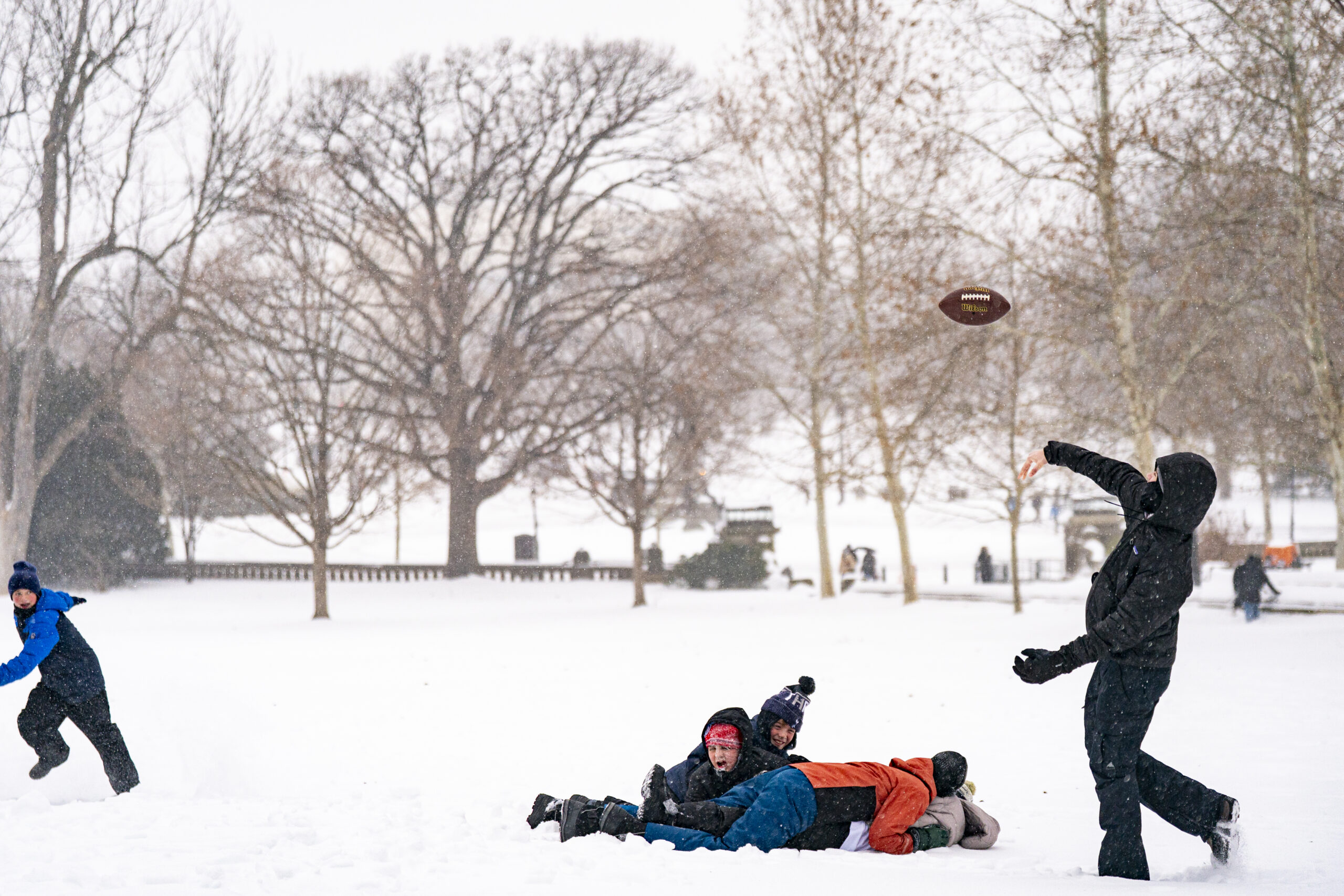
BOSTON (AP) — More than a thousand flights were canceled or delayed across the Northeast and Great Lakes regions due to snow as thousands took to roads and airports during the busy travel period between Christmas and New Year’s.
New York City received about 4 inches (10.2 centimeters) of snow Friday night into early Saturday — slightly under what some forecasts had predicted. At least 1,500 flights were canceled from Friday night, according to flight-tracking service FlightAware. But by the morning, both the roads and the skies were clearing.
“The storm is definitely winding down, a little bit of flurries across the Northeast this morning,” said Bob Oravec, a Maryland-based forecaster at the National Weather Service.
Oravec said the storm was moving from the northwest toward the Southeast, with the largest snowfall in the New York City area reaching over 6 inches (15 centimeters) in central eastern Long Island. Farther north in the Catskills, communities saw as much as 10 inches (25 centimeters).
Newark Liberty International, John F. Kennedy International and LaGuardia airports posted snow warnings on the social media platform X on Friday cautioning that weather conditions could cause flight disruptions.
The National Weather Service warned of hazardous travel conditions from the Great Lakes through the northern mid-Atlantic and southern New England, with the potential for tree damage and power outages.
In Times Square, workers in red jumpsuits worked to clear the sludge- and powder-coated streets and sidewalks using shovels and snowblowers.
Jennifer Yokley, who was there on a holiday trip from North Carolina, said she was excited to see snow accumulating as it dusted buildings, trees and signs throughout the city.
“I think it was absolutely beautiful,” she said.
Payton Baker and Kolby Gray, who were visiting from West Virginia, said the snow was a Christmas surprise for their third anniversary trip.
“Well, it’s very cold, and it was very unexpected,” Baker said, her breath visible in the winter air. “The city is working pretty well to get all the roads salted and everything, so it’s all right.”
Ahead of the storm, New York Gov. Kathy Hochul declared a state of emergency for more than half the state. Acting New Jersey Gov. Tahesha Way also declared a state of emergency for that state.
“This storm will cause dangerous road conditions and impact holiday travel,” Way said in a statement. “We are urging travelers to avoid travel during the storm and allow crews to tend to the roads. Drivers should plan their travel accordingly, monitor conditions and road closures, and follow all safety protocols.”
4 dead in California
On the other side of the country, California was experiencing a fairly dry weekend after powerful storms battered the state with heavy rains, flash flooding and mudslides. At least four people were killed including a man who was found dead Friday in a partially submerged car near Lancaster, the Los Angeles County Sheriff’s Department reported.
Some mountainous areas received 10 to 18 inches (25 to 45 centimeters) of rain over three days, peaking on Christmas Eve, National Weather Service meteorologist Rose Schoenfeld said. There were varied amounts of rain in other populated areas, including up to 4 inches (10 centimeters) across the Los Angeles Basin and many coastal areas.
There was significant damage to homes and cars in Wrightwood, a 5,000-resident mountain town about 80 miles (130 kilometers) northeast of Los Angeles, as floods and mudslides turned roads into rivers and buried vehicles in rock and debris.
Before rain reappears in the forecast later next week, California was expected to experience Santa Ana winds with gusts of over 60 mph (96 kph) in mountainous areas from Sunday night through Tuesday. The winds could uproot saturated trees and cause power outages.
___
Walker reported from New York. Associated Press writer Mark Thiessen in Anchorage, Alaska, contributed.