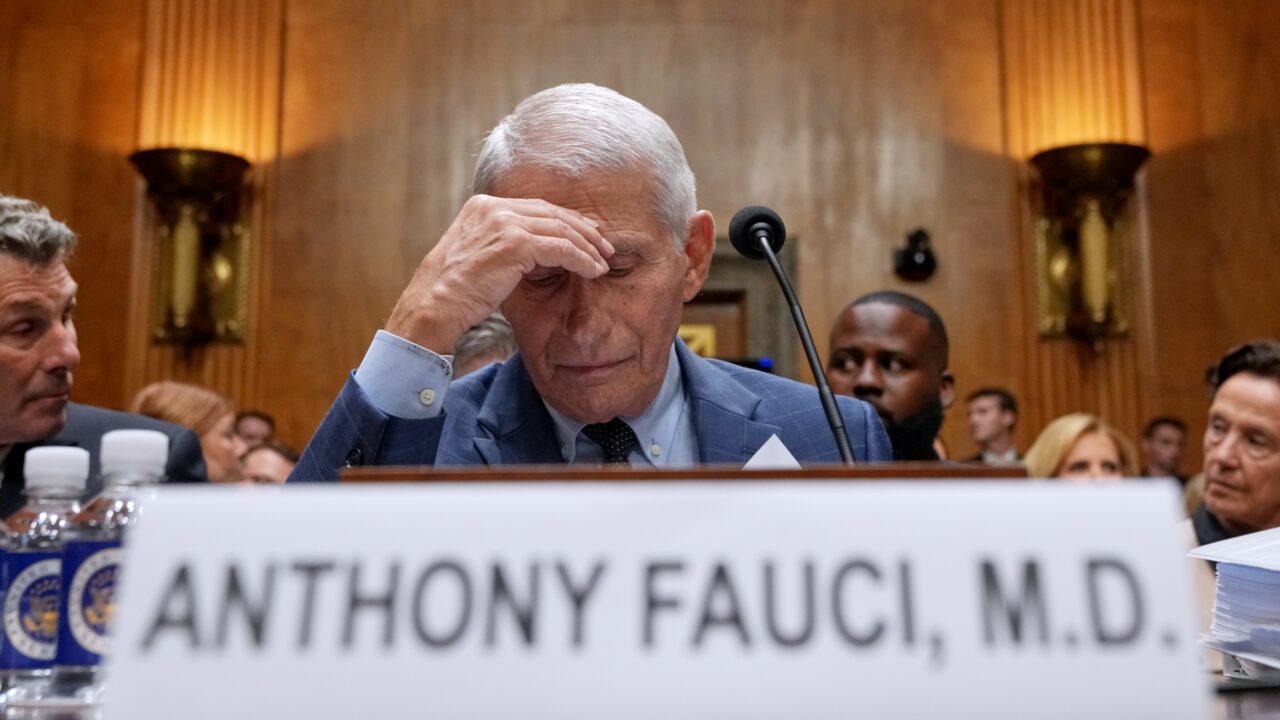
WASHINGTON (AP) — A Senate committee voted along party lines Thursday to hold Dr. Anthony Fauci in contempt of Congress over his refusal to answer questions at a hearing on his handling of the COVID-19 pandemic, setting up a referral to the Department of Justice for potential investigation over whether the country’s longtime top infectious disease official properly exercised his constitutional rights.
The vote approving the contempt resolution came a week after Fauci invoked his Fifth Amendment right against self-incrimination more than 100 times when he appeared before the Senate Committee on Homeland Security and Governmental Affairs, an episode that raised fresh legal questions about the ability of Congress to compel testimony from a previously pardoned witness.
Republican Sen. Rand Paul of Kentucky, the committee chairman who pressed for the contempt finding, said that constitutional protection did not apply because Fauci last year received a pardon from Democratic President Joe Biden and thus did not have to worry about the threat of prosecution. He has said he intends to send the referral directly to the Justice Department, rather than first to the full Senate, despite Democratic questions over the legal validity of such a maneuver.
“Dr. Fauci faced no risk of federal prosecution,” Paul said at the outset of Thursday’s hearing. “All he had to do was tell the truth.”
Fauci, in a statement last week explaining his decision to invoke his Fifth Amendment rights, said he had good reason to fear the possibility of criminal charges given what he said was Paul’s determination “to get me to say something, anything, that could vindicate his repeated public pledges that I end up, in his words, quote, behind bars, unquote.”
Fauci’s lawyer, David Schertler, said in a statement that the contempt resolution was “a continuation of Senator Paul’s personal vendetta against Dr. Fauci, who spent 50 years in public health and has saved countless lives.” Schertler accused Paul of abusing his power by trying to “weaponize the Justice Department.”
“Today’s partisan committee vote is a crude political stunt intended to punish Dr. Fauci for exercising his constitutional rights,” Schertler said. “The Senate should reject Senator Paul’s meritless and politically-motivated contempt resolution. For years, Senator Paul has proclaimed to anyone who would listen that Dr. Fauci should be prosecuted and put in prison. Dr. Fauci has committed no crime – and Senator Paul knows it.”
The pardon from Biden covered acts from 2014 through the January 2025 day it was issued but does not shield him from state-level prosecutions or for federal investigations into any testimony he did give that lawmakers deemed false.
Democrats who unanimously opposed the contempt resolution agreed with Fauci that he had a well-founded fear of self-incrimination given a publicly stated desire by Republicans to see him prosecuted in connection with COVID. The Trump administration has also raised questions about whether the Biden pardons were valid given Biden’s frequent use of an autopen to conduct official business.
“The goal was to wait for Dr. Fauci to make any kind of misstatement and then have a weaponized Department of Justice file criminal charges for that new statement that would not have been covered by the pardon, leaving Dr. Fauci little choice but to invoke his constitutional right to not walk directly into a trap,” said Sen. Maggie Hassan, D-N.H., before the vote.
Paul’s intention to send the referral directly to the Justice Department would leave it up to the U.S. attorney in Washington to decide whether to investigate or potentially attempt to prosecute Fauci for contempt. A referral from Congress does not compel prosecutors to act.
The committee’s top Democrat, Sen. Gary Peters of Michigan, questioned whether the referral would be legally valid if Paul transmitted it to the Justice Department without the approval of the entire Senate, where the 60 votes needed to pass the resolution are seen as unlikely. He said punishing a witness for exercising a constitutional right against self-incrimination would complicate future efforts by Congress to conduct oversight and compel appearances and testimony.
“If this committee now seeks to punish a witness for asserting their (constitutionally) protected Fifth Amendment rights, future witnesses will argue that appearing before Congress exposes them to punishment regardless of whether they comply with a subpoena and invoke a constitutional protection,” he said. “They will point directly to this vote — this vote — as a justification for refusing to appear at all.”
___
AP Congressional Correspondent Lisa Mascaro contributed to this report.
Copyright © 2026 The Associated Press. All rights reserved. This material may not be published, broadcast, written or redistributed.