DC police set juvenile curfew zone around Navy Yard this weekend

D.C. police announced a juvenile curfew zone around the Navy Yard that will be in effect Saturday and Sunday nights, citing a mayoral order that allows the chief to restrict large youth gatherings deemed a public safety risk.

The department did not detail a specific incident behind the decision, but said the order is intended to give police a tool to break up large youth gatherings before they escalate.

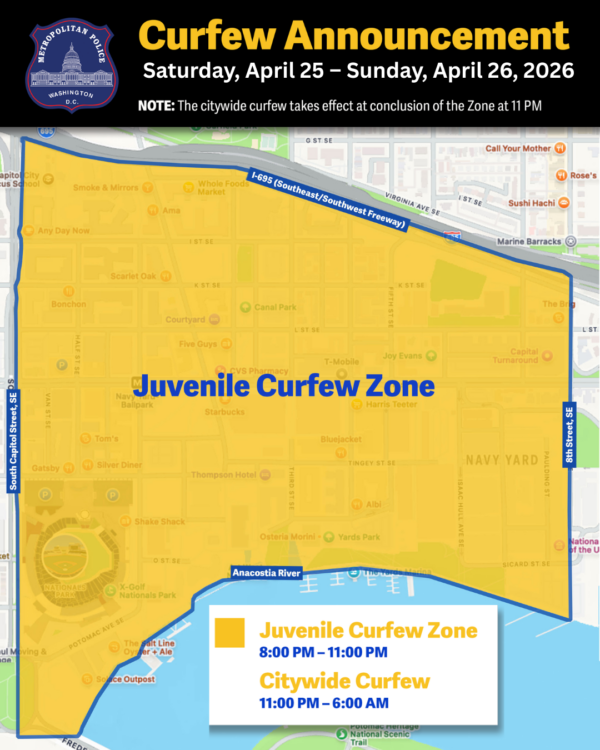
Police said the Navy Yard juvenile curfew zone covers the following perimeter:

North:

  • Interstate 695 and Virginia Avenue SE from South Capitol Street to 8th Street SE

East:

  • 8th Street SE from Virginia Avenue to the Anacostia River

South:

  • Anacostia River

West:

  • South Capitol Street SE from the Anacostia River to I-695

The zone will be in effect from 8 to 11 p.m. Saturday and Sunday, police said.

Within the zone, people younger than 18 are prohibited from gathering in groups of nine or more in public places or on the premises of an establishment unless they are engaged in certain exempted activities. A list of exemptions is available here.

Police also reminded residents that a citywide curfew is also in effect nightly for anyone younger than 18 from 11 p.m. to 6 a.m.

Get breaking news and daily headlines delivered to your email inbox by signing up here.

© 2026 WTOP. All Rights Reserved. This website is not intended for users located within the European Economic Area.
map of DC juvenile curfew zone

Civil rights groups make urgent plea for voting rights in DC, ahead of midterm elections

WASHINGTON (AP) — Voting rights, the work of the civil rights movement and racial justice took center stage on the National Mall Friday, with protesters gathering ahead of midterm elections and following a wave of changes to voting laws and redistricting that some have condemned as detrimental to Black Americans. Hundreds of people gathered near the steps of the Lincoln Memorial for the 2026 “Defend the Vote” March on Washington, organized by the Rev. Al Sharpton and Martin Luther King III, echoing the Rev. Martin Luther King Jr.'s 1963 march. The event follows the U.S. Supreme Court’s landmark April decision in Louisiana v. Callais that reinterpreted key provisions of the Voting Rights Act of 1965, allowing Southern states to redraw their congressional maps in a way that erodes equal representation in Black communities. “We’ve been doing these marches for years, but this is probably the most important because this is the first year we are marching that the voting rights bill has been nullified by the Supreme Court,” Sharpton, founder of the National Action Network, said in an interview with The Associated Press. Some call it a ‘very dangerous moment in American history’
Read Next Story