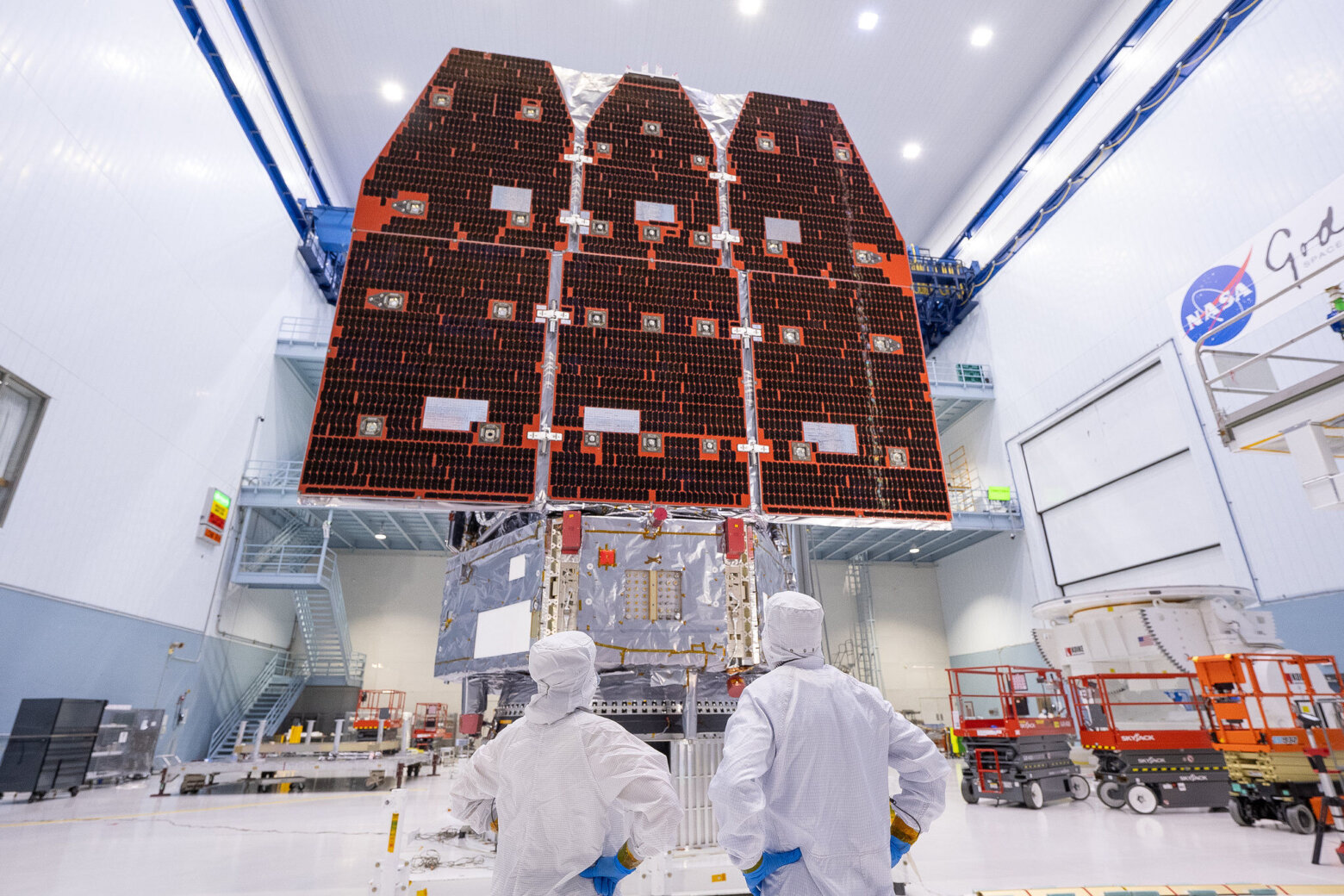
Inside a clean room at NASA’s Goddard Space Flight Center, engineers have finished building and testing a massive new space telescope designed to study the universe on an unprecedented scale.
The Nancy Grace Roman Space Telescope, named after NASA’s first chief astronomer, is now complete after more than a decade of development.
“It is a lot of work, millions of hours is no exaggeration. That’s actual, actual math,” Jamie Dunn, project manager for the telescope, said.
Standing just over 40 feet tall, the telescope is designed to take an unusually wide view of the universe. Scientists said that approach will help them better understand dark energy and dark matter while also discovering tens of thousands of planets beyond the solar system.
“One month of Roman observations would correspond to a century with Hubble,” said Julie McEnery, senior project scientist for the Nancy Grace Roman Space Telescope.
The Hubble Space Telescope was launched back in 1990 and remains fully operational.
McEnery said Roman’s sweeping surveys could also help scientists identify flaws in long-standing theories about how the universe works.
“Current observations hint that our standard model of the universe is incorrect,” she said. “Roman will be able to confirm these and set us on the path to understanding what’s right.”
Unlike earlier space telescopes that focus on individual targets, Roman is designed to scan vast areas of the sky at once.
“We, in the past, have concentrated on studying individual objects, Roman is going to do it differently. We’re going to be observing huge portions of the sky in order to fundamentally address something very human, which is trying to understand where do we come from and what about this universe we live in, how’s it evolving,” said Lucas Paganini, the mission’s program executive.
Roman also carries a coronagraph, a specialized instrument designed to block out light from stars so scientists can try to directly see planets orbiting them.
“It will be stable, more stable than all of these other observatories that we’ve built before, and that’s what allows us to do starlight suppression at these unprecedented levels,” said Vanessa Bailey, coronagraph instrument scientist at NASA’s Jet Propulsion Laboratory.
NASA Administrator Jared Isaacman said the telescope’s sweeping view could fundamentally reshape how scientists understand space.
“Roman will give the Earth the new atlas of the universe,” Isaacman said. “I think it’s worth pausing for a moment and just think about how really incredible that is.”
Nicola Fox, associate administrator for NASA’s Science Mission Directorate, said Roman also helps lay the groundwork for future exploration by advancing key technologies and scientific understanding.
“Everything we do at NASA builds off the successes of what we’ve done before,” Fox said. “It will definitely, definitely open doors to new cosmic pursuits.”
Before science operations begin, the telescope will undergo months of commissioning after launch.
“One of the things that we do over and over and over again is we practice our launch day, and we practice our first six days, and we practice beyond into day 40 of commissioning,” said Jeremy Perkins, the mission’s science commissioning lead.
Paganini said everything scientists can currently observe represents only about 5% of the universe, with the rest made up of dark energy and dark matter.
Quoting Carl Sagan, Paganini said, “Somewhere, something incredible is about to be discovered.”
With final testing complete, Roman is expected to ship soon to Kennedy Space Center in Florida, where it could launch as early as September.
Get breaking news and daily headlines delivered to your email inbox by signing up here.
© 2026 WTOP. All Rights Reserved. This website is not intended for users located within the European Economic Area.