
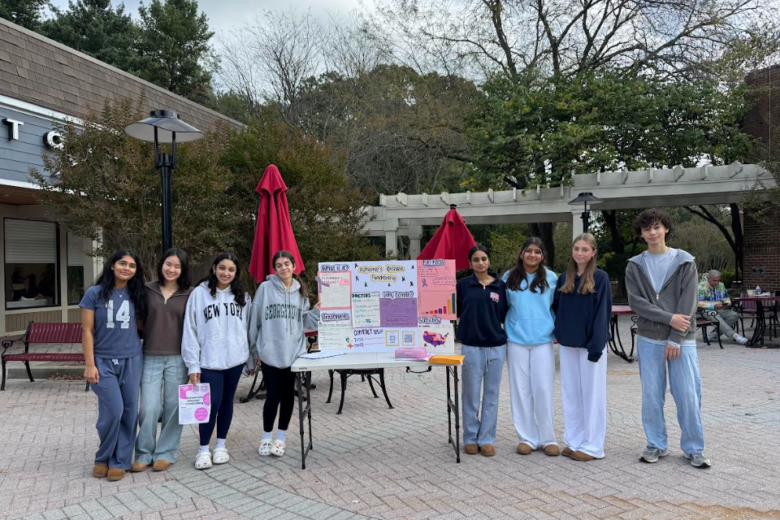
Not long after Milan Le and Eesha Kaushik launched the Medicine and Disease Club at Langley High School, they spent hours outside of a Northern Virginia grocery store with a trifold and flyers, asking people to consider donating to their efforts.
Intrigued by the setup, one community member stopped to learn more about why they were there. He asked about their career goals and what motivated them, and congratulated them on their hard work. And then, before walking away after a nearly half-hour exchange, he donated $100.
The moment was validating for the two Fairfax County students, who launched the club as sophomores in 2023 and are now seniors. It was their first fundraiser, and they didn’t know how many shoppers would even listen just for a few minutes.
Years later, the club has 30 regular members who attend weekly meetings to hear from guest speakers and prepare for competitions. Their fundraising totals recently reached $5,000.
“We had talked about the fact that there wasn’t very many clubs at our school that were for pre-medical students, just because there are a lot of students who are still exploring what they want to do in high school, and they might not have those distinctions,” Kaushik said.
Le and Kaushik, who’ve been friends since elementary school, initially envisioned the club as a place for students to study and earn community service hours. But now, there’s a core group in place, and younger students view older ones as mentors.
Using the U.S. Medicine and Disease Olympiad as the framework, the group regularly prepares for competitions. They present lessons on diseases and other medical conditions, and sometimes plan for interactive activities.
In one instance, leaders brought in pillows and stuffed animals for a lesson on CPR. Guest speakers, including psychiatrists and an internal medicine doctor, have shared details about their jobs too.
“I was teaching them how to read blood pressure, and a lot of them, this was the first time they were ever using a stethoscope, which is really cool,” Le said. “It’s a tangible first step into the field and you can really see and feel, understand. You can feel like you’re in the field.”
The pair, Kaushik said, is filling a void.
“What we found is the vast majority of the clubs offered that were academic were primarily individual,” Kaushik said. “They were, ‘We can help you study for something, but for the most part, you’re going to work on it on your own.’ And then the ones geared toward service were meeting infrequently and were more about, ‘You come here, get some service hours and that’s about all that happens.’”
Now, the club’s sense of community has grown so large, its members are disappointed when a meeting has to be canceled. One student made handmade bookmarks and stickers with the club logo to hand out during fundraisers.
Many of them “have shown so much interest and passion in it,” Kaushik said.