
NASA Administrator Jared Isaacman gave a major announcement about the future of the Artemis lunar exploration program Friday.
Artemis III will no longer be an attempted crew landing on the moon.
Instead, slated for launch in 2027, Artemis III is a new mission. It will carry out extensive flight maneuvers in low Earth orbit with one or both of the lunar human landing system vehicles being built by SpaceX and Blue Origin.
If new extravehicular activity suits are completed in time, the Artemis III crew will also test them.
Artemis IV and V are slated to attempt landing astronauts on the moon in late 2028.
During a news conference at Kennedy Space Center, Isaacman said NASA and its industry partners need to launch more often to become proficient.
Once every three years is not going to develop the “muscle memory” needed to sustain the Artemis program, he said.
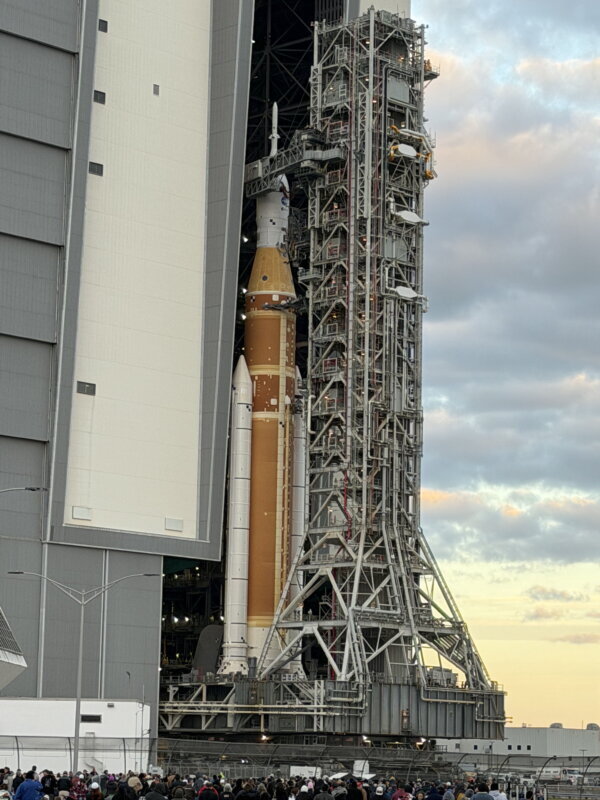
He invoked the NASA of the 1960s, when the Mercury, Gemini and Apollo programs worked toward the goal of landing astronauts on the moon. At that time, Isaacman said the launch rate was once every three months.
Institutional memory is also key.
“We need to rebuild and strengthen the workforce here at NASA,” Isaacman said.
According to the administrator, “75% of our workforce right now is contractors.”
“Rebuilding the civil servant workforce and restoring core capabilities again, that will directly contribute to NASA’s launch cadence,” he said.
“SLS is an impressive vehicle. We don’t want to turn every one of them into a work of art,” Isaacman said.
Artemis II is set to launch its 10-day lunar flyby mission without any changes sometime this spring, when SLS repairs are completed and all systems are a go for launch.
When feasible, NASA will announce a launch date with an eye toward April, if possible.
SpaceX continues to develop its Starship for Artemis III. Blue Origin is currently testing its lunar lander at NASA Houston’s test chamber.
“We are doing this to get back to the moon and have the capability to stay, certainly to build a moon base,” Isaacman said, where rovers, communications, navigation and power would be needed.
“I think it’s a great way to motivate our workforce and our partners to achieve the near impossible,” he said.
Isaacman also said that industry and congressional stakeholders were briefed on this new plan and all agreed it was necessary. He said NASA’s current budget can support this new path forward as well as the hardware currently available and in production.
I grew up with the Mercury, Gemini and Apollo programs and I have to say that Friday’s bold move is precisely what NASA needed if it is going to return to the moon and stay this time. If NASA gets what it needs in the way of funding, production and public support, the moon and beyond is possible.
Unfortunately NASA’s history saw the derailment of Apollo missions 18, 19 and 20 due to a lack of continued interest from the public and political leaders. The sad thing is, the hardware for these missions was built and paid for. They are now museum artifacts.
It is in our best interest as a species to continue our quest for the moon and beyond. Ultimately it contributes to the betterment and survival of humanity, and yes, our planet. The moon is the “Eighth Continent” and it is beckoning us to return and stay.
Let’s GO!!!!
Follow my daily blog to keep up with the latest news in astronomy and space exploration. You can email me at skyguyinva@gmail.com.